

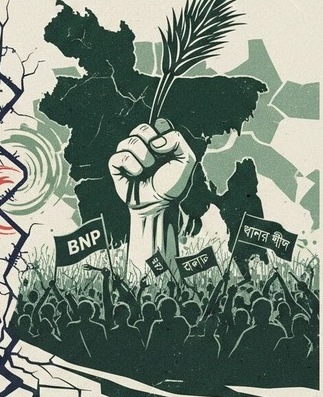
As Bangladesh approaches its 13th national parliamentary election, uncertainty and tension in the political arena are steadily intensifying. Issues such as dual citizenship, loan defaulter candidacy, candidate security, the overall law-and-order situation, and increasingly aggressive rhetoric among political parties have made the electoral environment more complex. In this context, objections raised by several parties over the provision of security to BNP Acting Chairman Tarique Rahman have sparked fresh debate. Analysts believe these developments indicate the emergence of a new political polarisation in the country. In recent weeks, a noticeable decline in political tolerance and mutual restraint has further heightened concerns. The issuance of show-cause notices to two leaders of the National Citizen Party (NCP), clashes between BNP and Jamaat activists in different parts of the country, the slow pace of arms recovery, and the killing of several BNP and Jamaat leaders and activists across various districts have collectively contributed to a tense political atmosphere. Observers warn that such incidents are raising serious questions about election-time security and the prospects for free and fair voting.
Against this backdrop, a significant split between Jamaat-e-Islami and Islami Andolan Bangladesh just ahead of the election has created a major division within Islamist politics. Political analysts argue that this rift could have a decisive impact on electoral calculations and may directly benefit a major political party.
Around three months ago, an initiative known as the “one-box policy” was launched with the aim of uniting Islamist votes to build a stronger electoral position. Under this plan, Jamaat-e-Islami and the Chormonai Pir-led Islami Andolan Bangladesh agreed in principle to nominate a single candidate in each constituency. However, ideological differences, leadership disputes, and disagreements over seat allocation ultimately led to the collapse of the initiative.
Political analyst and writer-researcher Altaf Parvez notes that Jamaat-e-Islami is rooted in Maududi ideology, while Islami Andolan follows a Deobandi school of political thought. This ideological divergence, he argues, has long fostered mistrust between the two parties. According to Parvez, the last-minute breakdown of unity has rendered the “one-box policy” ineffective and made the division of Islamist votes inevitable.
Bangladesh JASAD General Secretary and former Member of Parliament Nazmul Haque Pradhan shares a similar view. He believes that the split has placed the BNP in a comparatively advantageous position. Historically, Jamaat and Islami Andolan have been political rivals, and doubts about the sustainability of their sudden electoral alliance existed from the outset, he says.
The 13th parliamentary election is scheduled for 12 February. Due to restrictions, the ousted Awami League is unable to participate in this election. As a result, the main contest is expected to be between the BNP and the Jamaat-led alliance. However, with Islami Andolan contesting separately, Islamist voters now face three different political options: the Jamaat-led 10-party alliance, Islami Andolan Bangladesh, and BNP-led alliances that include several parties from the Qawmi madrasa-oriented tradition.
Earlier, eight Islamist-oriented parties had joined a joint movement demanding elections under a proportional representation (PR) system and a referendum prior to polls. On 8 December last year, a meeting in Paltan, Dhaka, formally adopted the “one-box policy,” proposing the selection of candidates based on merit, popularity, and organisational strength in each constituency.
Later, the inclusion of the National Citizen Party (NCP), Liberal Democratic Party (LDP), and Amar Bangladesh (AB) Party expanded the alliance into an 11-party bloc. However, Islami Andolan claimed it was not consulted beforehand regarding the inclusion of these parties, leading to growing tensions. Disputes over seat sharing further escalated, eventually prompting Islami Andolan to withdraw from the alliance.
Jamaat leaders have alleged that Islami Andolan had been creating complications within the alliance from the beginning. Islami Andolan, on the other hand, maintains that unilateral decision-making and disregard for partners’ opinions left it with no option but to leave. As a result, the Jamaat-led alliance is now seen as facing strategic pressure, while other partners have begun demanding a larger share of seats.
Historically, Jamaat-e-Islami has secured a total of 65 parliamentary seats across six national elections. In contrast, Islami Andolan Bangladesh has never won a seat, though it drew attention by securing over 1.2 million votes in the 2018 election.
According to political scientist and former Jahangirnagar University professor Dr Dilara Chowdhury, Jamaat is likely to suffer the most from the current fragmentation of Islamist politics, while the BNP stands to gain comparatively. The breakdown of a unified Islamist vote bank, she argues, could significantly weaken their collective electoral influence.
Overall, the deepening political polarisation, rising violence, and fragmentation within Islamist politics just ahead of the election are expected to play a crucial role in shaping the electoral outcome and are redefining the political landscape of Bangladesh.