

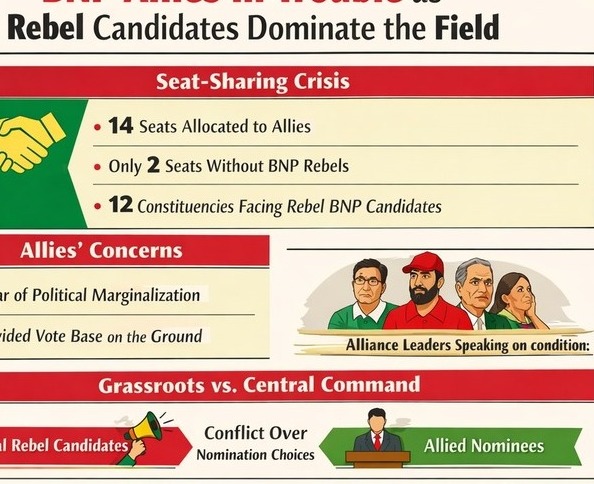
As the 13th National Parliamentary Election approaches, the Bangladesh Nationalist Party (BNP) is facing serious challenges in implementing its seat-sharing strategy with alliance partners. Despite officially allocating seats to allies, the presence of rebel BNP candidates on the ground has complicated the situation, leaving coalition partners uncertain about their electoral and political future even before campaigning begins.
According to BNP sources, seat-sharing agreements were reached for 14 constituencies in favor of alliance partners. However, only two of those seats are free of BNP rebel candidates. In the remaining 12 constituencies, nomination-deprived or expelled BNP leaders are contesting the election as independent candidates. Although the party has repeatedly warned of organizational action, the rebels have largely ignored those directives, raising questions about the effectiveness of the seat-sharing arrangement itself.
Allies Fear Political Marginalization
Leaders of allied parties claim that the continued presence of BNP rebel candidates is not only embarrassing but also poses a serious threat to their political survival. They argue that unless BNP takes swift and decisive action, the core objective of seat-sharing will fail. Such a failure, they warn, could weaken the long-standing relationship of political trust between BNP and its allies and exact a heavy political cost on both sides at the polls.
Several alliance leaders, speaking on condition of anonymity, said that on the ground they are encountering resistance from within BNP itself. “We see BNP activists campaigning against us. This is dividing the vote bank and making it extremely difficult to contest the election,” one leader said.
Grassroots Versus Central Decisions
Political analysts point out that most rebel candidates are well-known figures at the grassroots level, having been actively involved in local politics for years. In contrast, many candidates nominated under seat-sharing arrangements—despite being nationally prominent—are relatively unfamiliar to local BNP activists and voters.
Dissatisfaction is particularly visible regarding candidates who recently joined BNP from other parties and are now contesting with the party’s electoral symbol, the sheaf of paddy. Grassroots activists have not welcomed this development positively. Analysts fear that the resulting vote split within the same support base could hand an advantage to rival alliances.
Md. Anisur Rahman, Lecturer in Political Science at Bangladesh Open University, said, “Seat-sharing becomes meaningless if rebel candidates remain in the race. Grassroots activists generally follow local leaders. If the BNP symbol is handed to an allied or newly inducted leader, workers are more likely to support the rebel candidate.”
Situation in Jhenaidah-4
Rashed Khan, General Secretary of the Gono Odhikar Parishad, resigned from his party and joined BNP before receiving the party nomination for Jhenaidah-4. However, the same constituency has seen Md. Saiful Islam Firoz, Senior Joint General Secretary of BNP’s Swechchhasebak Dal, contesting as an independent candidate.
Rashed Khan said, “It is natural to feel aggrieved if someone does not receive a nomination. But BNP’s politics teaches us to rise above personal interests and work for the party. I hope no one will ultimately remain a rebel candidate here.”
Exceptions in Two Constituencies
The situation, however, is not uniform across all seats. In Lakshmipur-1, Shahadat Hossain Selim dissolved his party, Bangladesh LDP, and joined BNP, contesting with the sheaf of paddy symbol. Other BNP aspirants in the constituency have withdrawn in his favor, placing him in a strong position.
A similar scenario exists in Dhaka-13, where NDM Chairman Bobby Hajjaj is contesting as the BNP-backed candidate. Neither constituency has any BNP rebel candidates.
Selim said, “I have been closely involved with grassroots BNP leaders since 2018. Everyone has accepted me warmly and is actively participating in my campaign.”
Bobby Hajjaj added, “From the beginning, I have received strong cooperation from local leaders. Even those who sought nominations have stood by me after the final decision.”
Tarique Rahman’s Assurance, Yet Lingering Anxiety
Senior leaders of allied parties recently met BNP Acting Chairman Tarique Rahman, who reportedly expressed a positive attitude toward resolving the issue of rebel candidates and assured swift action.
A leader of the Ganatantra Mancha said that Tarique Rahman is expected to hold a meeting with rebel candidates next week to reach a solution.
Saiful Huq, General Secretary of the Revolutionary Workers Party and a candidate in Dhaka-12, said, “The presence of BNP rebel candidates is a serious threat to our political existence. However, BNP appears to be sincerely trying to resolve the issue.”
Jamiat Also Faces Rebel Pressure
BNP has reached seat-sharing agreements with Jamiat Ulema-e-Islam Bangladesh in four constituencies, where Jamiat candidates are contesting with the palm tree symbol. However, in all four seats, BNP rebel candidates have emerged as major challengers.
These constituencies include Nilphamari-1, Narayanganj-4, Sylhet-5, and Brahmanbaria-2, where expelled or independent BNP leaders are contesting against Jamiat nominees.
In Brahmanbaria-2, independent candidate Rumeen Farhana said, “I have been expelled from the party, but the voters are still with me.”
Jamiat Secretary General Manjurul Islam Aafandi stated, “Rebel candidates are a major challenge, but BNP has assured us that it will take a firm stance to contain the rebellion.”
BNP Moves Toward Strict Measures
For violating party decisions, BNP expelled nine leaders, including Rumeen Farhana and Saiful Alam Nirob, on December 30.
BNP Standing Committee member Salahuddin Ahmed said, “In the greater national interest, we have had to deprive even some capable candidates. In some cases, we are taking organizational action; in others, we are trying to resolve matters through dialogue. A resolution will come soon.”
Meanwhile, NPP Chairman Fariduzzaman Farhad, a BNP-backed candidate in Narail-2, said the party has warned of strict action against rebel candidates and anyone campaigning for them if they do not withdraw.
A Critical Test Ahead
Overall, BNP’s seat-sharing strategy ahead of the 13th National Parliamentary Election is facing a critical test. Political analysts believe that unless the party can effectively rein in rebel candidates, not only its allies but also BNP’s own electoral strategy could suffer serious consequences.