

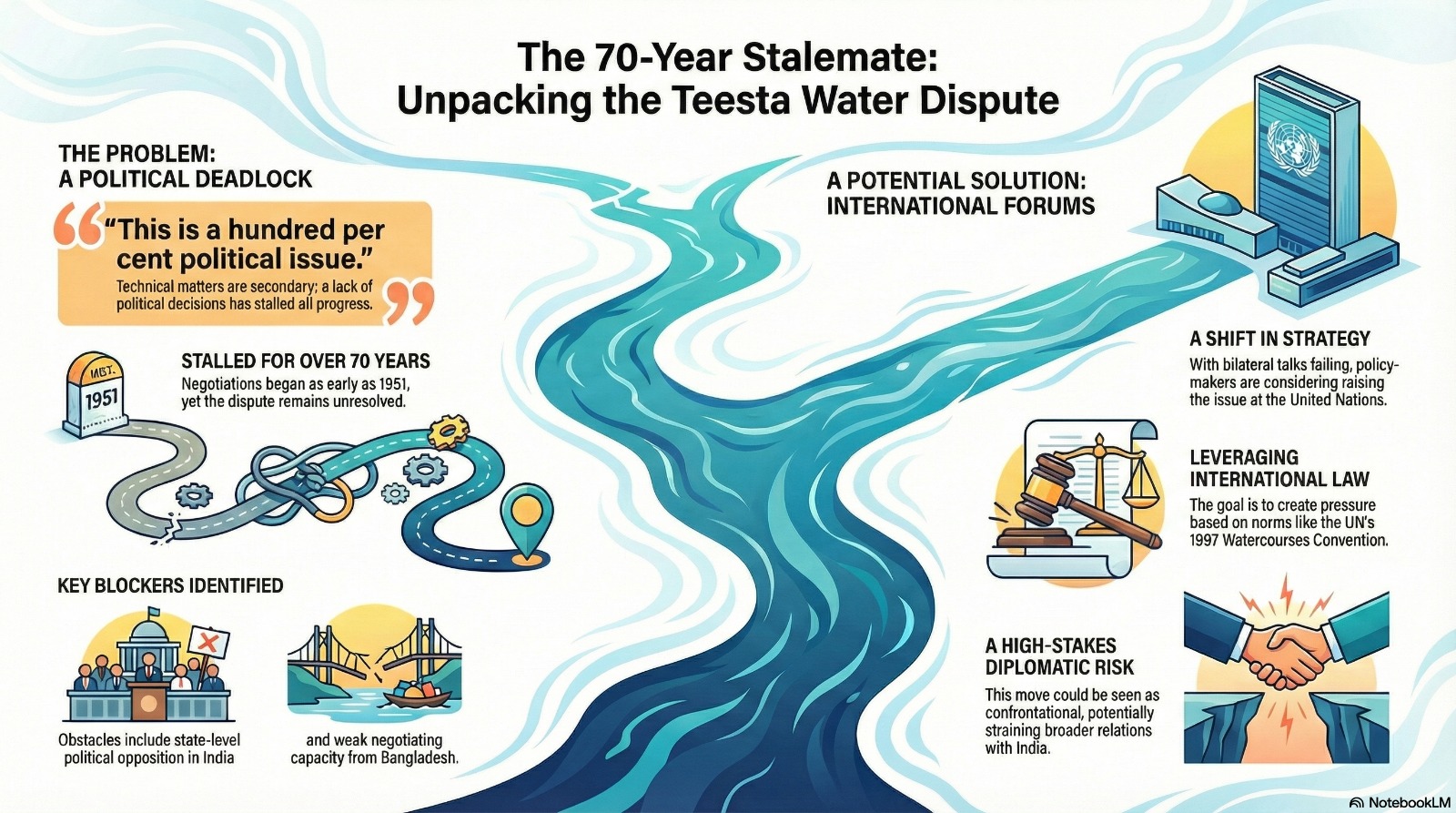
Nearly seven decades after negotiations first began, water-sharing agreements between Bangladesh and India remain trapped in a web of political hesitation, asymmetric power relations and diplomatic inertia. Despite changes of government in Dhaka—under military-backed administrations, the BNP, the Awami League and now an interim authority—the core disputes over shared rivers have remained unresolved. As time passes, the consequences are becoming increasingly severe, affecting agriculture, food security, river-dependent livelihoods and ecological stability across Bangladesh.
Experts argue that the failure lies not in technical complexity but in the absence of sustained political commitment. Water sharing, they note, is not merely a hydrological calculation; it is inseparable from regional power politics, national interests and questions of sovereignty.
A problem politics has refused to solve
Water specialists in both countries broadly agree that technical discussions alone cannot resolve the Bangladesh–India river disputes. What is required is political resolve at the highest level, backed by coherent diplomacy and a long-term strategic vision. India’s upstream control over most shared rivers has created a persistent imbalance in negotiations, making consensus difficult even during periods of otherwise cordial bilateral relations.
This reality was evident during the tenures of both the BNP and the Awami League, when Dhaka maintained comparatively stable ties with New Delhi. Yet no substantive progress was made on the Teesta or other major rivers. The pattern suggests that goodwill alone is insufficient without a clear national strategy, a skilled negotiating team and sustained diplomatic pressure.
Analysts warn that climate change, reduced dry-season flows and new upstream infrastructure projects could deepen the crisis in coming years. Without timely political intervention, water disputes may extend beyond diplomacy, directly affecting food prices, rural livelihoods and social stability.
The limits of the Joint Rivers Commission
The Joint Rivers Commission (JRC) continues to operate, but its impact remains limited. Officials describe the process as slow and technically demanding, involving data sharing, flow assessments and prolonged verification procedures.
Mohammad Abu Saeed, a director at the JRC, acknowledges the complexity. He points to the upcoming renewal of the 1996 Ganges Water Treaty, set to expire in December, as a critical moment. According to him, technical data on six rivers has already been exchanged, with further exchanges planned. A memorandum of understanding on the Kushiyara River, signed in 2022, is currently in the implementation phase.
Bangladesh officially recognises between 54 and 57 shared rivers, though independent research suggests the number of transboundary rivers may be as high as 123. Progress, however, remains incremental. As Abu Saeed concedes, only sustained engagement may eventually yield results.
Interim government: managing reality, lowering expectations
Officials within the interim administration argue that expectations must be tempered. One senior source notes that the government has been preoccupied with routine administrative management and lacks both the time and political mandate for major diplomatic initiatives.
The argument is pragmatic: if elected governments failed to resolve the issue over five decades, it is unrealistic to expect an interim authority to do so within a year. Yet critics say this position reflects a deeper structural problem—water diplomacy has never been treated as a strategic priority with a clear roadmap.
“This is entirely a political crisis”
Dr Ainun Nishat, emeritus professor and founder of the Institute for Sustainable Development, places responsibility squarely on political and diplomatic failure. Negotiations, he notes, began as early as 1951. More than seventy years later, the disputes remain unresolved—and are likely to worsen.
“This is a hundred per cent political issue,” Nishat argues. “Technical matters are important, but without political decisions, nothing moves.” He adds that deteriorating bilateral relations almost inevitably translate into heightened water tensions.
Asked why progress remained elusive even during periods of friendly relations, Nishat points to Bangladesh’s lack of seriousness and weak negotiating capacity. Over-reliance on bureaucratic channels, he says, has proven ineffective in resolving an issue of such strategic significance.
History, facts and unresolved promises
Talks on Teesta water sharing began in 1953 between India and Pakistan.
The Teesta agreement has remained stalled for over 70 years.
A water-sharing arrangement on the Feni River took nearly two decades to reach a memorandum of understanding.
The Ganges Treaty, signed in 1996, remains the only comprehensive agreement, but its renewal is now approaching amid uncertainty.
The Teesta remains blocked, largely due to political opposition at the state level in West Bengal.
Bangladesh’s position, consistently stated, is that access to fair water shares is not a concession but a right.
The growing risk ahead
Climate change, upstream dams, declining dry-season flows and intensifying regional competition are compounding the problem. Analysts warn that water scarcity is no longer only a diplomatic concern—it is becoming an economic and social risk, influencing agricultural output, food inflation and internal migration.
Without political courage, effective diplomacy and regional cooperation, the long-standing deadlock appears unlikely to break.
Turning to international forums
With bilateral talks yielding little progress, policymakers in Dhaka are increasingly considering international avenues. Discussions are underway about raising the issue at the United Nations, international water law platforms, climate conferences and regional bodies.
Supporters argue that internationalising the issue could create pressure grounded in established legal norms, including the UN’s 1997 Convention on the Law of the Non-Navigational Uses of International Watercourses and the principles of equitable and reasonable utilisation.
Diplomats, however, caution that such a move carries risks. India may respond defensively, potentially straining broader bilateral relations. The choice of forum, language and timing will therefore be critical.
For now, international engagement is seen less as a confrontation than as a potential lever—one of the few remaining options to break a stalemate that has endured for generations.