

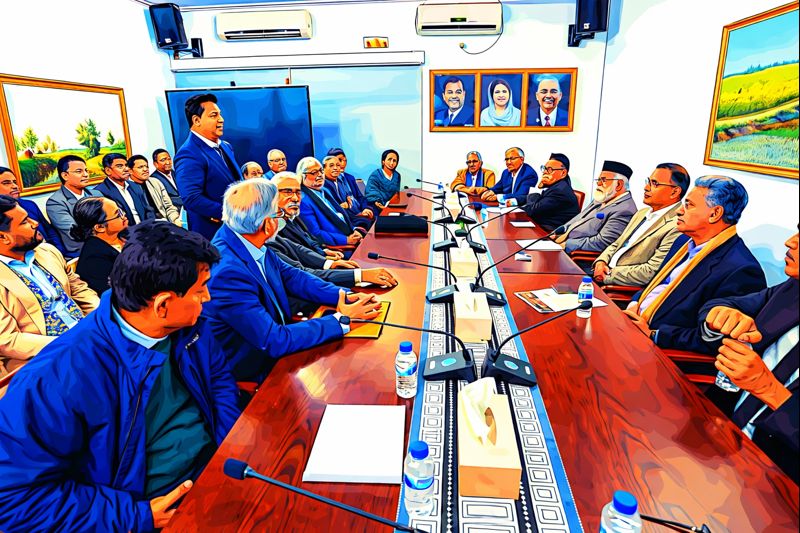
In Bangladesh’s political landscape, meetings and dialogues hold immense significance for party leaders and members. For a political party, personal observation by leaders, collection of opinions, and regular engagement with people at various levels of society form an inseparable part of safeguarding the party’s reputation and contributing to national development. In the case of the BNP, this tradition is particularly evident.
BNP’s Acting Chairman Tarique Rahman has long used meetings and dialogues as effective tools to monitor the country’s political, economic, and social situation and to gather perspectives on various issues. Following the passing of his mother, the late Chairperson Begum Khaleda Zia, he also met with individuals who came to offer condolences. Simultaneously, he continues to hold regular meetings with leaders of different political parties, business organizations, professional associations, and non-political organizations across the country. Analysts note, however, that due to his security concerns and political influence, it is crucial to avoid direct meetings with individuals whose identities are controversial or uncertain.
Experts assert that for political leaders, meetings and dialogues are not merely social gatherings. They constitute a process through which a leader gains an accurate understanding of the current state of the country and the party. Opinions and advice collected during these meetings play a critical role in policy-making. Moreover, such interactions help maintain internal party unity and ensure political foresight.
Earlier, BNP Chairperson Begum Khaleda Zia also effectively practiced this political culture during her tenure in parliament. She regularly held discussions with various individuals and organizations to promote national development and public welfare. She remained vigilant to ensure that sycophants, conspirators, opportunists, or those who could harm the party’s reputation did not influence the party’s image. This awareness enabled Begum Khaleda Zia to sustain public trust as one of the country’s most popular and resilient leaders for decades.
Analysts emphasize two key aspects of leadership: caution and prudent evaluation. A leader must discern who is a friend and who is an adversary, who genuinely supports the country and the party’s objectives, and who seeks trust merely for personal gain. Blind faith in politically or socially opportunistic individuals can lead to significant risks for both the leader and the party.
Decisions in political leadership are guided by insights gained through meetings. These include understanding the economy, public living standards, business and trade, the education system, and solutions to social problems. Meetings not only assist in policy formulation but also strengthen the connection between leadership and people across various social strata. Experts believe that for a genuinely patriotic leader, meetings are not mere casual discussions; they are a vital mechanism for national development, public welfare, and the preservation of the party’s reputation.
In today’s political environment, the process of meetings has become even more crucial. Leaders must observe the activities of both the government and opposition parties amid the country’s social, political, and economic challenges. Through meetings and dialogues, leaders can gauge public demands, government actions, political climates, and societal sentiments, which aid in effective decision-making.
Experts also note that the advice a leader accepts through these interactions depends on their mental integrity, careful observation, and prudent evaluation. Misjudgment or blind trust can pose significant risks to any political leader or party. History has shown that influence from uncertain or opportunistic individuals can result in flawed political decisions, potentially harming the party’s reputation and the country’s overall political stability.
Feedback collected through meetings is essential not only for understanding current circumstances but also for planning future strategies and long-term policies. For a political party, this process functions as an internal review mechanism where leaders make decisions considering the party’s objectives, the country’s needs, and the public’s expectations.
The importance of meetings and dialogues in BNP’s political culture becomes more apparent when leaders from diverse societal sectors participate. Engagement with business associations, professional bodies, social and non-political organizations, and political parties provides the party with a realistic perspective. This serves as a bridge between leadership and party awareness, ensuring political and social vigilance.
For the current Acting Chairman, Tarique Rahman, this process is invaluable. His engagement with patriotic and responsible individuals contributes to both the party’s reputation and the nation’s welfare. However, caution remains essential. Leaders must accurately identify those genuinely supporting the party’s goals and those who are self-interested or manipulative; failure to do so could jeopardize leadership decisions and the party’s image.
Analysts agree that prudence, observation, and caution are the core principles of political leadership. A sincere and responsible leader who verifies individuals and circumstances before making decisions ensures both the party’s reputation and the country’s welfare. History demonstrates that leaders who exercised such vigilance and prudence enabled their parties to maintain political strength and public popularity.
In summary, meetings and dialogues in BNP’s political culture are far more than casual interactions. They are crucial processes for national development, safeguarding the party’s reputation, political awareness, and public welfare. For current and future leadership, they provide an essential lesson in creating a bridge between competent leadership and the nation’s welfare.