

Bangladesh is heading toward its 13th national parliamentary election amid mounting fears over public safety, as a surge in killings, widespread circulation of looted weapons and hundreds of escaped prisoners continue to undermine confidence in law enforcement.
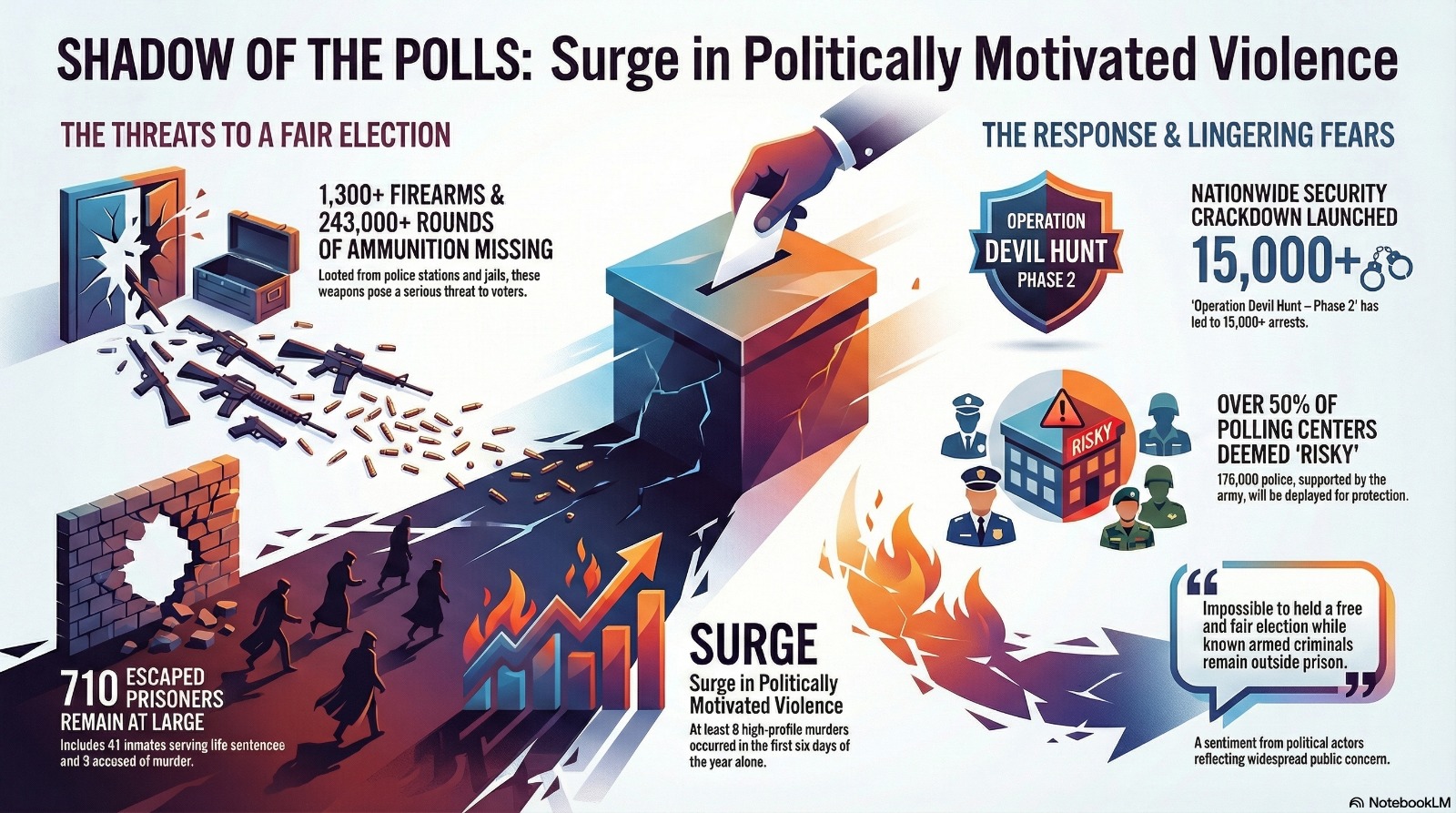
In the first six days of the new year alone, at least eight high-profile murders were reported across several districts, five of them carried out using firearms. Victims included political activists, businesspeople and civilians, some shot at close range and others killed with extreme brutality. The killings have taken place despite an ongoing nationwide security operation aimed at restoring order ahead of the polls, scheduled in just over a month.
The violence has intensified concerns that Bangladesh’s law and order situation remains fragile, even after repeated assurances from police and government officials that stability will be ensured during the election period.
According to official data from police headquarters, more than 1,300 firearms looted from police stations during last year’s mass uprising remain unrecovered. In addition, over 243,000 rounds of ammunition are still missing. Prison authorities have also confirmed that 27 firearms and 7,000 rounds of ammunition looted from jails have yet to be traced.
Security officials acknowledge that these weapons pose a serious threat to the electoral environment. “Unrecovered arms can be used to disrupt polling, intimidate voters, or settle political scores,” said a senior police official, speaking on condition of anonymity.
The scale of the challenge is compounded by the continued absence of 710 escaped prisoners, including 41 serving life sentences and nine accused in murder cases. Three are officially classified as “high-risk” inmates. During the unrest surrounding last year’s uprising, more than 2,200 prisoners escaped from 17 jails across the country, with several facilities completely emptied.
In response, the government launched a renewed crackdown under “Operation Devil Hunt – Phase 2” in mid-December. Authorities say more than 15,000 people have been arrested in 23 days and 218 firearms seized. Yet the killings have continued unabated, raising questions about the effectiveness of the operation.
Human rights groups and political actors have voiced alarm. Asif Mahmud Sajib Bhuiyan, spokesperson for the National Citizen Party (NCP), described the election-centred law and order situation as “deeply disappointing”, warning that armed groups are still roaming freely in many areas. “It is impossible to hold a free and fair election while known armed criminals remain outside prison,” he said after meeting the chief election commissioner.
Police leaders argue that not all killings can be prevented. Inspector general of police Baharul Alam said that Bangladesh typically records between 3,500 and 4,000 murders annually and that recent incidents are often the result of planned political or criminal rivalries. “Arrests help reduce further violence, but they cannot guarantee an immediate end to killings,” he said.
Election officials have meanwhile classified more than half of the country’s 42,761 polling centres as either “risky” or “high-risk”, with Dhaka accounting for the largest share. Around 176,000 police officers will be deployed nationwide, supported by the army, border guards and coastguard. High-risk polling stations will be monitored with body-worn cameras, and checkpoints have been expanded across urban and border areas.
The European Union and other international observers have also been briefed on security preparations, including measures to protect election monitors and seal border regions such as the Rohingya refugee camps to prevent arms smuggling or voter manipulation.
Despite these assurances, public confidence remains fragile. Human rights organisations report that political violence killed between 102 and 133 people last year, with thousands more injured. Analysts warn that unless looted weapons are recovered and escaped prisoners detained, security operations may offer only temporary relief.
As the election draws closer, the contrast between official optimism and ground realities is becoming increasingly difficult to ignore. For many voters, the question is no longer just who will win—but whether they will be able to vote without fear.