

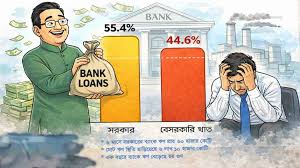
Facing a widening revenue shortfall and declining inflows of foreign loans and assistance, the government has once again turned heavily to the banking sector to finance its expenditures, raising concerns about pressure on liquidity and reduced credit availability for the private sector.Although the government initially refrained from fresh borrowing from banks and even repaid a portion of its loans at the beginning of the current fiscal year, the situation changed sharply by mid-year. Increased development spending, mounting subsidy and interest payment obligations, election-related expenses, and certain investment liabilities have significantly accelerated government borrowing from the banking system.
As a result, liquidity pressure in the banking sector has intensified, while the private sector faces the risk of investment stagnation due to limited access to credit. Economists warn that excessive government reliance on bank borrowing sends a negative signal for the economy in the long run.
Over Half of Annual Target Borrowed Within Half the Year
According to the latest data from Bangladesh Bank, the government borrowed a net Tk 59,756 crore from the banking sector between July of fiscal year (FY) 2025–26 and January 4 this year. This amount accounts for approximately 57.45 percent of the government’s total bank borrowing target for the current fiscal year.
The government has set a bank borrowing target of Tk 104,000 crore for FY 2025–26, meaning that more than half of the target has already been utilized before the halfway point of the fiscal year.
Sharp Surge in Borrowing Growth
Data analysis shows that government borrowing from the banking sector during the first six months and four days of the current fiscal year is nearly 619 percent higher than during the same period of the previous fiscal year. In FY 2024–25, net bank borrowing during the corresponding period stood at only Tk 8,312 crore.
Although government net bank borrowing remained negative until the end of October last year—indicating a net repayment of Tk 503 crore—borrowing surged rapidly in the subsequent months.
Why Bank Borrowing Is Rising
Economists attribute the increased reliance on bank borrowing primarily to three factors: failure to meet revenue collection targets, a slowdown in foreign loan and aid disbursement, and rising government expenditure.
Economist Majedul Haque said that revenue collection has fallen short of targets, while expected foreign loans and assistance have not been received on time. At the same time, spending on subsidies, interest payments, and development projects has increased, forcing the government to borrow more from the banking sector to cover fiscal deficits.
He warned that excessive government borrowing from banks is not a healthy sign for the economy. “When the government borrows heavily, banks’ capacity to lend to the private sector declines. This reduces investment, hampers job creation, and ultimately has a negative impact on overall economic growth,” he said.
Growing Outstanding Bank Debt
Bangladesh Bank data show that as of June 30 of the previous fiscal year, the government’s outstanding loans from commercial banks stood at Tk 452,481 crore. By January 4 of the current fiscal year, this figure had risen to Tk 488,232 crore—an increase of Tk 35,750 crore within just over six months.
During the same period, government borrowing from the central bank also rose significantly. Outstanding loans from Bangladesh Bank increased from Tk 98,423 crore at the end of the last fiscal year to Tk 122,429 crore as of January 4—an increase of Tk 24,006 crore. In contrast, during the same period last year, the government had repaid Tk 54,927 crore to the central bank.
Overall, the government’s total outstanding debt to the banking sector currently stands at Tk 610,661 crore.
Fears of ‘Crowding Out’ the Private Sector
Business leaders and industrialists have expressed concern that excessive government borrowing is crowding out the private sector. When the government absorbs a large share of bank funds, fewer resources remain available for private enterprises.
This situation discourages new investment, delays expansion plans, slows production growth, and weakens job creation, stakeholders said.
Long-Term Economic Risks
While bank borrowing can help address short-term budget deficits, economists caution that overreliance on the banking sector poses long-term risks to economic stability. Without structural reforms to boost revenue collection, improve spending efficiency, and strengthen foreign loan and aid management, pressure on the banking system is likely to intensify.
Analysts warn that if the current trend continues, government access to bank financing may expand, but the private sector—key to investment and employment—will bear the brunt of the impact, ultimately affecting the broader economy.