

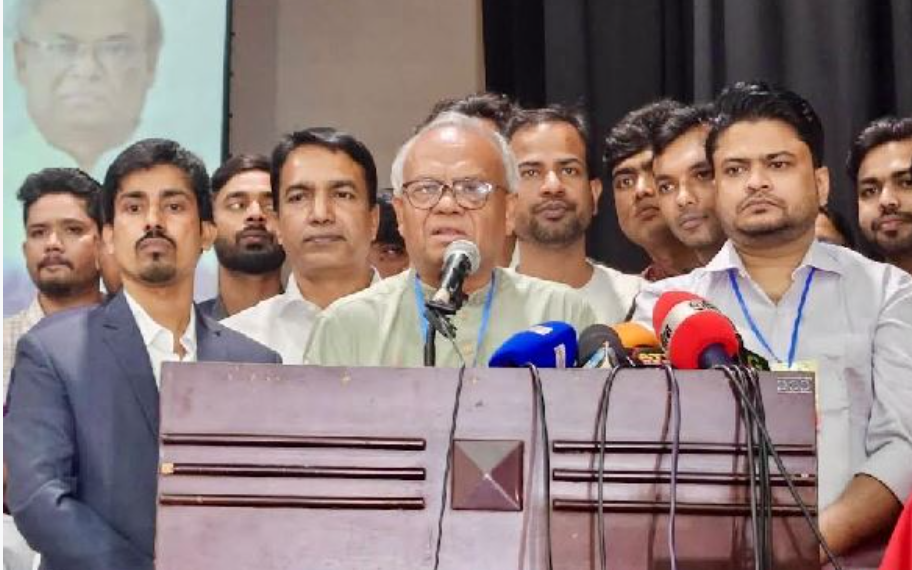
Acting Secretary General of BNP and Former Vice-President of Rajshahi University Central Students Union (RUCSU) Advocate Ruhul Kabir Rizvi on Tuesday categorically said that Bangladesh's foreign policy will be set by its people, not Delhi.
“The people alone have the right to determine Bangladesh's domestic and foreign policies. No hegemonic power can dictate the country’s independent decisions,” he said.
He made these remarks while taking part at a discussion on “7 November National Revolution and Solidarity Day” here as the chief guest. Rajshahi University (RU) unit of Jatiyatabadi Chhatra Dal (JCD) organised the discussion at Kazi Nazrul Islam Auditorium of the varsity.
Highlighting the historic significance of 7 November, Rizvi said, national unity, establishment of multi-party democracy and protection of national independence and sovereignty are the core spirit of 7 November.
“This spirit gives the people of Bangladesh the courage to fight against injustice, autocracy and hegemony,” he added.
Regarding the Awami League's rule, he said, from 1972 to 1975 and from 2009 to 2024, during the Awami League's rule, a tendency to hold on to power was seen while the last 17 years of rule was a new version of the old dictatorship.
Although the spirit of the Liberation War and independence was talked about, in reality people's voting rights and freedom of expression were curtailed.
He alleged that people's voting rights were taken away through various electoral systems, including midnight elections.
Regarding relations with India, Rizvi said, on one hand the Awami League talked about the Liberation War and the spirit of independence, on the other hand it raised questions about Bangladesh's interests and the independence of foreign policy.
Sheikh Hasina once said, 'What I have given to India, India will never forget.' This statement reflects the contradiction in Awami League's politics. In protecting Bangladesh's interests and determining foreign policy, the opinion of the people should get the highest importance, he added.
Regarding Abu Sayed's sacrifice in the July movement, he said, in the July movement of 2024, Abu Sayed, a student of Begum Rokeya University, stood in front of police bullets with his chest out. His sacrifice inspired the youth, teenagers, students, workers and common people across the country to join the movement.
The mass awakening created through the sacrifice of one student eventually led to the fall of Sheikh Hasina's government on August 5, 2024.
Raising allegations of Awami League's repression, Rizvi said, even after so many people lost their lives in the July movement, no remorse was seen in Sheikh Hasina. The death of nearly 1,400 people is deeply painful for the nation.
He also alleged that state forces and the party's student organization were used to suppress the movement.
At that time, he commented, an attempt was made to suppress the protesters by calling them grandchildren of Razakars.
Regarding Awami League's violent politics, he further said, even after shedding so much blood, their thirst for blood has not ended.
He alleged that with the aim of returning to power again, incidents like cocktail explosions in various places, setting fire to buses and arson at police boxes are being carried out.
Rizvi also commented that those accused of looting the country's wealth are again trying to make a political comeback.
Highlighting BNP's movement and current political position, he said, BNP and various other democratic political parties have struggled for a long 17 years to restore democracy and establish the people's voting rights.
Deshnetri Begum Khaleda Zia did not compromise on the question of democracy despite various adversities and imprisonment. As a symbol of nationalist politics and democracy, she has created an important position among the people.
Regarding the current situation, Rizvi said, the journey of democracy cannot be stopped by a few cocktail explosions or setting fire to one or two vehicles.
A democratic environment must be established where people can speak freely, express dissent, and no one will be subjected to enforced disappearance or torture for criticizing the government. No single force can survive in front of the united strength of the people.
He further said, the spirit of 7 November was built on the determination to protect national unity, multi-party democracy, and national independence and sovereignty. This spirit will inspire people for ages in the fight against injustice, autocracy and fascism.