

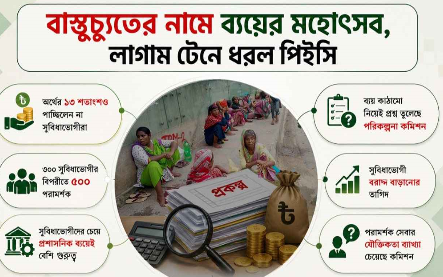
A proposed social welfare project worth Tk 612.96 million, aimed at improving the livelihoods of poor, displaced, women and persons with disabilities affected by climate change, has come under scrutiny after the Planning Commission found that only 13.23 percent of the total budget was allocated directly to beneficiaries. In contrast, more than Tk 531.8 million was earmarked for consultants, project management, office operations, domestic and foreign travel, training, and other administrative expenses. Citing serious concerns over the expenditure structure, the Project Evaluation Committee (PEC) of the Planning Commission declined to approve the proposal and sent it back for revision.
According to Planning Commission sources, the project, titled "Strengthening Urban Integration Capacities of Internally Displaced Persons and Supporting Host Communities (INTEGRATE)," was proposed to be fully financed through a grant from the German development agency GIZ. The project was scheduled to run for one year and nine months, from January 2026 to September 2027.
The initiative was designed to support climate-displaced populations in Khulna City Corporation, Satkhira Municipality, Rajshahi City Corporation, and Sirajganj Municipality by creating employment opportunities, supporting small businesses, promoting cooperative-based income-generating activities, and strengthening social protection services.
Under the proposal, 300 direct beneficiaries—including 270 women and 30 persons with disabilities—were to receive support for small businesses and livelihood development. In addition, around 1,500 people were expected to benefit from childcare services, vocational training, gender-sensitive programmes, and disability-inclusive social services aimed at enhancing their skills and economic resilience.
However, a financial review of the project revealed that only Tk 81.09 million of the total Tk 612.96 million budget had been allocated directly to beneficiaries, representing just 13.23 percent of the overall project cost. The remaining Tk 531.8 million was proposed for administrative and operational expenditures.
The most controversial component of the budget was the allocation for consultants. The project proposed hiring 473 local and international consultants at a cost of Tk 296.26 million, accounting for nearly half of the total project budget. Notably, the number of consultants exceeded the number of direct beneficiaries, raising concerns within the Planning Commission about the necessity and proportionality of such a large consultancy component in a relatively small-scale social development project.
The budget also included Tk 103.77 million for project management, Tk 31.93 million for office rent, and approximately Tk 47.8 million for domestic and international travel and training. Specifically, Tk 17.24 million was proposed for overseas travel, Tk 17.89 million for overseas training, and Tk 12.78 million for domestic travel. Additional allocations were made for electricity, internet services, telecommunications, security services, vehicle rentals, fuel, publications, representation expenses, postal services, office equipment, and other administrative costs.
The Planning Commission also questioned the substantial allocation for foreign travel and training, particularly in light of the government's ongoing austerity measures and restrictions on official overseas visits aimed at reducing pressure on foreign exchange reserves. Officials sought explanations regarding the necessity and practical value of these expenditures.
The Project Evaluation Committee (PEC), which met on July 5, conducted a detailed review of the project's expenditure framework. During the meeting, commission officials questioned the justification for consultant recruitment, management costs, office rent, foreign travel, and other administrative expenses. As the Department of Social Services and project officials failed to provide satisfactory explanations, the committee decided not to approve the proposal and instead returned it for revision.
A senior Planning Commission official said that although the project was grant-funded, more than 80 percent of the total budget would ultimately be spent on activities managed by the implementing agency rather than directly benefiting vulnerable people in Bangladesh. He noted that if the majority of a poverty-focused project's budget is consumed by administrative costs, its fundamental objective becomes questionable.
Another commission official, speaking on condition of anonymity, said that some development projects are often pushed forward by offering opportunities for foreign travel to a limited number of officials, while the intended beneficiaries receive only a small share of the available resources. He emphasized that public interest should remain the primary consideration in evaluating such projects.
The Planning Commission also identified several procedural shortcomings. It observed that the beneficiary selection process had not been clearly defined and questioned whether the proposal complied fully with the Public Procurement Act and Public Procurement Rules. Since part of the proposed implementation period has already elapsed, the commission also recommended revising the project's implementation timeline.
Furthermore, the commission instructed the implementing agency to submit detailed cost breakdowns and justifications for each procurement package under the Tk 326.17 million service procurement component. It also requested comprehensive explanations for expenditures related to consultancy services, domestic and international travel, overseas and local training, seminars, fuel consumption, telecommunications equipment, and other operational costs. In addition, the commission asked the project authorities to specify which organizations would participate in foreign visits, how many officials would attend, what their responsibilities would be, and how those visits would contribute to achieving the project's objectives.
The commission also raised concerns regarding the procurement plan. It recommended revising procurement packages, quantities, procurement methods, and approving authorities in accordance with the Public Procurement Act, Public Procurement Rules, and the government's delegated financial authority framework. It further instructed the implementing agency to establish a transparent and clearly defined process for selecting climate-displaced persons, women, and persons with disabilities as project beneficiaries.
The Department of Social Services, however, rejected responsibility for the criticised expenditure structure. Md. Sajjadul Islam, Director (Planning and Development) of the department, said the initiative is primarily a technical assistance project. According to him, the agreement with GIZ was negotiated through the Economic Relations Division (ERD), and the overall project framework was largely designed by the donor agency. As the project is financed through foreign grants, he said, there is limited flexibility to modify conditions set by the donor.
Economists argue that while administrative expenditures are unavoidable in development projects, such costs should never become so excessive that they overshadow the project's core objectives. Particularly in projects intended for poor, climate-displaced and marginalized communities, the majority of resources should be directed toward improving beneficiaries' livelihoods rather than supporting administrative structures.
Former Planning Secretary Mamun Al Rashid said projects intended for vulnerable people lose public credibility when a significant portion of the budget is spent on consultants, overseas travel and administration instead of directly benefiting target groups. "If a project promises to provide ten taka to a beneficiary but, in reality, delivers only three, the project's objective has effectively failed," he said. He stressed that expenditure structures should be subjected to rigorous scrutiny before any project receives approval.
Dr. M. Masrur Riaz, Chairman and Chief Executive Officer of Policy Exchange Bangladesh, expressed similar views. He said that although development projects inevitably require some spending on vehicles, training, travel and administration, such expenditures should be kept to the minimum necessary. The principal objective, he added, should be ensuring that the largest possible share of project resources reaches the intended beneficiaries.
According to analysts, the project's humanitarian objective is commendable. However, the disproportionate allocation of funds to administrative and consultancy expenses, compared with direct support for beneficiaries, has raised serious concerns about its effectiveness and value for money. Attention is now focused on whether the revised proposal will increase allocations for beneficiaries, rationalize consultancy and administrative expenditures, and establish a more transparent and accountable implementation framework.