

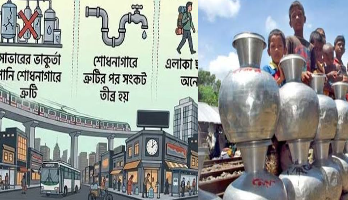
The introduction of the Metro Rail has brought a revolutionary change to Dhaka's transportation system. By significantly reducing travel time and easing daily commuting, it has transformed the lives of city residents. Among the greatest beneficiaries is Mirpur, where improved connectivity has made the area one of the most desirable residential locations in the capital. The convenience of rapid transportation has attracted a growing number of working professionals, leading to a surge in the construction of high-rise residential and commercial buildings.
However, alongside this remarkable urban development, Mirpur is now facing a serious crisis—an acute shortage of safe and adequate water supply. Although residents have experienced water shortages for several years, the situation has become considerably worse in recent months. Areas including different sections of Mirpur, Pallabi, Kazipara, Shewrapara, Monipur, Pirerbagh, and surrounding neighborhoods are suffering from an insufficient supply of water, causing severe hardship for thousands of residents.
According to local residents, water is no longer supplied according to schedule. In many areas, the water pressure is so low that even electric pumps fail to draw an adequate amount of water. As a result, essential daily activities such as cooking, bathing, washing clothes, cleaning homes, and maintaining personal hygiene—especially for children and elderly family members—have become increasingly difficult. Many households have been forced to purchase bottled or jar water or collect water from alternative sources, significantly increasing their monthly household expenses.
The crisis extends beyond residential households. Schools, restaurants, small businesses, mosques, and various service institutions are also struggling to operate due to the shortage of water. Public health experts warn that prolonged shortages of safe water could compromise personal hygiene and increase the risk of infectious diseases.
Residents claim that Kazipara, Shewrapara, and Monipur have been experiencing severe water shortages for more than a month. In many neighborhoods, water is unavailable for most of the day. Even when it becomes available, the supply lasts only for a short period and the pressure remains too weak to fill household storage tanks. Consequently, frustration and dissatisfaction among residents continue to grow.
Mostak Ahmed, a private-sector employee who lives with his family in Kazipara, said, "Since the Metro Rail began operating, commuting to my office has become much easier. Unfortunately, the ongoing water crisis has taken away that comfort. Most days of the month, there is simply no water in the supply line, making life extremely difficult for my family."
A resident of Baishbari in Mirpur, Selim Reza, shared a similar experience. "We have not received an adequate water supply for the past two months. We have to collect water from alternative sources to manage our daily household activities. It has become difficult even to bathe our children regularly. We do not know how much longer we can continue living like this," he said.
According to Dhaka WASA, the Bhakurta Water Treatment Plant in Savar normally supplies approximately 120 million liters of water every day, with a significant portion distributed across the greater Mirpur area. Consequently, even a minor disruption at the treatment plant has a substantial impact on water supply throughout Mirpur.
WASA sources reported that on June 20, a mechanical failure in the plant's transformer and generator reduced daily production to only 70 million liters. During the following two days, the plant supplied around 100 million liters per day. As a result, approximately 90 million liters less water than usual were supplied over three days, severely affecting Kazipara, Shewrapara, Monipur, and nearby areas.
However, Md. Emdadul Haque, Executive Engineer of WASA's MODS Zone-4, maintained that the overall water supply in Mirpur has now returned to normal. According to him, the shortage was only temporary and occurred between June 20 and June 23 due to the mechanical failure at the Bhakurta Water Treatment Plant.
He explained that many homeowners switch on high-powered pumps as soon as water becomes available, extracting more water than necessary. Consequently, houses located at the far end of supply lines often receive little or no water. This problem is particularly evident in Baishbari and several adjacent neighborhoods.
Regarding efforts to resolve the crisis, Emdadul Haque said that drilling work for a new deep tube well in Kazipara is expected to be completed within the coming week. In addition, several new groundwater pumps are being installed. He urged residents not to store more water than necessary, emphasizing that responsible water consumption would help reduce pressure on the distribution system.
He further noted that the rapid population growth following the launch of the Metro Rail has significantly increased water demand in Mirpur. While hundreds of new high-rise buildings have been constructed, suitable land for installing additional water pumps has become increasingly scarce, making it difficult to expand the supply infrastructure in line with growing demand.
According to Dhaka WASA, the capital requires nearly 3 billion liters of water every day. To meet this demand, the agency operates around 1,350 deep tube wells across the city, including approximately 180 in the Mirpur zone. In addition, treated surface water from nearby rivers is supplied to residents. Nevertheless, rapid urbanization and the continuous decline of groundwater levels have made it increasingly difficult to meet the city's growing demand.
Public frustration over the prolonged shortage intensified on June 28, when more than one hundred residents of Shewrapara blocked a major road while carrying buckets and water containers in protest. The demonstration lasted for about twenty minutes before protesters dispersed after receiving assurances from WASA that water supply would be restored by that night. However, according to local residents, the situation had shown little improvement even by July 7.
Md. Abdul Kader, Deputy Chief Public Information Officer of Dhaka WASA, stated that the volume of water currently supplied to Mirpur is similar to that of other times of the year. He explained that water demand rises significantly during the summer months, while groundwater levels decline, creating temporary shortages. He expressed optimism that the situation would improve once the ongoing infrastructure development projects are completed.
The Metro Rail has undoubtedly transformed the lives of Mirpur residents by providing faster and more convenient transportation. Yet, rapid urbanization and population growth have simultaneously placed enormous pressure on essential public services, particularly water supply. Experts believe that expanding water supply infrastructure, installing additional deep tube wells, developing alternative water sources, and promoting responsible water use are essential for achieving a sustainable solution. Without timely intervention, the water crisis is likely to become even more severe as Mirpur's population continues to grow.