

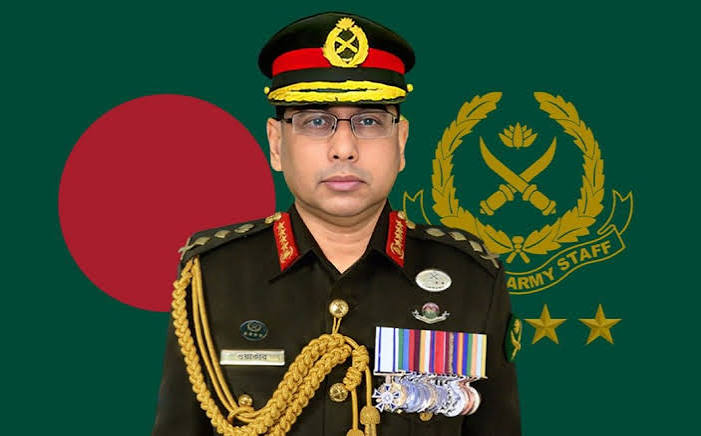
General Waker-Uz-Zaman, the current Chief of Army Staff of the Bangladesh Army, is one of the country's most prominent military leaders. Over a military career spanning nearly four decades, he has served in numerous key command and staff appointments, demonstrating professional excellence both at home and abroad. On 23 June 2024, he assumed office as the 18th Chief of Army Staff of Bangladesh. Prior to this appointment, he served as Chief of General Staff (CGS), Principal Staff Officer (PSO) of the Armed Forces Division, and Military Secretary at Army Headquarters, among several other important positions.
General Waker-Uz-Zaman was born on 16 September 1966, and his ancestral home is in Sherpur District, Bangladesh. He completed advanced military education at the Defence Services Command and Staff College (DSCSC) in Bangladesh. He later attended the Joint Services Command and Staff College in the United Kingdom and earned a master's degree from King's College London. His academic and professional training in military strategy, leadership, and administration has established him as a highly qualified career military officer.
He was commissioned into the East Bengal Regiment of the Bangladesh Army in 1985. Throughout his military career, he has held a wide range of command and staff appointments. He has commanded an infantry battalion, an infantry brigade, and an infantry division. In addition, he has served at the School of Infantry and Tactics and in several key branches of Army Headquarters. In 2017, he was appointed Military Secretary at Army Headquarters. He later served as the Principal Staff Officer of the Armed Forces Division. On 5 November 2023, he was appointed the 7th Colonel Commandant of the Army Service Corps.
General Waker-Uz-Zaman also has extensive experience in United Nations peacekeeping operations. He served as a Senior Operations Officer in UN peacekeeping missions in Angola and Liberia. These international assignments further strengthened his leadership, operational planning, and crisis management capabilities.
On 23 June 2024, he formally assumed office as the 18th Chief of Army Staff of the Bangladesh Army. As Army Chief, his primary responsibilities include safeguarding the country's sovereignty, enhancing the operational capability and professionalism of the Bangladesh Army, maintaining military discipline, and contributing to national security.
On 5 August 2024, Bangladesh experienced a major political turning point when Prime Minister Sheikh Hasina resigned amid widespread unrest and political uncertainty. During this period, General Waker-Uz-Zaman addressed the nation, calling for peace, restraint, and the maintenance of law and order. He also announced that discussions with political parties would be held to facilitate the formation of an interim government. Following consultations involving political parties and representatives of the student-led movement, an interim government headed by Nobel Peace Prize laureate Professor Dr. Muhammad Yunus was formed, and its members took the oath of office on 8 August 2024.
Many political observers and members of the public have argued that General Waker-Uz-Zaman's decisions during the crisis played an important role in maintaining public order and national stability. According to these assessments, he instructed the Bangladesh Army to exercise restraint and prioritized the safety and security of civilians. Supporters of this view contend that these measures helped reduce the risk of wider violence and facilitated a comparatively peaceful political transition. However, these assessments are based primarily on the views of analysts, media reports, and sections of public opinion, and differing interpretations of his role also exist.
In his personal life, General Waker-Uz-Zaman is married to Begum Sarahnaz Komolika, and they have two daughters. He is also the son-in-law of former Chief of Army Staff General Mustafizur Rahman. Although his family background has occasionally attracted public attention, his military career is generally evaluated on the basis of his professional service, leadership, and extensive experience.
Public opinion regarding General Waker-Uz-Zaman's leadership remains diverse. Many people regard him as a capable, prudent, and experienced military leader who sought a peaceful resolution during a period of national crisis. Others, particularly within certain political circles, have questioned some of his decisions and positions. Consequently, assessments of his leadership continue to vary depending on differing political and analytical perspectives.
Throughout Bangladesh's military history, several Chiefs of Army Staff—including General Ziaur Rahman, General Nuruddin Khan, and General Mustafizur Rahman—have played significant roles in shaping the armed forces and the nation. Determining who was the most successful or influential Army Chief remains a matter of historical interpretation and scholarly debate, as no universally accepted official ranking exists. General Waker-Uz-Zaman's historical standing will likewise be determined over time through objective research, historical analysis, and public evaluation.
Overall, General Waker-Uz-Zaman is widely recognized as an experienced and professional military officer. During his long career, he has held numerous key command and staff appointments, participated in United Nations peacekeeping operations, and made significant contributions to the leadership of the Bangladesh Army. His role during the political crisis of 2024 attracted considerable attention both domestically and internationally. At the same time, his actions have been the subject of both praise and criticism. Ultimately, the long-term assessment of his leadership and contributions to Bangladesh's military and political history will depend on impartial historical research, scholarly evaluation, and the passage of time.