

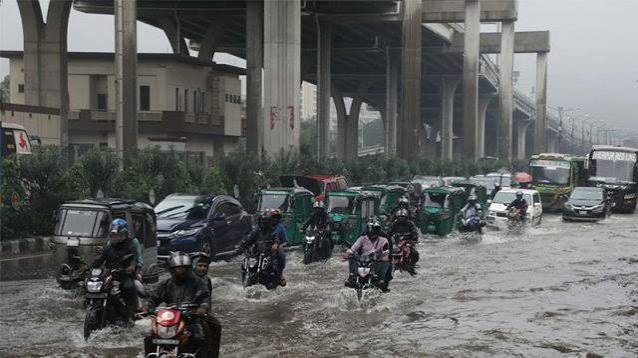
While a spell of rain brings much-needed relief from the scorching summer heat, for residents of Bangladesh's capital, Dhaka, heavy rainfall has become synonymous with hardship. Even moderate rainfall now causes widespread waterlogging across the city, submerging roads and alleys, disrupting daily life, hampering transportation, damaging businesses, and bringing normal activities to a standstill.
Continuous rainfall that began on the night of Saturday, July 11, left large parts of the capital inundated. Major areas including Dhanmondi, Mirpur, New Market, Elephant Road, and Mugda experienced severe waterlogging, with floodwater ranging from knee-deep to waist-deep in some locations. Numerous shops and business establishments were forced to remain closed, while commuters endured long traffic jams, financial losses, and immense suffering.
Urban planners and environmental experts say Dhaka's waterlogging is not the result of a single factor. Rather, it is the combined consequence of unplanned urbanization, the encroachment and filling of canals, an inefficient drainage system, uncontrolled plastic waste, and a lack of public awareness.
Once home to an extensive network of canals and natural water bodies, Dhaka had an effective system for draining rainwater. Over the years, however, many of these canals have been illegally occupied or filled in, significantly reducing the city's natural drainage capacity. At the same time, drains have become clogged with plastic bottles, polythene bags, and other solid waste, preventing rainwater from flowing freely and causing water to accumulate on roads after even moderate rainfall.
Urban planners argue that while inadequate planning and poor management by public authorities have contributed to the crisis, irresponsible public behavior has also played a significant role. Discarded plastic bottles, snack packets, polythene bags, and other waste are frequently thrown onto streets and sidewalks. During rainfall, these items are washed into drains, where they accumulate over time and obstruct the flow of water.
Residents of the Mugda area say that roads near the Market Mosque regularly remain submerged after rainfall. Although city corporation sanitation workers clean the drains frequently, the problem quickly returns. According to one sanitation worker, a large portion of the waste removed from drains consists of plastic bottles, polythene bags, and paper. These materials clog the drainage system, forcing water to overflow through manholes onto the streets.
A similar situation can be observed in Gulistan, where piles of waste generated by roadside vendors are dumped beside drainage channels. Much of this waste, particularly plastic materials, eventually enters nearby manholes. Such scenes are common across most footpaths and market areas of the capital. Many pedestrians complain that the shortage of public waste bins encourages indiscriminate dumping. However, experts stress that improved civic awareness is just as important as expanding waste disposal facilities.
Waterlogging also poses serious public health risks. Rainwater collected in discarded coconut shells, old vehicle tires, and unused containers around homes and rooftops creates ideal breeding grounds for Aedes mosquitoes, increasing the risk of dengue and other mosquito-borne diseases. Public health experts emphasize that maintaining a clean environment requires active participation from both authorities and citizens.
Plastic pollution is not only damaging Dhaka's drainage infrastructure but also posing a grave threat to biodiversity and the global environment. According to research by Professor Dr. Tofazzal Islam of the Department of Biotechnology and Genetic Engineering at Gazipur Agricultural University, approximately 3.81 billion tons of plastic and plastic products are produced worldwide each year. Around 50 percent of these are single-use plastics, while only 9 percent are recycled. If current trends continue, global plastic production could nearly double by 2031.
Research further indicates that nearly 88 percent of the ocean's surface contains varying levels of plastic pollution. Globally, approximately one million plastic bags are discarded every minute, while hundreds of billions of plastic bags and plastic waste enter the oceans each year. Scientists warn that if plastic pollution continues at its current pace, marine biodiversity will face increasingly severe threats.
A study conducted by Australia's national science agency, CSIRO, found that enormous quantities of microplastics accumulate on the ocean floor annually, threatening marine ecosystems. The study estimates that the amount of plastic beneath the sea surface is approximately 35 times greater than the plastic floating on the surface.
Meanwhile, most of the canals surrounding Dhaka have been encroached upon, filled in, or turned into dumping grounds. These canals once served as the city's primary drainage network. According to official sources, responsibility for maintaining Dhaka's drainage system was previously divided between Dhaka WASA and the city corporations. Although the management of canals and drains has since been transferred to the two city corporations, residents have yet to experience significant improvements.
Professor Dr. Adil Muhammad Khan, General Secretary of the Bangladesh Institute of Planners (BIP), says Dhaka's waterlogging problem is worsening every year. He attributes the crisis to the filling of canals and wetlands in the name of development, inadequate maintenance of local drainage systems, and ongoing construction activities that obstruct water flow during the monsoon season.
Similarly, Professor Dr. Akhtar Mahmud, an urban planning expert at Jahangirnagar University, explains that Dhaka began losing its canals and wetlands during the 1980s as rapid and largely unplanned urban expansion spread into surrounding low-lying areas. Private housing developments and real estate projects gradually eliminated natural waterways, significantly reducing the city's capacity to drain rainwater. As a result, even short periods of rainfall now cause extensive waterlogging.
Experts believe that addressing Dhaka's chronic waterlogging requires restoring canals, modernizing the drainage network, ensuring regular drain maintenance, reducing plastic waste, and implementing effective solid waste management. Equally important is fostering greater public awareness so that citizens dispose of waste responsibly instead of littering streets and drains. Without coordinated action by the government, city corporations, and the public, Dhaka is unlikely to overcome its long-standing waterlogging crisis.