

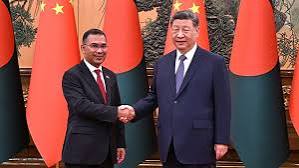
Prime Minister Tarique Rahman's recently concluded four-day official visit to China is being widely regarded by diplomats, foreign policy experts, and strategic analysts as a significant milestone in the history of Bangladesh-China relations. More than a continuation of longstanding bilateral ties, the visit is viewed as the beginning of a new chapter marked by deeper political trust, expanded economic cooperation, stronger strategic partnership, enhanced regional connectivity, technological collaboration, defense engagement, and sustainable development.
One of the most notable outcomes of the visit was the joint announcement by both governments to establish a "Bangladesh-China Community with a Shared Future in the New Era." The two sides also reaffirmed their commitment to elevating their comprehensive strategic cooperative partnership to a higher level. According to diplomatic observers, this declaration is far more than symbolic; it provides a long-term political framework for expanding cooperation across diplomacy, trade, security, technology, and regional affairs.
A New Political Foundation for Bilateral Relations
During high-level talks in Beijing, Chinese President Xi Jinping and Prime Minister Tarique Rahman agreed to strengthen bilateral relations by institutionalizing their strategic partnership. The agreement reflects a shared commitment to broadening cooperation across multiple sectors and creating a more comprehensive framework for future engagement.
Analysts believe the strengthened partnership will enhance cooperation in foreign policy coordination, regional security, economic integration, climate resilience, and mutual support in international forums. For Bangladesh, China is expected to remain one of its most reliable development partners in the years ahead.
Fifteen-Point Joint Statement and Seventeen Agreements
A major outcome of the visit was the announcement of a 15-point Joint Statement, accompanied by the signing of 17 agreements and Memorandums of Understanding (MoUs) covering investment, infrastructure, agriculture, healthcare, education, information technology, human resource development, media cooperation, Chinese language education, and broader development collaboration.
These agreements are expected to facilitate new investment opportunities, technology transfer, industrial modernization, and workforce development. Bangladesh also seeks to position itself as a competitive manufacturing and export hub for Chinese enterprises looking to diversify their global production networks.
Chinese Support for the Teesta Project
One of Bangladesh's most significant diplomatic gains from the visit is China's commitment to support the Teesta River Comprehensive Management and Restoration Project (TRCMRP), a long-standing national priority.
If implemented successfully, the project could significantly improve irrigation, water management, flood control, agricultural productivity, and ecological sustainability across northern Bangladesh. At the same time, observers note that the project's implementation will inevitably require careful management of regional diplomatic sensitivities and the interests of neighboring countries.
Prospects for a New Economic Corridor
The two sides also discussed the possibility of establishing a Bangladesh–Myanmar–China Economic Corridor, although no final agreement has yet been reached.
If realized, the corridor could transform Bangladesh into an important regional trade and logistics hub connecting South Asia with Southeast Asia. It could substantially enhance the economic significance of Chattogram and Cox's Bazar, strengthen cross-border trade, improve port infrastructure, and stimulate tourism and regional connectivity. However, experts emphasize that such an initiative would depend on political stability, regional security, and infrastructure readiness.
Joining the Global Development Initiative
Bangladesh also decided to participate in China's Global Development Initiative (GDI), marking another important step in bilateral development cooperation after joining the Belt and Road Initiative (BRI) in 2016.
Participation in the GDI is expected to create new opportunities in poverty reduction, sustainable development, climate resilience, food security, digital transformation, and development financing. Bangladesh's endorsement of China's four major global initiatives has also reinforced mutual political trust between the two governments.
Expanding Defense Cooperation
Defense cooperation emerged as another important area of discussion. Both countries agreed in principle to explore the establishment of a "Two Plus Two" dialogue mechanism involving their foreign and defense ministries.
The two governments also expressed interest in expanding military training, high-level exchanges, defense technology cooperation, and institutional experience sharing. Analysts suggest that these initiatives could contribute not only to Bangladesh's defense modernization but also to broader regional security cooperation, disaster response, and United Nations peacekeeping operations.
Technology, Artificial Intelligence, and Green Development
China expressed strong interest in expanding cooperation with Bangladesh in digital economy, artificial intelligence (AI), information technology, renewable energy, low-carbon development, and green industries.
Experts believe future collaboration could include smart cities, e-governance, semiconductor manufacturing, cloud computing, data centers, renewable energy projects, and high-tech industrial development. Such investments could significantly accelerate Bangladesh's industrial transformation while creating skilled employment opportunities.
Areas for Future Cooperation
Policy experts believe the momentum generated by the visit could pave the way for deeper collaboration in several strategic sectors, including:
Development of industrial zones around Chattogram and Payra ports.
Expansion of railway networks, expressways, and regional transport connectivity.
Joint investment in renewable energy and power generation.
Cooperation in digital infrastructure, 5G technology, cloud computing, and artificial intelligence.
Agricultural modernization, food processing industries, and advanced irrigation technologies.
Higher education partnerships, academic research, scholarships, and university collaboration.
Healthcare, pharmaceutical manufacturing, and medical technology investment.
Long-term cooperation in disaster management, climate adaptation, and river management.
Shared Strategic Interests
For Bangladesh, stronger ties with China serve several strategic objectives, including development financing, infrastructure modernization, technology transfer, export diversification, employment generation, and improved regional connectivity. Chinese support also strengthens Bangladesh's position in international development cooperation.
From China's perspective, Bangladesh occupies a strategically important position along the Bay of Bengal, offering access to one of South Asia's fastest-growing consumer markets and an increasingly competitive manufacturing base. Bangladesh is also viewed as an important partner in advancing regional connectivity under the Belt and Road Initiative and expanding China's economic engagement across the Indian Ocean region.
The Geopolitical Message
Prime Minister Tarique Rahman's decision to visit China shortly after his official visit to Malaysia has been interpreted as an important diplomatic signal. According to foreign policy analysts, Bangladesh intends to pursue a balanced and diversified foreign policy while maintaining constructive engagement with all major global partners, including China, the United States, India, Japan, and the European Union.
Rather than aligning exclusively with any one geopolitical bloc, Dhaka appears committed to a pragmatic, development-oriented foreign policy that prioritizes national interests and economic growth.
Implementation Will Determine Success
Although the visit did not produce any immediate announcement of major loans or large-scale infrastructure projects, it laid a strong political and strategic foundation for future cooperation. The agreements reached on the Teesta project, development initiatives, technology investment, defense dialogue, and regional connectivity represent significant long-term opportunities.
International relations scholar Professor Imtiaz Ahmed believes the visit will inject new momentum into Bangladesh-China relations and contribute to the country's economic development. Former Bangladeshi Ambassador to China Munshi Faiz Ahmad also expects bilateral trust and economic cooperation to deepen further in the coming years.
Diplomatic observers, however, stress that the true success of the visit will depend on the effective implementation of the agreements and commitments made during the visit. If translated into concrete projects and sustained policy coordination, this new phase of Bangladesh-China relations has the potential to reshape bilateral cooperation in trade, investment, technology, infrastructure, and strategic affairs for many years to come.