

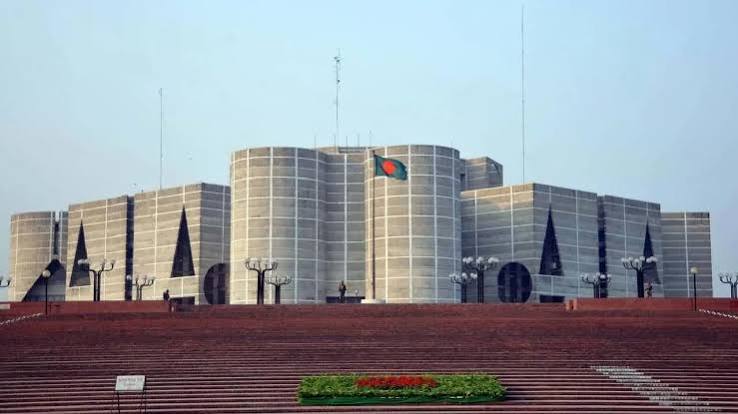
With the commencement of the 13th National Parliament, several significant and visible changes have been introduced to the Jatiya Sangsad (National Parliament) complex. According to information released by the Parliament Secretariat, these initiatives aim to enhance the symbolic representation, aesthetic appeal, and historical identity of the Parliament House. The government says the changes are intended to more prominently reflect national identity, the legacy of the Liberation War, and important religious values within the country's highest legislative institution.
One of the most widely discussed changes is the installation of Arabic calligraphy displaying the Islamic declaration of faith, "La ilaha illallah, Muhammadur Rasulullah" ("There is no deity but Allah, and Muhammad is the Messenger of Allah"), on the wall behind the Speaker's chair in the main parliamentary chamber. Government officials and several media reports stated that the installation was carried out following the Prime Minister's directive. The addition has introduced a new symbolic dimension to the chamber and, according to the government, represents the fundamental creed of Islam.
Another notable development is the replacement of the portrait of Bangabandhu Sheikh Mujibur Rahman, which had previously occupied the same location behind the Speaker's chair, with the newly installed calligraphy. According to the Chief Whip, the change was made as a symbol of faith in the oneness of Allah. The government has described the initiative as an effort to emphasize religious identity and belief through symbolic representation. The move has generated widespread discussion in political and social circles, with differing opinions expressed by various groups.
A further major change concerns the renaming of the Parliament galleries. Previously, the galleries were named after Bangladesh's rivers and flowers, including Shimul, Shiuli, Bakul, Shapla, and Jamuna. These names have now been replaced with the names of the country's seven Bir Sreshtho—the highest recipients of gallantry awards for their extraordinary heroism during the 1971 Liberation War. According to the government, the initiative is intended to give greater prominence and recognition to the sacrifices and contributions of these national heroes within the country's supreme legislative institution.
The renaming of the galleries is being viewed as a symbolic effort to preserve the history of the Liberation War and introduce future generations to the nation's greatest war heroes. Officials believe the initiative will also help present Bangladesh's liberation history in a more meaningful way to local and international visitors, researchers, and guests attending the Parliament House.
Another important change has been made at the main entrance to the Parliament complex. A new signboard has officially renamed the principal gate as the "General M. A. G. Osmani Gate." The gate has been named in honor of General Muhammad Ataul Gani Osmani, the Commander-in-Chief of Bangladesh's armed forces during the Liberation War. Authorities say the renaming recognizes his outstanding leadership and invaluable contribution to the country's struggle for independence.
According to the Parliament Secretariat, these visible changes have been accompanied by several administrative developments marking the beginning of the 13th National Parliament. A new Speaker and Deputy Speaker have formally assumed office, while parliamentary standing committees have also been reconstituted. Officials say these measures are intended to make parliamentary activities more effective, dynamic, and responsive to contemporary needs.
Observers note that the installation of the Kalima calligraphy behind the Speaker's chair, the renaming of the galleries after the seven Bir Sreshtho, and the designation of the main entrance as the General M. A. G. Osmani Gate have emerged as the most prominent and widely discussed changes. Beyond architectural or decorative modifications, these initiatives are being regarded as symbolic efforts to highlight Bangladesh's national identity, religious values, and the historical legacy of the Liberation War.
As the country's highest legislative institution, the Jatiya Sangsad serves as an important symbol of Bangladesh's history, culture, and national values. Consequently, every visible change to the Parliament House naturally attracts considerable public attention. According to the government's position, the initiatives undertaken at the beginning of the 13th National Parliament are expected to create a renewed parliamentary environment while reinforcing the symbolic significance of the institution.
According to the information published by the Parliament Secretariat, the installation of the Kalima calligraphy behind the Speaker's chair, the renaming of the galleries after the seven Bir Sreshtho, and the naming of the main entrance as the General M. A. G. Osmani Gate represent the most significant and visible changes implemented at the Parliament House during the opening phase of the 13th National Parliament.