

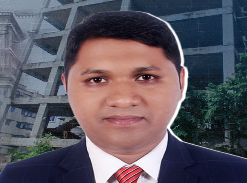
Dhaka: Serious allegations of amassing illegal wealth, abuse of power, bribery, irregular recruitment practices, and administrative influence have been raised against Md. Ahmadullah, Deputy Manager of the Bangladesh Petroleum Corporation (BPC) and former Personal Secretary (PS) to the BPC Chairman. According to multiple sources, field investigations, and statements from individuals familiar with the matter, Ahmadullah allegedly accumulated assets worth hundreds of millions of taka that are disproportionate to his known legal income. It is further alleged that many of these assets were registered in the names of his wife, parents, and father-in-law in an attempt to conceal ownership and avoid legal scrutiny.
Investigations indicate that Ahmadullah and his family own several apartments, plots, and parcels of land in different parts of Dhaka. These include a 1,160-square-foot apartment located on the second floor of a residential building in Pallabi, Mirpur. In addition, he is reported to own another apartment in Mohammadpur and a residential plot in Adabar.
During his tenure as the Chairman's Personal Secretary, Ahmadullah allegedly purchased a 3.5-katha plot in the Bashundhara Riverview Project at Ainta Mouza under Konda Union of Keraniganj South in the name of his wife, Nusrat Jebin Sinthy. Although the market value of the property was reportedly much higher, the registered deed declared its value at only Tk 3.096 million. The land was transferred to his wife's name on November 11, 2021, from fuel transportation businessman Abul Bashar Abu.
Nusrat Jebin Sinthy has acknowledged ownership of the land but stated that she obtained a bank loan to construct an eight-storey building on the property. It is also alleged that the Adabar plot was initially purchased in the name of her father, Oliul Haque, before later being transferred to her.
Beyond the capital, Ahmadullah is also alleged to possess significant assets in his home district of Jhalokathi. He reportedly built a luxurious duplex residence in Dibakarkathi village under Jhalokathi Sadar Upazila and owns more than 10 acres of land in the area. Reports also suggest that he owns an apartment in Barishal city and additional land near Uzirpur College.
Questions have also been raised regarding Ahmadullah's lifestyle. His wife reportedly uses a privately owned vehicle bearing registration number Dhaka Metro-Gha 43-4769, which allegedly displayed a government logo despite being a private car. Ahmadullah himself is accused of using official vehicles allocated for the BPC Chairman and directors for personal purposes.
Local sources further claim that vehicles carrying gifts from various individuals and business representatives frequently visited his residence in Pallabi each month, attracting the attention of neighbors. His son reportedly studies at one of Dhaka's prestigious English-medium schools.
One of the most serious allegations concerns the abuse of authority in processing official files. BPC oversees eight subsidiary organizations, including Eastern Refinery Limited, Padma Oil Company Limited, Meghna Petroleum Limited, Jamuna Oil Company Limited, Eastern Lubricants Blenders Limited, LPG Limited, Petroleum Transmission Company Limited, and Standard Asiatic Oil Company Limited.
According to sources, procurement and financial files from these organizations required the Chairman's approval but first passed through Ahmadullah's desk while he served as Personal Secretary. It is alleged that he deliberately delayed files and demanded financial benefits from the concerned parties before forwarding them for approval.
Sources also claim that Ahmadullah received regular payments from bunker fuel dealers supplying foreign vessels at Chattogram Port. Similar allegations have been made regarding private refinery companies, including Partex Petro Limited, Petromax Refinery Limited, Super Petrochemical Limited, Aqua Refinery Limited, and Bashundhara Oil & Gas Company Limited, where he allegedly accepted monthly payments in exchange for expediting the approval of large financial bills. Super Petrochemical Limited alone reportedly processed bills ranging between Tk 3 billion and Tk 5 billion every month.
Additional allegations state that payments were demanded before files relating to bitumen distribution, letters of credit (LCs) for foreign fuel shipments, and other financial matters were placed before the Chairman.
A separate allegation involves the approval of AHK Filling Station in Shibchar, Madaripur, where approximately Tk 600,000 was allegedly received to release the approval file. The transaction is said to have taken place at a hotel in Dhaka.
Questions have also been raised regarding Ahmadullah's appointment to BPC. Reports allege that when he joined the corporation directly in 2019 as a Grade-6 Deputy Manager, he concealed his permanent address in Jhalokathi and instead used a Dhaka address in his job application.
BPC regulations classify the Chairman's Personal Secretary position as equivalent to an Assistant Manager (Grade 9). However, Ahmadullah reportedly continued performing the role for nearly six and a half years despite holding the higher rank of Deputy Manager.
He is further accused of creating a powerful internal network by recruiting and promoting individuals primarily from the Barishal region. Employees from Barishal allegedly occupied numerous positions in the Dhaka headquarters, including office assistants, security guards, receptionists, drivers, and personal assistants.
Following the appointment of ABM Azad as BPC Chairman in 2021, Ahmadullah was transferred to Chattogram after allegations regarding his activities surfaced. However, according to insiders, the transfer order was revoked within a day due to pressure from an influential syndicate, allowing him to resume his position as Personal Secretary.
It is also alleged that Md. Shafiul Islam, the former in-charge of the BPC Dhaka Rest House, lost his job after protesting Ahmadullah's irregularities.
Another major allegation concerns Ahmadullah's influence over banking decisions. Former BPC Personal Secretary KM Riaz Rahman submitted a written complaint to the Energy Adviser on March 1, alleging that Ahmadullah arranged jobs for relatives in various banks and, in return, directed BPC's Fixed Deposit Receipts (FDRs) and Special Notice Deposit (SND) accounts to those institutions.
The complaint further alleges that during Ahmadullah's tenure, substantial amounts of BPC funds were deposited in financially vulnerable banks, exposing the corporation to significant financial risk while providing him with personal benefits.
Other allegations include recruitment corruption, extortion through transfer threats against depot officials, manipulation of investigation reports, and influence over major financial decisions. According to a certification issued by BPC's Accounts Division, Ahmadullah received Tk 559,000 during the 2024–25 fiscal year for entertainment expenses, travel allowances, daily allowances, and fuel costs.
In response to these allegations, current BPC Chairman Md. Rezanur Rahman transferred Ahmadullah to Meghna Petroleum Limited on May 13. However, several officials, speaking on condition of anonymity, claimed that members of his alleged syndicate continue to obstruct administrative activities within BPC.
Commenting on the matter, Shahina Sultana, Secretary of BPC, stated that she had not received any formal complaints against Ahmadullah since joining the organization, nor had the Anti-Corruption Commission (ACC) sent any official communication regarding him. She advised seeking information through the Right to Information (RTI) Act for further details on BPC's financial decisions.
Repeated attempts to obtain comments from BPC Chairman Md. Rezanur Rahman were unsuccessful. Ahmadullah's mobile phone was reportedly switched off, preventing journalists from obtaining his response to the allegations.
It should be noted that the allegations outlined in this report have not yet been proven in a court of law or through any final determination by the relevant investigative authorities. The claims remain allegations unless and until they are established through due legal and investigative processes.