

Rural Power Company Limited (RPCL), a key state-owned entity in Bangladesh’s power sector, is facing a series of allegations involving irregularities in recruitment and promotion, delays in project implementation, alleged preferential treatment to contractors, financial losses to the state, prolonged additional responsibilities, and questionable procurement practices.
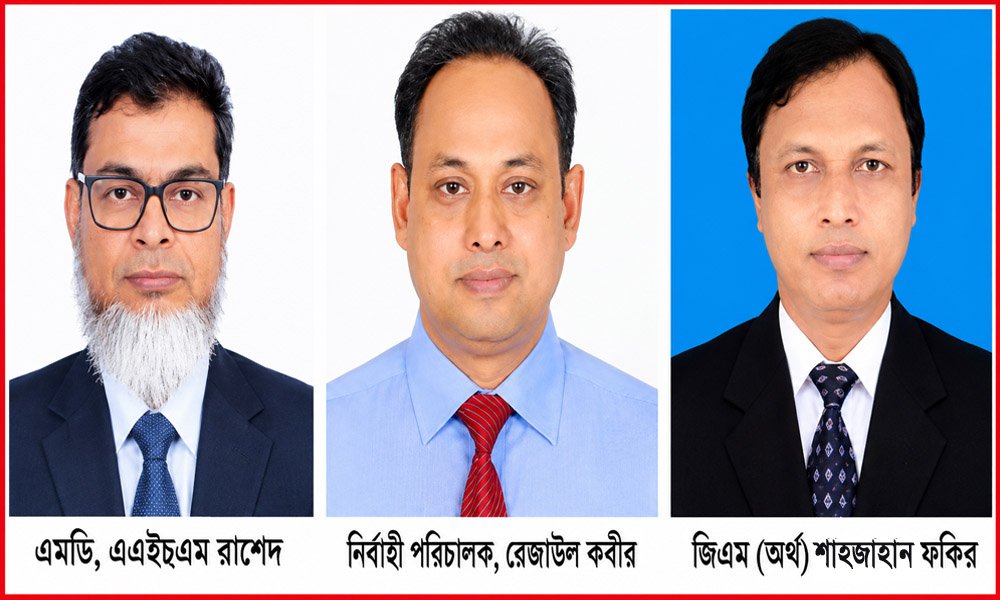
The allegations repeatedly name Managing Director (MD) AHM Rashed, Executive Director (O&M) Md. Rezaul Kabir, and Md. Shahjahan Fakir, who is serving as Executive Director (Finance & Accounts) on an additional-charge basis.
According to RPCL’s official website, AHM Rashed is currently serving as Managing Director, while Rezaul Kabir is listed as Executive Director (O&M). Shahjahan Fakir is listed as Executive Director (Finance & Accounts) in an additional capacity and is also shown as General Manager (Finance & Accounts).
One of the most significant allegations concerns Rashed’s appointment as Managing Director. According to complainants, although Rashed reportedly ranked second in the MD recruitment examination held in September 2025, he was allegedly appointed through an improper financial arrangement. The complainants further allege that Rezaul Kabir, Shahjahan Fakir and Nazmus Sayadat, then Member (Finance) of the Bangladesh Rural Electrification Board (BREB), played important roles in the process. There are also allegations that former interim government adviser Fouzul Kabir was influenced in connection with the appointment. However, whether any public government investigation report or court judgment has established these allegations requires independent verification.
Serious allegations have also been raised concerning the 360MW combined-cycle power plant under construction in Mymensingh. According to the allegations, Rezaul Kabir and Shahjahan Fakir allegedly received financial benefits from contractor Harbin Engineering in exchange for extending various facilities to the company.
One of the key allegations concerns a 240 MVA, 132 kV step-up transformer that was reportedly supplied in a defective condition. It has been alleged that the transformer was subsequently repaired and allowed to be resupplied without a formal decision of the RPCL Board. The process was reportedly approved by then acting Managing Director Nazmus Sayadat. The allegations also suggest that Rezaul Kabir and Shahjahan Fakir were directly involved. These claims, however, require verification through procurement documents, technical reports, board records and correspondence between RPCL and the contractor.
The same project has reportedly faced a delay of nearly two years. Questions have therefore been raised over accountability for the delay and the subsequent promotion of Rezaul Kabir, who was reportedly serving as the project director. According to the allegations, he was promoted from Superintending Engineer to Chief Engineer and subsequently appointed Executive Director (O&M) within a relatively short period. Whether there was any connection between the project delay and the promotion process can only be determined through examination of the relevant official records.
Questions have also been raised over Shahjahan Fakir’s prolonged tenure in an additional capacity. Allegations suggest that although the RPCL Board had decided to recruit a regular Executive Director (Finance & Accounts), the recruitment circular was not issued within the expected timeframe. Questions have also been raised regarding his educational qualifications.
According to a report published by Bangla Tribune, a written complaint was submitted to the Anti-Corruption Commission (ACC) on December 11, 2025, alleging irregularities and corruption involving Shahjahan Fakir. The complaint reportedly raised issues concerning his additional charge, educational qualifications, delays in the recruitment process and his responsibilities in multiple organisations. The filing of a complaint, however, does not by itself establish the truth of the allegations.
Further allegations concern Shahjahan Fakir’s involvement with RPCL as well as other entities, including RNPL and BPEMC. He has reportedly been serving as Chief Financial Officer (CFO) of BPEMC in an additional capacity for an extended period. Allegations have also been raised regarding an initiative to procure five lakh smart prepaid meters and related equipment through a Direct Procurement Method (DPM), reportedly involving an estimated expenditure of around Tk 400 crore. The allegations require verification through board decisions, approvals, procurement documents, tender records and financial files.
Questions have also been raised over the procurement of coal for RNPL’s 1,320MW coal-fired power plant. According to complainants, a company named PT Sampar was awarded a large-value contract through a single-bid process. They further allege that the supply of substandard coal subsequently affected the plant’s generation. Rashed, Shahjahan Fakir and Nazmus Sayadat have also been accused by complainants of receiving illegal financial benefits in connection with the acceptance of allegedly inferior-quality coal. These claims should be examined against tender documents, the composition and proceedings of the evaluation committee, the contract, coal-quality specifications, laboratory test reports and delivery records.
Another major allegation concerns Gas Turbine-4 at RPCL’s 210MW Mymensingh power plant. The unit reportedly remained out of operation for approximately 14 months, from March 2025 to May 2026. It has been alleged that the prolonged outage caused a financial loss of around Tk 110 crore to RPCL. Rashed reportedly served as the plant in-charge during part of the relevant period. Determining the actual financial loss and responsibility would require examination of maintenance records, equipment failure reports, repair initiatives, generation data, lost revenue and related financial statements.
Allegations have also surfaced regarding promotion examinations for Executive Engineer and Sub-Divisional Engineer positions. Complainants allege question-paper leakage, financial transactions in favour of preferred candidates and violations of seniority in the promotion process. Questions have also been raised over the composition of the relevant committees, particularly the alleged exclusion of Executive Director (P&D) KM Nayeem Khan and inclusion of Executive Director (O&M) Rezaul Kabir.
The use and procurement of official vehicles have also come under scrutiny. It has been alleged that RPCL purchased four new Pajero vehicles despite government austerity measures and that the vehicles were subsequently used by senior officials. Verification of procurement approvals, vehicle allocation orders, logbooks and fuel expenditure records would be necessary to establish whether any irregularity occurred.
Taken together, the allegations cover a broad range of RPCL’s activities, including recruitment, promotion, project implementation, procurement, fuel management, maintenance and administrative decision-making. However, allegations must be distinguished from established facts. No allegation against an individual or institution should be treated as proven unless supported by credible documentary evidence, an official investigation or a judicial determination.
A comprehensive inquiry should therefore examine, at a minimum, the recruitment circular and examination results for the Managing Director position, minutes of the relevant recruitment committee, Rezaul Kabir’s promotion records, Shahjahan Fakir’s appointment and additional-charge orders and educational certificates, the contract and transformer-related documents concerning the Mymensingh 360MW project, RNPL’s coal procurement records and the PT Sampar contract, question papers and evaluation records from the engineering promotion examinations, and outage and financial-loss records relating to Gas Turbine-4 at the Mymensingh 210MW plant.
The concerned officials, contractors and other relevant stakeholders should also be given an opportunity to respond to the allegations. Only a comparison of documentary evidence, financial records, technical reports and the statements of the concerned parties can establish whether the allegations reflect genuine irregularities or are otherwise unfounded.