

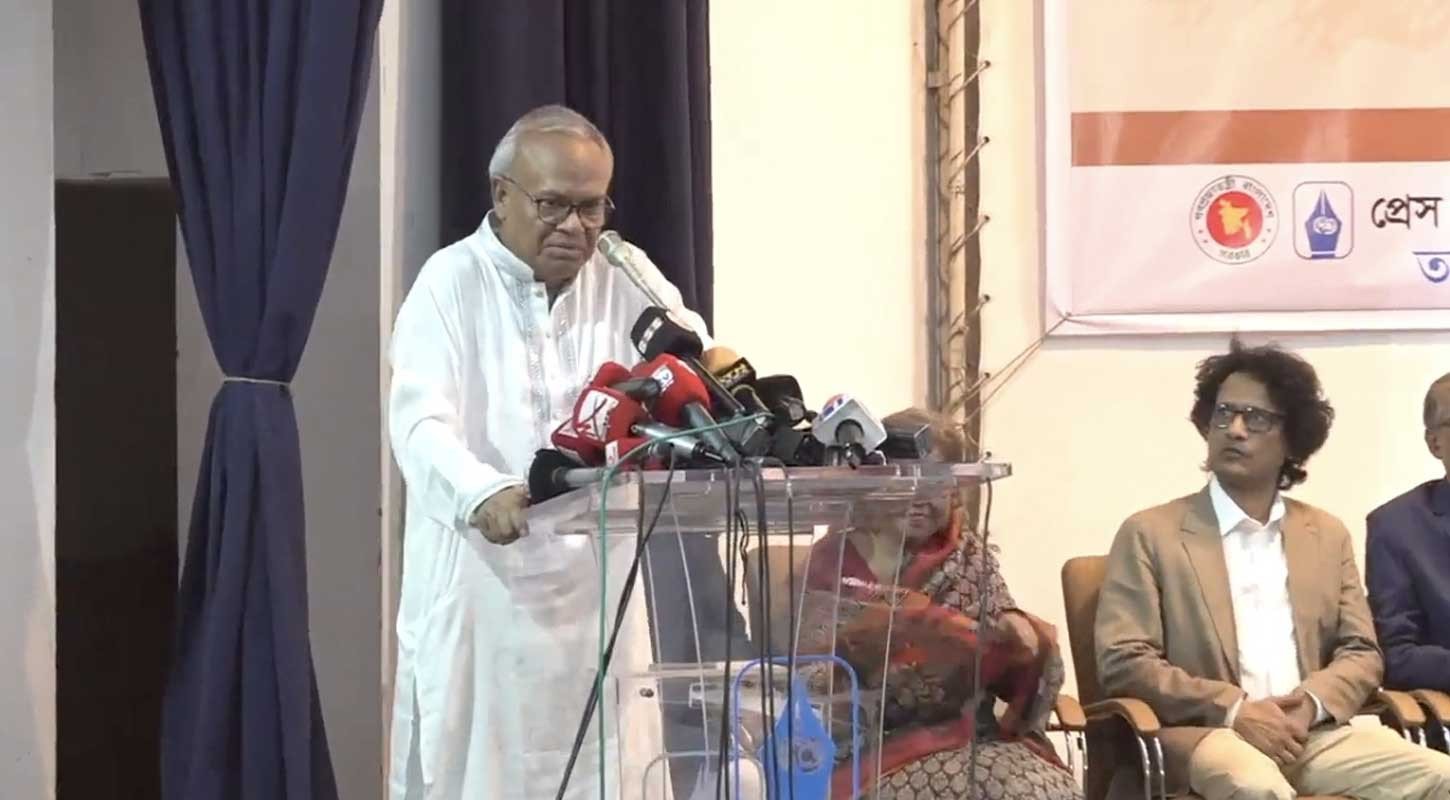
BNP Acting Secretary General Advocate Ruhul Kabir Rizvi has said that rulers with authoritarian tendencies in democratic states often use the media as a “stick” to suppress people and serve their own interests. He made the remarks on Sunday (August 30) as the chief guest at a memorial meeting held at the auditorium of the Press Institute Bangladesh (PIB) in the capital.
The discussion was organized to mark the 116th birth anniversary of journalist Abdus Salam, founder Director General of the Press Institute Bangladesh (PIB), founding editor of The Bangladesh Observer, and a language movement veteran.
Rizvi said that just as sticks and batons are essential tools for suppressing people under authoritarian rule, rulers with authoritarian characteristics in so-called democratic states use the media as a “stick.”
“A stick can be seen with the naked eye, but this form of media control is not easily visible,” Rizvi said. “Instead, attempts are made to control and influence people's minds by using the machinery of propaganda.”
Tribute to Abdus Salam
Recalling the ideals and struggles of renowned journalist Abdus Salam, Rizvi said the world today is experiencing an acute shortage of independent-minded and objective journalists like him.
He said Abdus Salam left a secure and lucrative government job and chose the difficult path of journalism.
“Abdus Salam was imprisoned several times and endured persecution, but he never compromised his commitment to truth and principles,” Rizvi said.
Drawing a comparison between the lives of Abdus Salam and celebrated poet Kazi Nazrul Islam, the BNP leader said both fought against injustice and were imprisoned for their convictions.
He also noted that both Nazrul and Abdus Salam were awarded the Ekushey Padak in 1976.
“The ideals of truth-driven journalists like Abdus Salam need to be revived in today's troubled world,” Rizvi said.
Prominent Figures Attend
Dhaka South City Corporation Administrator Abdus Salam, BSS Editor-in-Chief Kader Gani Chowdhury, Prime Minister's Adviser Dr. Zahed Ur Rahman, Abdus Salam's daughter Nihat Salam, and prominent journalists, intellectuals and representatives from various media organizations attended the discussion.