

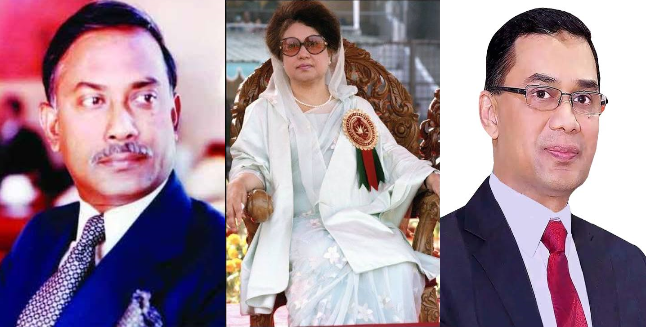
In this riverine country of fertile alluvial soil, the course of politics has often been as winding and unpredictable as its rivers—sometimes turbulent, sometimes calm.
Against this backdrop, the Bangladesh Nationalist Party (BNP) has completed 48 years of its political journey. Founded on September 1, 1978, amid a particular political and social context, the party has experienced more than four decades of political ups and downs—from holding state power to facing intense repression on the streets.
Yet, if the BNP’s political philosophy and its successive visions for rebuilding the state are viewed as a continuous thread, they can be traced from the 19-point programme introduced by Ziaur Rahman to the 31-point reform plan announced under Tarique Rahman.
The 19-point programme, introduced under Ziaur Rahman, was presented as a commitment to transforming a newly independent and economically struggling country into a self-reliant nation. More than four decades later, the 31-point plan under BNP Chairman Tarique Rahman has emerged, according to the party, as a roadmap for rebuilding state institutions and restructuring the country’s political, constitutional, administrative and economic systems.
The Beginning: Bangladesh in 1977
The year was 1977. Only a few years after independence, Bangladesh was struggling with a range of economic and social challenges. A weak economy, severe food shortages, rural-urban disparities, illiteracy, unemployment and excessive administrative centralisation posed major obstacles to rebuilding the country.
For a nation emerging from the experience of one-party rule under BAKSAL, there was a growing need for a new political direction.
Against this backdrop, then-President Ziaur Rahman introduced a political, social and economic programme known as the 19-point programme. Announced before the nation on April 30, 1977, the programme focused on self-reliance, increased production, rural development, food self-sufficiency, administrative decentralisation and greater public participation.
At that time, the Bangladesh Nationalist Party had not yet been established. The BNP was founded by Ziaur Rahman about a year and a half later, on September 1, 1978.
Thus, the 19-point programme preceded the formal establishment of the BNP and served as an important expression of the political and developmental thinking associated with its founder.
The 19 Points: A Vision for a Self-Reliant Bangladesh
The 19-point programme was presented as a roadmap for building a self-reliant Bangladesh. It sought to mobilise farmers, workers and ordinary citizens around a set of national priorities.
The programme placed emphasis on protecting the country’s independence, territorial integrity and sovereignty. It also referred to faith in Almighty Allah, democracy, nationalism and social and economic justice.
Agriculture and the rural economy received particular emphasis. The programme called for strengthening the national and rural economy through agricultural development, achieving food self-sufficiency and ensuring that no person remained without food.
It also included objectives related to increasing the supply of clothing, reducing homelessness and illiteracy, and ensuring minimum healthcare for all.
The social dignity of women, the participation of young people in national development, encouragement of the private sector, improved relations between workers and employers, and a stronger sense of public service among government employees were also included in the programme.
Population control and maintaining friendly relations with all countries on the basis of equality were among its other objectives, alongside strengthening relations with Muslim-majority countries.
The programme also emphasised administrative decentralisation, stronger local government, a corruption-free and justice-based social order, and protection of the rights of citizens irrespective of religion or ethnicity.
Changing Times, Changing Challenges
Bangladesh’s political landscape changed significantly after the introduction of the 19-point programme.
Following Ziaur Rahman’s assassination in 1981, Begum Khaleda Zia took leadership of the BNP during a period of political uncertainty. Under her leadership, the BNP became a major political force, particularly through its role in the movement against the military rule of General Hussain Muhammad Ershad.
The party later formed the government after the 1991 parliamentary election, and subsequently gained experience in democratic governance as well as opposition politics.
Under Khaleda Zia’s leadership, the BNP introduced Vision 2030 in 2017, presenting a broader political framework for state reform and its vision for the future of Bangladesh.
However, the political environment became increasingly confrontational from the late 2010s.
The BNP has alleged that during the long tenure of the Awami League government, democratic institutions were weakened, opposition political activities were suppressed and various state institutions were politicised. The party also raised allegations concerning enforced disappearances, killings, extrajudicial violence, lack of judicial independence and economic mismanagement.
Against this backdrop, the BNP began developing a new framework for structural changes to the state.
The Emergence of the 31-Point Plan
In July 2023, the BNP was in the final phase of its anti-government movement. On July 12, the party announced a “one-point” demand at a rally in Dhaka, calling for the resignation of the government and political change through a neutral election.
The following day, July 13, the BNP unveiled its 31-point plan for reforming the state structure.
According to the party, the plan is not merely an election manifesto but a comprehensive proposal for qualitative changes to Bangladesh’s political, constitutional, administrative, judicial and economic structures.
The BNP says the framework was developed through discussions and coordination with other opposition political parties and groups involved in the movement.
The party says Tarique Rahman, then acting chairman and now chairman of the BNP, played a central role in advancing the reform agenda amid the movement against the Awami League government and in the effort to rebuild democratic institutions after what the BNP describes as authoritarian rule.
According to the BNP, the 31-point plan reflects the views and consensus of democratic political parties that participated in the broader anti-government movement.
What Does the 31-Point Plan Propose?
At its core, the 31-point plan calls for replacing politics of revenge and retaliation with an inclusive and non-discriminatory state.
It proposes building an inclusive “Rainbow Nation” based on Bangladeshi nationalism and establishing a National Reconciliation Commission.
In terms of electoral reform, the plan proposes restoring a non-party caretaker government system during elections, establishing a balance of executive power, introducing a constitutional provision limiting an individual to serving as prime minister for no more than two consecutive terms, creating a bicameral parliament and reforming Article 70 of the Constitution.
The plan also proposes reforms to the Election Commission and electoral system, restructuring constitutional and statutory institutions, ensuring full judicial independence, reforming the Judicial Service Commission, establishing an administrative reform commission and an independent media commission.
It calls for making the Anti-Corruption Commission fully independent and effective, recovering money allegedly siphoned abroad, establishing an ombudsman, and strengthening the rule of law and protection of human rights.
The economic reform proposals include establishing an economic reform commission, ensuring the security and rights of all religious and ethnic communities under the principle that “religion belongs to individuals, while the state belongs to everyone,” ensuring fair wages for workers, and modernising the electricity, energy, mineral and industrial sectors.
The plan also calls for a foreign policy based on national interests, keeping the defence forces above political controversy and strengthening local government institutions.
Other proposals include state recognition for the martyrs of the Liberation War, a modern youth policy, women’s empowerment, improvements to the education system, healthcare for all, fair prices for farmers, modernisation of road, rail and waterways, measures to address climate change, development of information technology, exploration of space and nuclear energy potential, and environmentally sustainable housing and urban development.
In broad terms, while the central themes of the 19-point programme were self-reliance, production, rural development and social justice, the 31-point plan focuses more strongly on institutional reform, restoration of democracy, electoral reform, the rule of law, human rights and economic restructuring.
From 17 Years of Rule to the Politics of State Reform
In BNP leaders’ political narrative, the need for the 31-point plan is closely linked to the party’s experience during the long period of Awami League rule.
The BNP maintains that during the Awami League’s nearly 17-year tenure, various state institutions were weakened and politically influenced. The party says the 31-point plan was therefore developed under Tarique Rahman’s leadership to establish an effective, democratic and accountable state.
At a workshop in 2025, Tarique Rahman reportedly instructed BNP leaders and activists to take the message of the 31-point plan beyond the party and communicate it to ordinary people at the district, upazila, union and village levels.
His stated position was that implementing the plan was necessary to reflect the aspirations of the people through constitutional reforms and to rebuild institutions that, according to the BNP, had been severely weakened.
A Continuity of Political Thought
BNP Vice Chairman Shamsuzzaman Dudu views the journey from the 19-point programme to the 31-point plan as part of a broader political continuity.
In an interview with Banglanews, Dudu recalled the party’s founding period and said many people initially dismissed the BNP, describing it as a party created merely to hold power or as a platform for opportunists.
According to him, history has proved those assessments wrong.
Dudu described the BNP’s history as one of sacrifice as well as political power. He said the party had repeatedly formed governments but had also faced significant repression while in opposition, including attacks, cases, enforced disappearances and other forms of political persecution.
Referring to Khaleda Zia, he said the former three-time prime minister played a significant role in developing the party but was later imprisoned in what he described as politically motivated cases.
He also credited Ziaur Rahman with restoring and developing democracy, while noting that, in his view, democracy had previously been curtailed under one-party rule.
In the context of recent political developments, Dudu said that despite the political ups and downs and the events surrounding the 2024 mass uprising, the BNP remained a major focus of public expectations.
He argued that the party had demonstrated the importance of democracy not only through political slogans but also through its political activities.
Looking ahead, Dudu identified the restoration of democracy as one of the BNP’s biggest challenges. He also warned that despite the fall of what the party calls authoritarian forces, political risks remain.
From 19 to 31: Two Chapters of the Same Political Journey
After nearly five decades of political evolution, a central question for the BNP is whether the 31-point plan represents a modern version of the state philosophy reflected in the 19-point programme.
The BNP’s answer is yes.
The party argues that the 31-point plan was not created suddenly. Rather, it represents a continuation of the political thinking associated with Ziaur Rahman’s 19-point programme, Khaleda Zia’s Vision 2030 and the party’s subsequent political experiences.
Bangladesh in 1977 was vastly different from Bangladesh today, and the challenges facing the country have also changed.
In the late 1970s, the central challenge was how to rebuild a war-ravaged and economically fragile country, increase production and achieve self-reliance.
Today, the challenges identified by the BNP include strengthening democratic institutions, restoring institutional checks and balances, reforming the electoral system, ensuring citizens’ rights, strengthening the rule of law and rebuilding the economy.
Thus, the 19-point programme of 1977 and the 31-point reform plan of today can be viewed, from the BNP’s perspective, as two chapters of a continuing political narrative—from the promise of building a self-reliant nation to the pledge to reform and rebuild the state.
At one end of that journey stands the 19-point programme; at the other stands the 31-point plan.
As the BNP marks nearly five decades of political existence, the evolution from 19 points to 31 points represents, in the party’s own narrative, a transition from a vision of national development and self-reliance to a broader agenda of democratic reform, institutional reconstruction and state rebuilding.