

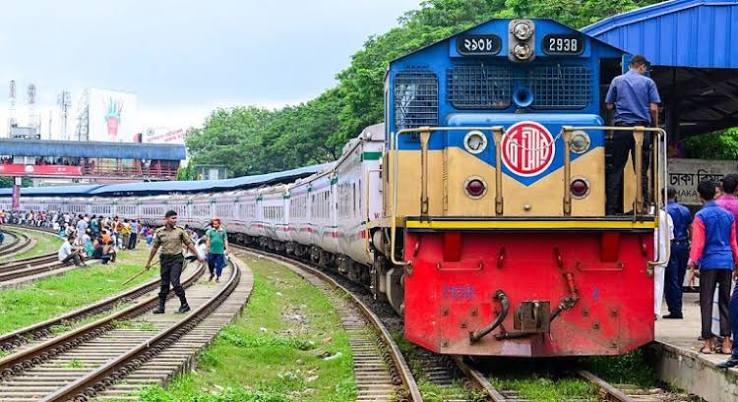
Serious allegations of irregularities and corruption have surfaced in the infrastructure development and land management of Bangladesh Railway. Allegations include irregularities in tender evaluation, contract implementation and payments in major mega projects such as the Jamuna Railway Bridge, Kalurghat Rail-cum-Road Bridge and the CDRP, as well as the illegal occupation of government railway land.
Documents, audit objections and written complaints reviewed by this newspaper have revealed several instances of alleged irregularities. Officials familiar with the matter fear that, if substantiated, the alleged irregularities could cause the government financial losses amounting to several thousand crores of taka.
The allegations have been directed at several influential railway officials and some contractors involved in the projects. In particular, allegations involving nearly Tk 3,000 crore have been raised against Al Fattah Md Masudur Rahman, Project Director (PD) of the Jamuna Railway Bridge Project. The matter is reportedly under investigation by the Anti-Corruption Commission (ACC), according to sources familiar with the investigation.
34 Audit Objections in Jamuna Railway Bridge Project
A special audit of the Jamuna Railway Bridge Construction Project identified 34 serious objections. According to relevant documents, the objections involve alleged irregularities amounting to nearly Tk 3,000 crore.
The audit objections allege that the quantity of work was reduced in violation of contractual provisions while unit rates were increased, allegedly providing undue benefits to the contractor. The resulting financial loss to the government has been estimated at Tk 1,726.52 crore in the audit objections.
In addition, there are allegations that the contractor was paid an extra Tk 1,221.06 crore through contracts executed at unusually high rates.
Another objection concerns the payment of Tk 405.68 crore for equipment without verifying its “country of origin”, according to the audit findings.
The documents also raise questions over expenditure of Tk 127.45 crore without approved drawings, designs and BOQs (Bills of Quantities). Furthermore, alleged abnormal expenditure on the construction of a cafeteria reportedly caused an additional loss of Tk 113.31 crore.
The audit report also raises questions about several luxury vehicles reportedly imported from Japan for use in the project area. According to the allegations, the whereabouts of the vehicles could not subsequently be traced.
Sources familiar with the matter said the ACC is currently looking into allegations of irregularities amounting to nearly Tk 3,000 crore involving Project Director Al Fattah Md Masudur Rahman. However, no formal statement from the ACC regarding the allegations could be obtained.
Tender Evaluation Controversy in Kalurghat Bridge Project
Serious allegations have also emerged regarding the evaluation of tenders for the Kalurghat Rail-cum-Road Bridge Project in Chattogram.
The tender documents reportedly specified a Bachelor of Science degree in Civil Engineering as a mandatory qualification for the position of International Team Leader. However, SAMBO-led JV submitted the CV of a candidate whose academic qualification was a BSc in Agricultural Engineering.
Complainants have alleged that under the Public Procurement Rules (PPR) and the policies of the lending agency, EDCF, a bidder cannot subsequently rectify a material qualification deficiency after the submission of a tender.
However, according to relevant documents, Al Fattah Md Masudur Rahman, chairman of the proposal evaluation committee, sent a confidential letter to the concerned bidder on August 3, 2026, asking whether the Agricultural Engineering degree could be considered equivalent to a Civil Engineering degree.
A bidder has reportedly submitted a written complaint to the secretary over the matter.
The complaint argues that Agricultural Engineering and Civil Engineering are separate disciplines and that attempting to treat a different degree as equivalent to the mandatory qualification specified in the tender would be contrary to procurement rules.
The concerned bidder and the project authorities could not be reached for detailed comments on the allegations.
Allegations of ‘Double Standards’ in CDRP
Allegations of “double standards” have also surfaced in the tender evaluation process of the CDRP project.
According to relevant documents, an initiative is reportedly being taken to award work to a consortium led by MAX despite an alleged shortfall in its financial capacity.
The project’s ITB, BDS and Section 3 reportedly require the use of a “least-cost combination” approach when evaluating multiple contracts. Under this system, if a bidder submits bids for multiple contracts and offers a discount for receiving more than one contract, the authority is expected to determine which combination would result in the lowest overall cost to the government.
However, being the lowest bidder for multiple contracts does not automatically entitle a company to receive all of them. The bidder’s financial and technical capacity to execute multiple contracts simultaneously must also be assessed.
This includes consideration of the bidder’s average annual construction turnover, available financial resources, equipment and manpower.
According to the relevant documents, ITB 37.4 requires a bidder seeking both WD-1 and WD-2 contracts to have a combined Average Annual Construction Turnover (AACT) of US$220 million.
However, according to the complaint, MAX’s turnover stands at US$208.17 million.
This means the company allegedly falls short of the stipulated turnover requirement, yet an initiative is reportedly being taken to award it both contracts.
Other Bidders Rejected for Minor Deficiencies, Alleged Concession to MAX
Relevant documents also reportedly show that other bidders were declared technically “non-responsive” over deficiencies involving documents such as Completion Certificates, SIL-4/User Certificates and Test Reports.
In contrast, allegations have been raised that MAX is being considered eligible despite deficiencies in mandatory and fundamental qualification requirements.
A draft document reportedly includes a proposal seeking the Asian Development Bank’s (ADB) consent to award the work to MAX, citing an estimated saving of around Tk 146 crore.
Stakeholders have expressed concern that awarding multiple major contracts to a company without the required financial and technical capacity could create risks for construction quality, project completion timelines and future maintenance.
However, no detailed response from MAX regarding these allegations could be obtained.
More Than 560 Permanent Shops on Railway Land
Allegations of irregularities have also emerged in the management of railway land outside the mega projects.
According to Paragraph 205 of the Railway’s “Way and Works Manual”, Divisional Engineers (DENs) have significant authority and responsibility for protecting railway land boundaries and preventing encroachment. The relevant provision also reportedly places their authority in this regard at a level comparable to that of a Deputy Commissioner (DC).
There are allegations that more than 560 permanent shops have been constructed on high-value railway land in the Khilgaon area of the capital and have been operating commercial activities for years.
Complainants allege that although the concerned Divisional Engineer/1 was responsible for protecting railway land and boundaries and preventing illegal occupation, effective action was not taken to remove the alleged illegal structures.
Several local residents have alleged that the commercial establishments were built under the protection of influential groups and that railway officials received regular payments in exchange for allowing the occupation.
However, these allegations, including the claims of regular payments to officials, could not be independently verified.
No Comment from Al Fattah
The reporter made several attempts to contact Al Fattah Md Masudur Rahman, Additional Director General (ADG-1) of Bangladesh Railway and Project Director of the Jamuna Railway Bridge Project, for his response to the allegations.
Although attempts were made to reach him by phone, he did not answer the calls. No response was received subsequently either.
As a result, his comments on the allegations could not be included in this report.
State Minister: Action Will Be Taken if Specific Evidence Is Provided
The reporter spoke to State Minister for Railways Habib Rahman Habib regarding the allegations.
He said the government was aware of corruption-related concerns within Bangladesh Railway. However, if specific allegations or concrete information were submitted, the authorities would verify them and take appropriate action against those found responsible.
He further said that if the allegations were proven, legal action would be taken against the individuals concerned.
Calls for Transparent Investigation and Accountability
The allegations of financial irregularities involving thousands of crores of taka in major infrastructure projects of Bangladesh Railway have raised serious questions about transparency and accountability within the organisation.
The concerns are particularly significant because questions have been raised regarding audit objections, tender qualifications, contractors’ financial capacity and government payments.
Stakeholders say that if the allegations are substantiated through investigation, the consequences could extend beyond financial losses to the government. The quality of construction and timely completion of major infrastructure projects could also be affected.
They have therefore called for a transparent and independent investigation into the audit objections, scrutiny of tender evaluation documents, reassessment of contractors’ financial and technical capabilities, and an investigation into allegations of encroachment on railway land.
Stakeholders have urged the authorities to identify those responsible through an impartial investigation and take swift legal action if the allegations are proven.