

Introduction
The history of Bengal is not merely a history of kings, wars, and political power. It is also deeply connected with the social lives and struggles for rights of peasants, fishermen, laborers, and marginalized communities. The history of the Namasudra community, one of the largest Hindu communities of Bengal, represents an important chapter in this broader history of social transformation. Their identity, social status, experiences of caste-based discrimination, and struggles for dignity and self-respect during the nineteenth and twentieth centuries hold considerable significance in the social history of Bengal.
Ancient Origins and Identity
There is no single, universally accepted historical view regarding the origins of the Namasudra community. Colonial-era ethnographic accounts and subsequent studies have generally associated their ancestors with a large population inhabiting the wetlands and riverine regions of eastern and southern Bengal, whose livelihoods were connected with agriculture, fishing, and river-based occupations. They were particularly concentrated in areas such as Faridpur, Barisal, Dhaka, Jessore, Khulna, and adjoining regions. During the late nineteenth century, the desire for a distinct social identity and greater social dignity gradually became stronger within the community.
It is important to note, however, that contemporary scholarship does not provide sufficient evidence to conclusively identify the Namasudras as the direct and exclusive descendants of any single “Austric” or “Dravidian” racial group. A more historically appropriate approach is to understand the Namasudras as a community shaped by the long and complex processes of social and demographic formation in Bengal.
The Sena Period, the Caste System, and the “Chandala” Identity
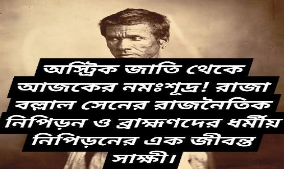
During the Sena period, the influence of Brahmanical social institutions increased in Bengal, and the system of Kulinism developed significantly. Later social traditions and some historical interpretations have associated King Ballala Sena with the social marginalization of lower-status communities. However, there is no clear contemporary evidence to support the simple conclusion that Ballala Sena personally declared the Namasudras to be “Chandalas.” The development of social hierarchy during the Sena period therefore needs to be examined within the broader historical context of changing social and political institutions.
Several medieval religious and Puranic texts placed the Chandala among socially marginalized or outcaste groups. The Brihaddharma Purana, for example, classified various communities within a hierarchical social framework. Such texts are important sources for understanding the idealized concepts of caste and social order prevalent in their respective historical contexts. However, they should not automatically be treated as precise historical accounts of the ethnic origins or actual social identities of particular communities.
Religious Changes during the Pala and Sena Periods
Buddhism exerted considerable influence in Bengal during the Pala period. During the subsequent Sena period, Brahmanical institutions and social regulations became increasingly influential. Some later Namasudra traditions have connected this historical transition with the alleged social decline of their ancestors.
However, the claim that the ancestors of the Namasudras were predominantly Buddhist during the Pala period and that the Sena rulers deliberately transformed them into Chandalas should be treated with caution. Direct historical evidence for such a continuous and straightforward process is limited, and scholars have expressed differing views on the subject.
The Social Boycott Movement of 1872–73
The social boycott movement of 1872–73 in the Faridpur and Bakarganj regions represents an important episode in the history of the Namasudra struggle for dignity and social recognition. Following an incident involving a funeral or shraddha ceremony and the refusal of participation by members of the higher castes, members of the Namasudra community organized forms of social and economic protest.
They reportedly refused to provide various forms of labor and assistance to members of the socially dominant castes, including agricultural work and other customary services. Although the movement did not continue indefinitely, it contributed to the development of greater organization, solidarity, and a sense of self-respect within the Namasudra community.
Harichand Thakur, Guruchand Thakur, and the Matua Movement
The development of the Matua religious and social movement under the leadership of Sri Sri Harichand Thakur in the nineteenth century marked a significant new chapter in the history of the Namasudra community. The movement emphasized simple devotion, human dignity, the value of labor, and social equality.
Later, Guruchand Thakur placed education and social development at the center of the movement's activities. He played an important role in promoting education among the Namasudra community, establishing schools, and encouraging social organization. The Matua movement therefore became not only a religious tradition but also an important platform for social solidarity and community development.
From “Chandala” to “Namasudra”
Under British colonial rule, censuses and administrative classifications gave increasing political significance to community and caste identities. Nineteenth-century census reports commonly used the term “Chandala” for the community. In response, community leaders increasingly demanded recognition under the name “Namasudra.”
The term “Namasudra” became officially established in colonial administrative records through the 1911 Census. This change was more than a mere alteration of terminology. It was closely connected with the community's efforts to reject a stigmatized social identity and assert a distinct sense of dignity and self-respect.
Political and Social Advancement
During the first half of the twentieth century, the Namasudra community became increasingly active in education, agriculture, social organization, and politics. Constitutional reforms in colonial India also brought the question of political representation for marginalized communities into greater prominence.
One of the notable political figures associated with this broader historical development was Jogendra Nath Mandal. He became an important member of Pakistan's first Constituent Assembly and served as one of the country's early Law Ministers. He also played a significant role in the opening proceedings of the Constituent Assembly of Pakistan.
Conclusion
The history of the Namasudra community cannot be fully understood simply as a story of the rise and decline of a particular caste or social group. It is deeply connected with the evolution of caste-based social structures, the agrarian economy of Bengal, religious transformations, colonial census practices, and the struggle for modern political and social rights.
The transition from the stigmatized identity of “Chandala” to the community's assertion of the name “Namasudra,” the social protests of 1872–73, the development of the Matua movement, and the expansion of education and political organization together constitute an important history of the struggle for dignity, social recognition, and equal rights.
At the same time, there are differences between community memory, religious traditions, and modern historical scholarship concerning several aspects of this history. Therefore, a responsible understanding of Namasudra history requires not only respect for the community's collective memory and traditions but also careful examination of historical documents, census records, contemporary literature, and modern academic research. Such an approach allows the history of the Namasudra community to be presented with both dignity and historical integrity.