

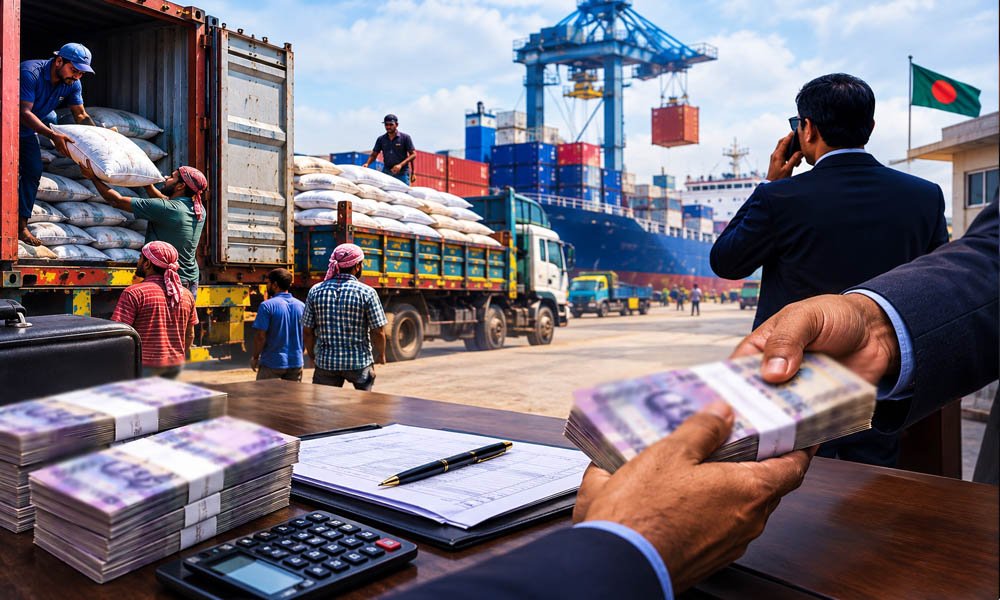
Bangladesh: Allegations of widespread irregularities and excessive collection of labour-handling charges have surfaced at Banglabandha Land Port, the country's only land port connected to three neighbouring countries. According to importers and local stakeholders, a significant amount of money is being collected from importers every year in the name of loading and unloading imported goods, although, they allege, the required loading services are often not provided.
At present, labour-handling operations at the port are reportedly being carried out by Banglabandha Land Port and Aftahi Trade International (ATI). Importers are charged Tk 76.83 per tonne for loading and another Tk 76.83 per tonne for unloading.
According to data provided by the Banglabandha Land Port authorities, the port handled approximately 1,516,140 tonnes of imported goods during the 2025–26 fiscal year. At a combined loading and unloading charge of Tk 153.66 per tonne, the total amount collected under these two heads would amount to approximately Tk 23.29 crore during the fiscal year.
Importers allege that they are being charged for loading and unloading services even when the services, particularly loading, are not actually provided. As a result, they say, they have to pay additional costs to have their goods loaded again, increasing their overall business expenses.
Some importers have also alleged that the additional costs are discouraging traders from using the land port, potentially affecting the volume of trade through the facility.
Allegations over ATI's involvement
The allegations have also raised questions about the continuation of ATI's involvement in labour-handling operations at the port.
According to local sources, Banglabandha Land Port authorities awarded a work order to Aftahi Trade International in 2018 for labour-handling services. The decision reportedly triggered protests and agitation in the area at the time.
Local stakeholders allege that ATI has continued to receive labour-handling responsibilities over the years despite questions surrounding the arrangement.
ATI is reportedly owned by Ruhul Amin, also known as Babul Hossain, who has been identified in local reports as a former chairman of Burimari Upazila Parishad and a former general secretary of the Burimari Upazila unit of the Bangladesh Awami League.
There are also allegations that a local network involving political figures, C&F agents and some traders has historically been involved in managing the labour-handling operation. However, these allegations could not be independently verified.
Labourers claim they receive only a portion of the charges
Aktarul Islam, president of the Banglabandha Land Port Workers' Association, alleged that the port authorities compulsorily collect loading and unloading charges from importers.
“We receive around Tk 42 to Tk 43 per tonne for unloading. Although loading is not carried out, the remaining amount is collected by Aftahi Trade International and the port authorities,” he alleged.
The allegation could not be independently verified.
Efforts were made to obtain a response from ATI proprietor Ruhul Amin Babul. He was contacted by phone and sent a text message seeking his comments on the allegations, but no response was received.
Port operator denies withholding loading services
Abul Kalam Azad, in-charge of Banglabandha Land Port Limited, rejected the allegation that importers are being charged without any provision for loading services.
“We want to load the imported goods for the importers. But the traders themselves do not want to have the stones loaded at the yard,” he said.
According to Azad, importers are refunded Tk 32 per tonne against the loading charge. He further said that the remaining amount is retained by the port authorities as port charges and for government taxes and VAT.
The conflicting statements from importers, workers and the port operator could not be independently reconciled.
The allegations have prompted calls from local traders and stakeholders for greater transparency in the collection and distribution of labour-handling charges at Banglabandha Land Port, as well as an independent review of the existing labour-handling arrangement.