

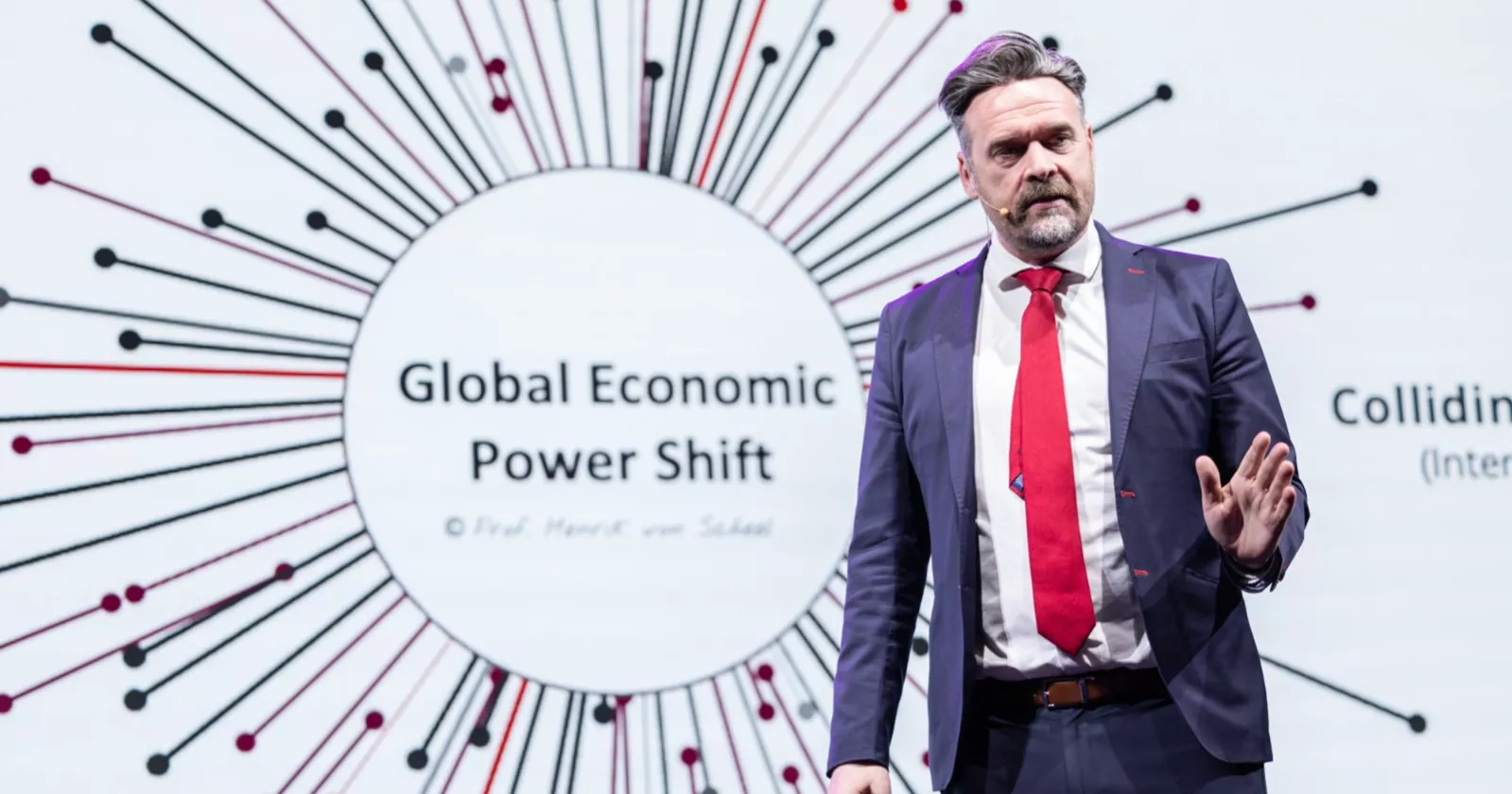
Bangladesh must invest in people, practical skills and emerging technologies rather than blindly chasing expensive AI solutions, said Prof Henrik von Scheel who is widely recognised as the originator of the ‘4th Industrial Revolution’ and a defining voice in the global digital agenda.
He said Bangladesh can strengthen its global competitiveness by embracing collaboration, adopting common AI standards and preserving its strong culture of social responsibility.
“Bangladesh is better prepared for the artificial intelligence (AI) era than many people believe, but the country must invest in people and practical skills,” the founder and president of the Institute of Strategic Intelligence told UNB in an interview. Colleges& Universities
Prof Henrik said the country's strong sense of community distinguishes it from many developed societies.
"If Bangladesh can preserve that spirit while investing in knowledge, innovation and people, its future is extremely promising," he said. "Nobody should go to bed hungry, and everyone should have the opportunity to build skills. That is the foundation of a stronger Bangladesh.”Prof Henrik said Bangladeshi businesses should avoid treating AI knowledge as a competitive secret and instead share best practices, particularly in robotic process optimisation, to accelerate innovation across industries.
"Bangladesh should develop standards on AI and robotic process optimisation," he said. "If businesses share what they learn instead of keeping it secret, the whole country becomes more competitive." Demographics
Prof Henrik also said Bangladesh's greatest strength lies in its people, describing them as resilient, optimistic and community-oriented despite facing economic and climate-related challenges.
"The optimism comes from the people," he said. "They are positive, they smile and they believe in the future even though life is not easy."Recalling his first evening in Dhaka, Prof Henrik said a motorcycle ride through the city gave him a glimpse of the warmth and generosity of ordinary Bangladeshis.
He said the country's strong family values and community spirit set it apart, adding that Bangladesh should adopt a simple national principle: "Nobody goes to bed hungry."
"People help each other here," he said. "That hope and compassion are Bangladesh's greatest strengths and give me confidence about the country's future."
During a visit to Dhaka last week, Prof Henrik attended a roundtable discussion titled "AI Futures for Bangladesh: Challenges and Prospects," hosted by the EELAIA Foundation, conducted a two-day AI masterclass for business leaders, and held discussions with policymakers. The futurist said Bangladesh possesses the talent and industrial capability to embrace AI without sacrificing jobs, provided it adopts a people-centred strategy.
"I came here expecting to teach AI, but I left impressed," he said. "Bangladesh is not behind in AI. The skills are here. People understand industry, they learn quickly and they are ready to implement AI."
The masterclass brought together executives from Bangladesh's leading textile manufacturers, pharmaceutical companies, banks, steel producers and food-processing industries. Demographics
According to him, many participants initially believed AI simply meant using consumer tools such as ChatGPT and other generative AI platforms.
Over the two-day programme, however, they developed a broader understanding of AI applications in business operations, industrial automation and government services.
"They realised AI is much more than chatbots," Prof Henrik said. "By the end of the programme, most participants had designed roadmaps for moving from manual operations to automation, from automation to digitalisation and ultimately to intelligent organisations."
Willingness to Learn
He praised Bangladeshi companies for their willingness to learn and said executives quickly grasped concepts such as robotic process optimisation, AI-driven workflows and automation without depending entirely on costly foreign software.
"The exciting part was that they understood they don't always need expensive international solutions," Prof Henrik said. "Many AI tools can be developed internally, reducing costs while improving productivity and services."
Despite the enthusiasm surrounding AI, the futurist urged governments and businesses to move beyond what he described as the "hype" surrounding the technology.
"AI is not intelligence," he said. "It predicts patterns based on data. It doesn't truly understand what it produces, and that means human judgment remains essential."
He also warned that excessive dependence on generative AI could weaken human creativity and critical thinking, particularly among young people.
"We learn by making mistakes," Prof Henrik said. "If students receive answers without understanding how they are reached, they lose the opportunity to develop real skills."
Drawing an analogy with GPS navigation, Prof Henrik argued that relying too heavily on AI could gradually reduce people's natural problem-solving abilities.
"When we stop thinking for ourselves, we lose capabilities that humans have developed over thousands of years," he said.
Addressing widespread concerns that AI will eliminate jobs, he rejected the idea that automation necessarily leads to mass unemployment.
Instead, he said Bangladesh should focus on automating repetitive, non-core business functions while investing in workers so they can perform higher-value roles. Demographics
"Technology should not replace people," Prof Henrik said. "It should enable people to do better work."