

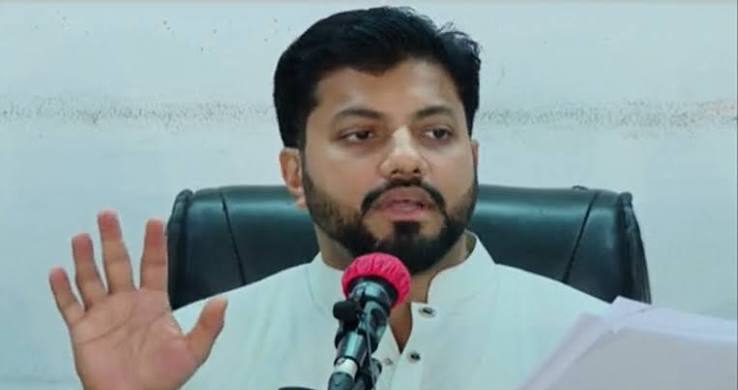
In Dhaka’s political arena, Ishraq Hossain has emerged as one of the prominent leaders of the younger generation to establish a distinct identity of his own. As the son of the late BNP leader, former mayor, minister and parliamentarian Sadeque Hossain Khoka, Ishraq inherited a strong political legacy. Over time, however, his active participation in politics, organisational role and consistent presence on the streets have helped him build an identity beyond that of his father’s son.
Ishraq Hossain was born on April 5, 1987. He spent his childhood and adolescence in Dhaka. After completing his education at Scholastica School in the capital, he pursued higher education in the United Kingdom, earning degrees in Mechanical Engineering from the University of Hertfordshire. After completing his studies, he spent some time working professionally in the UK before becoming actively involved in Bangladeshi politics. His association with Sadeque Hossain Khoka remains an important part of his political identity, but his subsequent activities have increasingly shaped his own profile.
Sadeque Hossain Khoka was a participant in Bangladesh’s Liberation War and a prominent leader of the Bangladesh Nationalist Party (BNP). He served as a member of parliament, a minister and the mayor of the undivided Dhaka City Corporation. As a result, Ishraq’s entry into politics was influenced by a strong political family background. At the same time, he faced the challenge of establishing himself in a political landscape where his father had already left a significant legacy.
Ishraq’s visible rise in electoral politics came through the Dhaka South City Corporation election. In the 2020 mayoral election, he contested the race as the BNP-nominated candidate. According to the initial results, he received more than 236,000 votes. He later challenged the election result through the appropriate electoral tribunal. On March 27, 2025, the election tribunal cancelled the results of the 2020 election and declared Ishraq Hossain the winner, while ordering the cancellation of the gazette declaring Sheikh Fazle Noor Taposh as the elected mayor.
Ishraq has also maintained a strong presence in street politics for years. He has been actively involved in various political programmes, protests and party-led movements. In 2022, reports emerged of his arrest from Motijheel during a BNP programme. In 2023, a case was also filed over an attack involving him. Such incidents have further highlighted his active engagement in grassroots and street-level politics.
One of the notable features of Ishraq’s political activities is his close communication with party leaders and activists. He has regularly been seen participating in BNP programmes and standing alongside party workers during political movements. His supporters believe that his direct engagement with activists and his willingness to remain with them during difficult periods have helped him develop a strong organisational base within the BNP’s politics in Dhaka.
His supporters portray him as a courageous and committed leader who is willing to take political risks and remain on the streets alongside party activists. Political opponents, however, may naturally have different assessments of his role and popularity. Nevertheless, his continued presence in political programmes has made him one of the more recognisable faces of the BNP’s younger generation in Dhaka.
Ishraq’s political position is also closely linked to the ideological legacy of the BNP. He has publicly expressed his commitment to the political ideals of BNP founder and former president Ziaur Rahman, as well as his respect for former prime minister and BNP Chairperson Khaleda Zia and the leadership of BNP Chairman Tarique Rahman. His political statements and activities have repeatedly reflected his loyalty to the party and its leadership.
In the 2026 general election, Ishraq Hossain contested the Dhaka-6 constituency as a BNP candidate. He won the election with 78,850 votes, defeating his nearest rival, Jamaat-e-Islami candidate Md. Abdul Mannan, who received 55,697 votes. Ishraq therefore won the seat by a margin of 23,153 votes, marking another significant milestone in his political career.
Following his election to parliament, Ishraq Hossain assumed the position of State Minister for the Ministry of Liberation War Affairs. His appointment marked a new phase in his political career, taking him beyond street politics and into the national parliamentary and governmental arena.
Even after becoming a parliamentarian and state minister, however, speculation about his political future in Dhaka has continued. In February 2026, Ishraq expressed his interest in contesting the Dhaka South City Corporation mayoral election. He later indicated that he could participate in the city corporation election if his party nominated him.
Perhaps the most significant feature of Ishraq Hossain’s political journey is his continued engagement with grassroots politics. His family background undoubtedly opened the door to politics, but his prolonged involvement in political activities, confrontations with legal and political challenges, arrests and participation in party programmes have gradually helped him develop an identity of his own.
For decades, the names of leaders such as Sadeque Hossain Khoka, Mirza Abbas and Mostafa Mohsin Montu were closely associated with the politics of Dhaka. As political generations have changed, a new group of leaders has emerged. Ishraq Hossain is now considered one of the prominent figures of that younger generation.
The challenges before him are also greater than ever. Alongside his responsibilities as a parliamentarian and state minister, he faces the task of strengthening his organisational position within the party and consolidating his influence in Dhaka’s complex urban political landscape.
Political inheritance can provide an initial platform, but a leader’s long-term position is ultimately determined by his performance, political strategy, public engagement and organisational ability. Ishraq Hossain’s political journey will therefore continue to be closely watched. Whether he ultimately emerges as one of the country’s influential national political figures will depend not only on his family legacy, but also on how effectively he uses his own political experience, public support and organisational strength in the years ahead.