

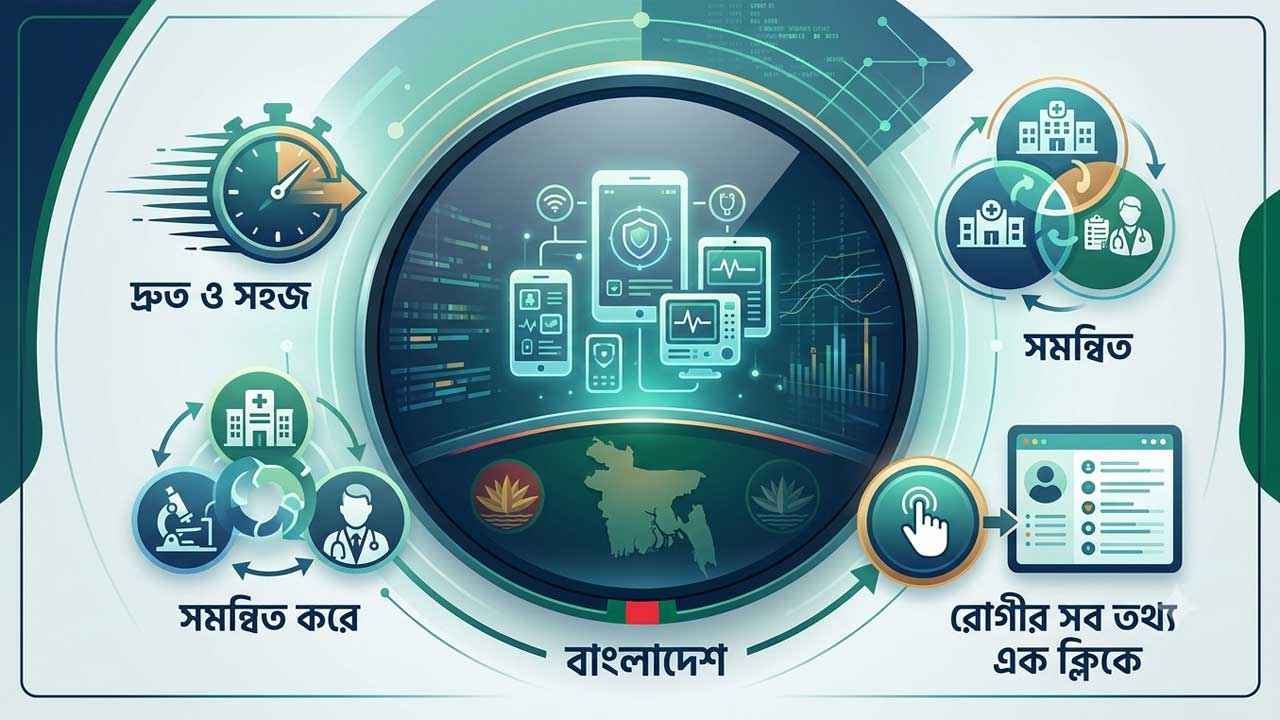
The BNP-led government has undertaken a series of ambitious initiatives aimed at transforming Bangladesh’s healthcare sector into a technology-driven, integrated, and accountable system. The plan seeks to bring every stage of healthcare delivery under a unified digital platform, making patient management, treatment, medicine supply, referrals, financial transactions, and policymaking more efficient and effective. Stakeholders view the initiative as a potential digital revolution in the country's healthcare sector.
Under the proposed framework, more than 114 existing digital health initiatives currently operating in isolation will be integrated into a single platform. The government also plans to establish a National Digital Health Authority, introduce an artificial intelligence-based e-prescription system, create a centralized patient database, develop a national ambulance network, and launch a universal Digital Health Card. These measures are intended to make healthcare services faster, more transparent, and more citizen-friendly.
The Ministry of Health and Family Welfare has already submitted a project proposal titled “Preparatory Activities for the Digital Transformation Program of the Health Sector” to the Planning Commission. The project, estimated to cost approximately BDT 168 crore, will receive around BDT 159 crore in loan assistance from the Asian Development Bank (ADB). The initiative aims to integrate existing digital health programs while developing the necessary software, hardware, and technological infrastructure to digitize healthcare, nutrition, and population services across all five levels of the healthcare system, from community clinics to tertiary-level hospitals.
According to officials, although multiple digital systems are currently operating under different departments and institutions, there is little effective data exchange among them. As a result, patient information often has to be collected repeatedly, continuity of care is disrupted, and policymakers face challenges due to the lack of reliable data. The new project will include baseline surveys, feasibility assessments, and the development of a long-term digital health roadmap. In addition, a National Digital Health Authority will be established to oversee information management, technological standards, inter-institutional coordination, and data security.
As part of the initial phase, a pilot digital healthcare system and plastic-based health card will be introduced in Khulna district. Based on the lessons learned from the pilot project, the program will gradually be expanded nationwide. The proposal has recently been reviewed by the Special Project Evaluation Committee under the Social Infrastructure Division of the Planning Commission. The committee emphasized the importance of data security, privacy protection, institutional capacity building, and clearly defining the responsibilities of the proposed authority.
One of the key advantages of the digital healthcare system will be easy access to patients’ medical histories. Currently, when a patient is referred from a district hospital to a medical college hospital, previous medical records are often unavailable. This frequently results in repeated diagnostic tests, causing unnecessary costs and delays. Under the new system, healthcare providers at any government health facility will be able to instantly access a patient’s treatment history, diagnostic reports, prescriptions, referrals, and follow-up records. This is expected to improve the quality of treatment and enhance the efficiency of healthcare management.
Another major component of the initiative is the introduction of a nationwide AI-powered e-prescription system. Every prescription issued by a physician will be digitally stored, creating a comprehensive medical history for each patient. Prescription audits will also help monitor unnecessary antibiotic use, multiple prescriptions for the same patient, and other irregularities in medical practice. Health Ministry officials believe that the system will significantly enhance transparency in healthcare delivery and support evidence-based policymaking.
The government’s digital health agenda also includes integrating hospital management, patient referrals, medicine supply chains, billing systems, and financial transactions into a single digital framework. These commitments are reflected in the BNP’s election manifesto, which outlines plans for digital hospital management, national e-prescriptions, prescription audits, real-time referral systems, a national ambulance network, and technology-based emergency healthcare services.
Prime Minister’s Special Assistant on Health Affairs, S. M. Ziauddin Haider, stated that the government plans to recruit 100,000 new healthcare workers and 25,000 midwives over the next three to four years. Initiatives are also underway to establish health units at union and ward levels, upgrade Upazila Health Complexes to 100-bed facilities, and strengthen integrated maternal and neonatal healthcare services. The government also intends to ensure international-standard training for midwives before deployment.
He further emphasized that no community clinic in the country will be closed. Instead, existing community clinics will be incorporated into an integrated primary healthcare network, enabling healthcare workers to deliver services directly to people's homes. This approach is expected to strengthen preventive healthcare, maternal health services, child immunization programs, nutrition services, and primary disease detection.
The government’s commitment to healthcare reform is also reflected in the proposed national budget for the 2026–27 fiscal year. A total allocation of BDT 69,409 crore has been proposed for the Ministry of Health and Family Welfare, nearly double the revised allocation of the previous fiscal year. The allocation represents approximately 1.01 percent of the country’s Gross Domestic Product (GDP). The government has also set a long-term target of increasing public healthcare expenditure to 5 percent of GDP.
The budget proposal includes plans to establish at least one modern primary healthcare unit in every union and one or more units in every urban ward. Additionally, under the Universal Health Coverage initiative, every citizen will gradually receive a Digital Health Card. The card will store treatment histories, diagnostic reports, prescriptions, and referral information on a unified platform, enabling healthcare providers to make informed decisions more quickly.
However, experts caution that digital healthcare cannot succeed through technology alone. Ensuring secure data storage, protecting personal privacy, strengthening cybersecurity, expanding reliable internet infrastructure, training healthcare personnel, and establishing sustainable maintenance systems will be essential. Effective coordination among government institutions and the adoption of common data standards will also be crucial for maximizing the benefits of digital healthcare.
According to the Centre for Policy Dialogue (CPD), the true success of digital healthcare depends not merely on technology but on building a patient-centered healthcare system. The organization argues that the ultimate goal should be to create a connected healthcare ecosystem in which a patient’s journey—from community clinics to hospitals, from prescriptions to pharmacies, and from preventive care to follow-up treatment—is managed within a unified framework.
Experts believe that with proper planning, effective implementation, and strong governance, the government’s initiative could mark the beginning of a new era in Bangladesh’s healthcare sector. Beyond improving the quality of medical services, digital healthcare has the potential to increase accountability, reduce costs, and ensure accessible healthcare services for all citizens.