

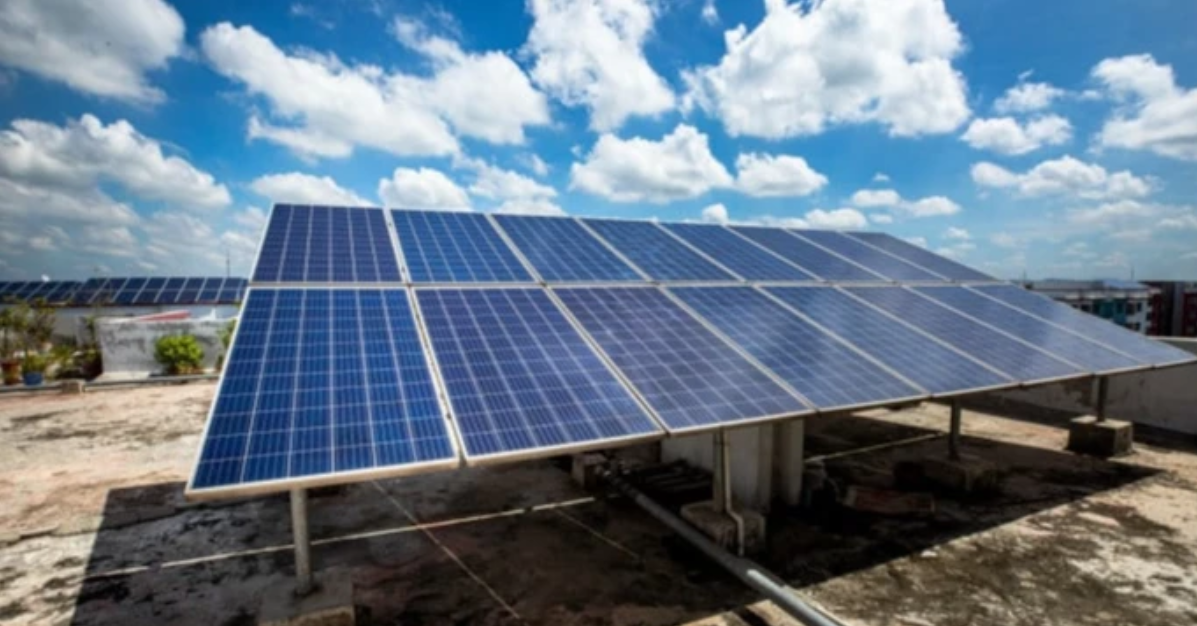
The Special Solar Power Installation Bill, 2026 aimed at accelerating the rollout of small-scale solar power across the country was placed in Parliament on Wednesday, seeking to turn an existing ordinance into a full-fledged law.
State Minister for Power, Energy and Mineral Resources Aninda Islam Amit, in absence of the Minister, moved the Special Solar Power Installation Bill, 2026 and it was passed by voice vote.
If passed, the legislation will repeal the Special Solar Power Installation Ordinance, 2026 (Ordinance No. 39 of 2026), which was promulgated on October 19 this year.
The bill states that the law will be deemed to have come into force on that date. Actions taken and steps adopted under the ordinance will be treated as having been taken under the new law.
The bill defines a "special solar power system" as an installation of up to 5 megawatts on rooftops, courtyards or other suitable sites of government, semi-government, autonomous and local government institutions, state-owned company premises and residential buildings.
It also covers solar-powered irrigation pumps, solar-run cold storage facilities, electric vehicle (EV) charging stations, tea garden rooftops and adjoining fallow land, floating solar and agro-voltaic systems. Large land-based solar plants are excluded.
Under the proposed law, special solar systems will be installed on a priority basis under the OPEX (Operational Expenditure) model, in which a service provider finances, operates and maintains the system at a suitable site.
Institutions with their own funds or regular income may, in the future, set up systems under the CAPEX (Capital Expenditure) model, subject to financial feasibility.
The competent authority will prepare and maintain district-wise lists of eligible service providers, simplifying the existing enlistment process. Customers will select a provider from the listed companies through competition. A customer may also opt to install a system through an open tender without a service provider.
A tripartite agreement will be signed among the customer, the service provider and the competent authority. The government will fix a standard contract format through a notification.
The contract will cover issues including equipment quality and safety standards, the safe collection, recycling and disposal of electronic waste, and a take-back scheme for equipment that has expired or is no longer usable. It will also address the distribution of generated electricity, the minimum share for customers and the rates for consumption beyond that share.
Notwithstanding the Public Procurement Act, 2006, the Invest Bangladesh Act, 2026 and the Public Procurement Rules, 2023, the bill sets the financial limit for limited tendering for goods and related services under the CAPEX model at up to Tk 5 crore.
Use of the electronic government procurement (e-GP) system will not be mandatory for the related procurement. For approval of tripartite contracts, the authority one level above the procuring entity will act as the approving authority.
The bill defines net metering as a two-way metering and billing arrangement in which a customer uses solar power generated at the site for own needs and supplies surplus electricity to the national grid. The amount supplied is adjusted against the electricity bill within the billing period, and any remaining surplus is paid for at the government-determined tariff.
The government or an authorised institution may announce net-metering incentive programmes to help achieve national renewable energy targets. The Sustainable and Renewable Energy Development Authority (SREDA) will keep records of all such systems on its website and regularly monitor whether they remain operational.
The bill provides for a National Policy Council, headed by the Prime Minister, to provide policy direction. Its members will include the Leader of the Opposition, ministers concerned, the Cabinet Secretary, the Principal Secretary to the Prime Minister, the National Board of Revenue chairman and the secretary of the Power Division, who will serve as member-secretary.
At the local level, a District Technical and Coordination Committee, chaired by the deputy commissioner, and an Upazila Technical and Coordination Committee, chaired by the upazila nirbahi officer, will oversee implementation. District committees will submit progress reports to the council every three months, while upazila committees will report to district committees monthly.
The bill proposes jail terms of up to three years or a fine of up to Tk 50,000, or both, for stealing electricity or components from a special solar system, or for knowingly buying, selling or possessing stolen components.
Damaging any component of a system will carry up to five years' imprisonment or a fine of up to Tk 5 lakh, or both. Providing illegal connections without written permission from the competent authority, or obstructing installation, inspection or maintenance work, will be punishable by up to three years' jail or a fine of up to Tk 5 lakh, or both.
Offences under the law will be tried by a first-class magistrate or a metropolitan magistrate and, subject to inclusion in the schedule of the Mobile Court Act, 2009, may also be tried by mobile courts.
In the statement of objectives of the Bill, it said the law was needed to meet growing power demand, reduce dependence on imported fossil fuels, ensure energy security and achieve national renewable energy targets.
It said the National Renewable Energy Development Strategy Paper 2026-2030 had been formulated and an incentive announced for purchasing surplus grid-supplied electricity from rooftop solar systems until 28 February 2027.
The ordinance was issued because existing laws did not allow solar power activities on such rooftops and premises, the statement added.