

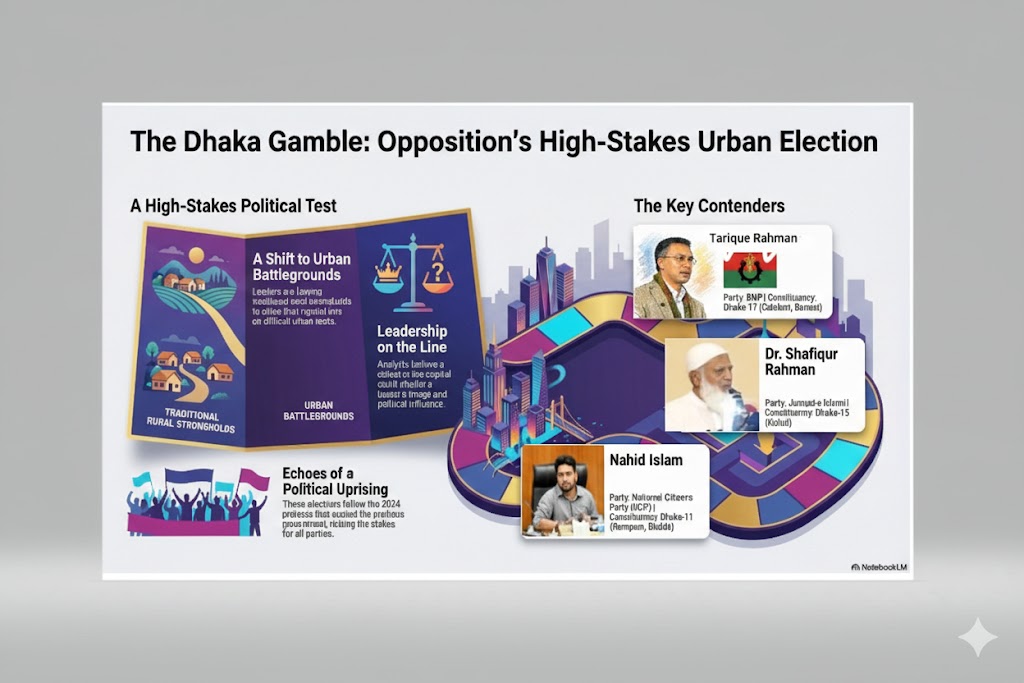
As Bangladesh prepares for the 13th parliamentary elections on 12 February, political tensions and strategic calculations in the country have reached a new level. Breaking from long-standing norms, several prominent leaders from opposition alliances have decided to contest key, highly competitive constituencies in the capital, Dhaka. Political analysts say this is not only a personal political gamble but also a critical test of the future trajectory of opposition politics in the country.
Traditionally, senior political leaders prefer to contest relatively safe rural constituencies or strongholds. This year, however, the situation is markedly different. Leaders from the Bangladesh Nationalist Party (BNP), Jamaat-e-Islami, National Citizens Party (NCP), and Bangladesh Khelafat Majlis are preparing to face Dhaka’s densely populated, politically aware, and multifaceted electorate.
Although nationwide election campaigning has created a festive atmosphere, Dhaka’s constituencies are experiencing heightened political tension. Posters, rallies, and public meetings, coupled with counter-accusations among rival leaders, have intensified the political heat in the capital. From affluent neighborhoods to middle- and lower-income areas, candidates are meticulously calculating their voter strategies.
Observers note that these contests in Dhaka are about more than individual seats. They serve as a litmus test for the political credibility, organizational strength, and leadership capacity of the respective parties.
Among the most closely watched candidates is BNP Chairman Tarique Rahman, the eldest son of former Prime Minister Khaleda Zia. He is contesting Dhaka-17, which includes affluent and strategically significant areas such as Gulshan and Banani. His candidacy, announced at the end of December, triggered a significant stir within the BNP, prompting a party ally to withdraw from the race as part of broader electoral strategy.
Rahman’s main rival in Dhaka-17 is Dr. Khaliduzzaman of Jamaat-e-Islami. Campaigning on a platform of democratic restoration, political stability, and security, Rahman told supporters at a rally: “People want change. People want security.” He also highlighted alleged political repression over the past 15 years.
In Dhaka-15, Jamaat-e-Islami Amir Dr. Shafiqur Rahman is contesting as an independent candidate. Although he was defeated here in 2018 under the BNP banner, he is now campaigning on a platform of “inclusive development” and citizen empowerment. He stated, “Empowering every citizen is the only way to build a sustainable and just nation.” His main competitor in the constituency is BNP’s Shafiqul Islam Milton.
In Dhaka-11, National Citizens Party (NCP) convener Nahid Islam is running with the support of a political alliance formed with Jamaat in June. He has accused opponents of intimidating his supporters. Addressing voters, Nahid Islam said, “No rigging can succeed if there is public support. Voters themselves will safeguard their choices.” His principal opponent is Dr. M.A. Quayum of BNP.
In Dhaka-13, Maulana Mamunul Haq, leader of Bangladesh Khelafat Majlis and candidate of the unified opposition alliance, is emphasizing religious values, social reform, and political unity. He stated: “We have not forgotten the sacrifices of martyrs from 1971 to the 2024 uprising. The politics of division must end here.” His main rival is former NDM leader Bobby Hajjaj, contesting on the BNP symbol.
Political analysts describe these high-profile candidacies in Dhaka as a high-risk political gamble. One analyst, speaking on condition of anonymity, said: “Defeat in Dhaka is more than losing a seat; it can severely damage a leader’s political image and credibility. Dhaka voters are discerning, and decisions are often driven by reason and practical judgment rather than emotion.”
Historical trends provide some caution. In the 1991 elections, Awami League leader Sheikh Hasina lost two seats in Dhaka. In 2008, Jatiya Party leader H.M. Ershad won Dhaka-17 with a substantial vote margin. While the Awami League has generally dominated the capital in recent cycles, many of those elections were affected by opposition boycotts.
The 2024 mass uprising, which led to the fall of Sheikh Hasina’s government and the assumption of interim rule, has significantly heightened the political stakes of this election. At the same time, concerns over voter intimidation, control of polling centers, and election irregularities persist.
The 20 parliamentary constituencies in Dhaka now reflect the broader political divisions and realignment across the country. The outcome here could shape new alliances and reveal the true strengths and weaknesses of opposition politics.
With the memory of the 2024 uprising still fresh in public consciousness, victory in Dhaka is not merely a matter of electoral success; it is widely seen as a measure of the opposition’s survival, credibility, and potential resurgence, analysts say.