

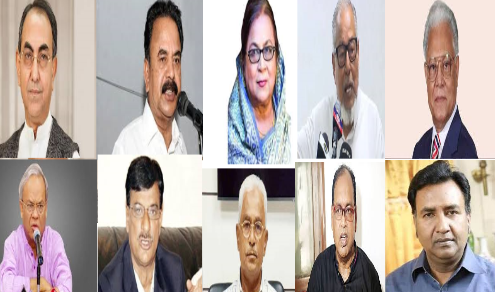
In the politics of the Bangladesh Nationalist Party (BNP), several leaders are repeatedly cited for their sacrifice, endurance in the face of repression, and long organizational experience. Among them are Mirza Abbas, Goyeshwar Chandra Roy,Air Vice Marshal (Retd.) Altaf Hossain Chowdhury,Shamsuzzaman Dudu, Ruhul Kabir Rizvi, Selima Rahman, Nazrul Islam Khan, Moezzem Hossain Alal, Zainal Abedin Farroque, Habibun Nabi Sohel and Ruhul Quddus Talukder Dulu. According to party sources, their contributions are deeply intertwined with the history and evolution of the BNP. A section of party activists believes that failing to properly evaluate and recognize such tested and dedicated leaders would not merely harm individuals, but could also prove detrimental to the party in the long run.
A Long History of Sacrifice and Repression
Throughout the BNP’s political journey, Goyeshwar Chandra Roy has faced repeated imprisonment, lawsuits, attacks and physical assault. In recent years, he has reportedly been subjected to police baton charges while participating in party programs. An incident in which the septuagenarian leader was beaten on the streets drew significant public and political attention. Party workers argue that these experiences have made him not only a victim of repression but also a symbol of the party’s struggle-oriented politics.
From Student Politics to National Leadership
Goyeshwar Chandra Roy began his political career in the 1960s. He was a student of philosophy at University of Dhaka and became involved in student politics through Jagannath Hall. He was first associated with the then East Pakistan Chhatra League and later with JASAD Chhatra League. Following Bangladesh’s independence and the subsequent shifts in political dynamics, his political alignment evolved.
In 1978, at the call of former President Ziaur Rahman, he joined BNP politics and became actively involved through the Jubo Dal, the party’s youth wing. His role during the formative years of the party placed him among its early and seasoned organizers.
Architect of Organizational Expansion
From 1987 to 2002, Roy served as the General Secretary of the central Jubo Dal for nearly 15 consecutive years. During this time, he traveled extensively across the country to strengthen the organization at the grassroots level. He played a key role in forming committees, recruiting activists, and implementing political programs nationwide.
According to party leaders, many youth activists nurtured under his leadership later assumed important positions within the BNP. The generation of leaders that emerged from Jubo Dal is widely seen as having reinforced the party’s organizational foundation.
Rise to the BNP’s Top Leadership
In 2002, Roy was promoted to the position of Joint Secretary General of the BNP. Later, in 2009, he became a member of the party’s highest policymaking body, the Standing Committee. In this capacity, he has been involved not only in organizational matters but also in shaping party strategy and policy decisions. His public statements and political stances on key national issues have frequently drawn attention among party ranks.
Influence Among Minority Communities
An important aspect of Roy’s political identity is that he belongs to the Hindu minority community and is one of the BNP’s most prominent leaders from that background. Party activists claim that although a significant portion of minority voters have historically leaned toward other political forces, Roy’s presence within the BNP has encouraged greater participation from segments of the minority community.
According to party sources, minority student leaders at various colleges and universities often view him as a reference point in national politics. During election campaigns, local BNP leaders have reportedly cited his political journey to reassure minority voters about their representation within the party.
The Context of “Vote Bank” Politics
In Bangladesh’s electoral discourse, minority votes are often described as a “vote bank,” reflecting a perception that they tend to consolidate behind particular political forces. Analysts have long debated this trend. In recent political developments, BNP leaders have claimed that a portion of minority voters have shown growing confidence in their party.
However, political analysts caution that assertions of unified or near-total support from any community require careful statistical verification. Only detailed surveys and electoral analyses can provide a clearer understanding of actual voting behavior.
The Question of Recognition and Future Challenges
Within party politics, the proper recognition of long-standing sacrifice and organizational contributions is considered crucial for maintaining morale among grassroots activists. Observers note that the BNP now faces the challenge of balancing experienced leadership with the aspirations of a new generation of politicians.
Supporters of Goyeshwar Chandra Roy argue that ensuring due respect and meaningful roles for leaders of his stature would strengthen internal unity and consolidate the party’s base. On the other hand, political analysts suggest that long-term sustainability depends less on individual prominence and more on institutional strength and policy-driven politics.
In sum, Goyeshwar Chandra Roy’s political career represents a significant chapter in the history of the BNP. His record of sacrifice, organizational leadership, and influence among minority communities continues to be discussed within political circles. How effectively the party utilizes his experience and political capital in the coming years remains an important question for observers and supporters alike.