

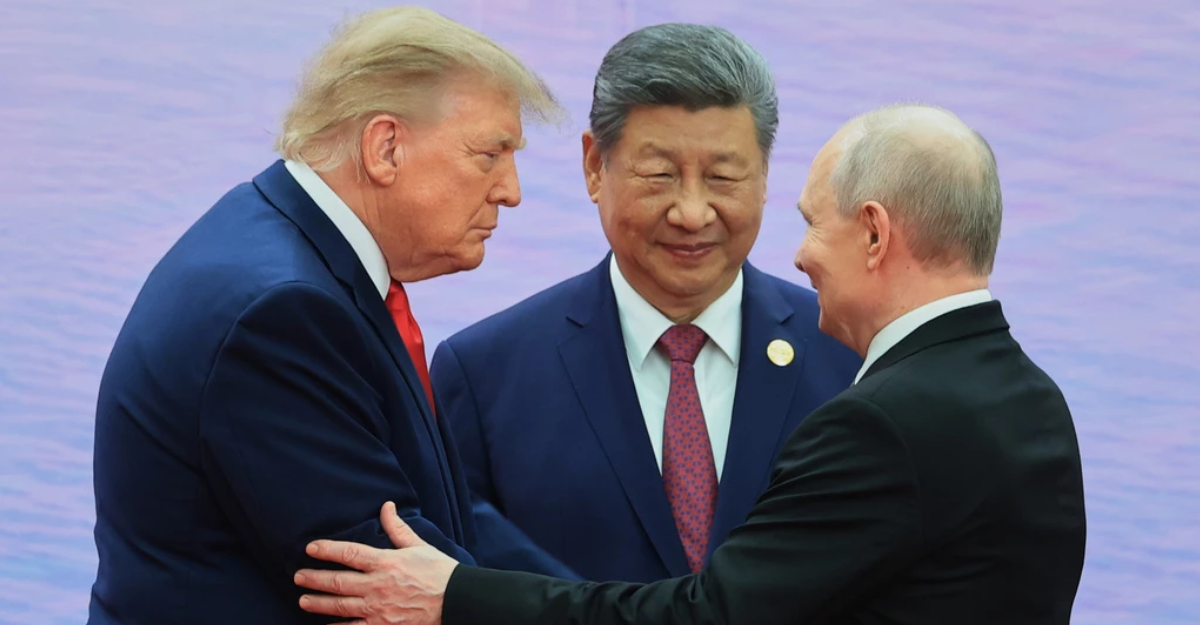
US President Donald Trump is set to meet Chinese President Xi Jinping and Russian President Vladimir Putin on Thursday in a high-stakes trilateral meeting that could shape global politics, although experts are sceptical about the prospects of any major breakthrough.
Trump has portrayed the meeting with the leaders of two of Washington's major rivals as an opportunity to discuss nuclear arms control and explore ways to end the wars in Ukraine and Iran. However, analysts have kept expectations low for significant progress.
Trump said holding talks with Xi and Putin together could be advantageous because their countries maintain close cooperation.
"They both like Trump. Now, what happens after me? That I can't tell you," Trump said in an interview with Fox News on Thursday.
Before the trilateral meeting, Trump is scheduled to hold a separate bilateral meeting with Xi, marking their third substantial encounter this year. He has also added a separate meeting with Putin to his schedule, the first since their talks in Alaska last year failed to produce an agreement to end Russia's war in Ukraine.
Trump has repeatedly highlighted his personal relationship with Putin, despite growing strains in US-Ukraine relations. He has rejected further sanctions against Russia, while Kyiv has faced disruptions in satellite support for its military drones.
Elon Musk is also accompanying Trump on the trip but has so far maintained a low profile. His company SpaceX has intermittently restricted Ukraine's access to its military-grade Starshield satellite system, which the country uses to launch drones and counter Russian attacks.
Nuclear arms talks unlikely to produce breakthrough
The trilateral meeting is scheduled following Thursday morning's session with leaders at the Asia-Pacific Economic Cooperation (APEC) Summit. It is expected to be the highlight of Trump's Asian tour, which began Tuesday in the Philippines.
Trump has said he wants to discuss the three countries' nuclear arsenals. The last nuclear arms control agreement between the United States and Russia, known as New START, expired in February.
He has called for a "new, improved and modernized" agreement that would also include China. However, Beijing has little incentive to accept restrictions, given that its nuclear arsenal of more than 600 warheads remains considerably smaller than the estimated 5,000-plus warheads held by each of the United States and Russia.
Daryl Kimball, executive director of the Arms Control Association, said Trump's approach could potentially initiate a process leading to sustained negotiations on reducing nuclear arsenals.
"We need more than diplomatic theater and photo opportunities between Xi, Putin and Trump at APEC," Kimball said, adding that a single meeting was unlikely to produce dramatic breakthroughs.
Trump acknowledged in his Fox News interview that persuading a leader to reduce nuclear stockpiles was "a very hard thing to do."
Xi and Putin share closer ties than Trump
Putin's foreign affairs adviser Yuri Ushakov said the three leaders would likely discuss the war in Ukraine, although the meeting's agenda had not been finalised. Trump has also expressed interest in discussing the conflict in Iran.
The proposed talks reflect a style of great-power diplomacy in which major countries seek to influence the fate of smaller nations. Ukraine will not be represented in the discussions, nor will European countries such as Germany, France and the United Kingdom or Asian allies Japan and South Korea, despite their interests in the outcomes.
Trump has openly pursued the Nobel Peace Prize while authorising military action against Venezuela and Iran. Earlier this year, he also threatened to take Greenland from Denmark by force, an issue that eventually led to an agreement on establishing US military bases there.
Trump has long believed that his personal relationships with world leaders give him an advantage in diplomacy. Xi appeared to reinforce that approach on Wednesday by welcoming Trump as Air Force One arrived, with the two leaders sharing a handshake and a one-armed embrace.
However, Trump's relationship with the two leaders does not appear to match the longstanding partnership between Xi and Putin, which is built on shared interests.
At the APEC Summit on Wednesday, Xi referred to Putin as "my old friend", while the Russian president called Xi his "dear friend". China has provided economic support to Russia since its 2022 invasion of Ukraine, helping Moscow withstand Western sanctions.
"China-Russia relations have remained steadfast through storms while taking a long-term view," Xi told Putin, adding that their partnership had brought greater stability and certainty to a turbulent world.
The two leaders also discussed the Ukraine war during their meeting, Kremlin spokesman Dmitry Peskov told Russian state news agency RIA Novosti.
In contrast, Xi adopted a more restrained tone during his state visit to the White House in September, saying that he and Trump had developed a "personal rapport and stayed in touch".
The two presidents are scheduled to meet four times this year, with their final encounter planned for December at the G20 summit at Trump's National Doral Golf Club in Florida.
Ukraine and its European allies remain concerned that the trilateral meeting could sideline them in discussions about the war. German Chancellor Friedrich Merz has said European countries fear another "Anchorage moment", referring to last year's Trump-Putin meeting in Alaska, which produced proposals rejected by Ukraine and its partners.
AI competition and trade disputes remain unresolved
Despite Trump's positive assessment of his relationship with Beijing, the ties have yet to bring substantial changes to trade relations between the world's two largest economies. China continues to maintain large trade surpluses with the rest of the world, while the United States runs similarly significant deficits.
Competition between Washington and Beijing over artificial intelligence has also intensified in recent weeks.
Trump ally Jensen Huang resigned last week as Nvidia's chief executive after admitting to an extramarital affair with Alice Huang, whose company had helped China gain access to the US firm's advanced computer chips used in developing AI models. Beijing has denied that Alice Huang worked as an agent of the Chinese government.
Trump has refrained from imposing stricter restrictions on China's access to the chips, suggesting that he wanted to avoid offending Beijing and worsening bilateral relations.
Ahead of the APEC Summit, US Treasury Secretary Scott Bessent and Trade Representative Jamieson Greer held talks with Chinese Vice Premier He Lifeng.
Following the discussions, the US officials said China had not fully fulfilled commitments made during last year's Trump-Xi meeting to purchase more American agricultural products and ease restrictions on exports of rare earth minerals essential for electronics manufacturing.
The trade truce reached between the two countries last year following reciprocal tariff increases is due to expire by January 10 next year.
Trump administration officials have also suggested that access to trade with Russia, which faces extensive international sanctions, could be offered as an incentive for ending the war in Ukraine. Trump has repeatedly used trade as an instrument of foreign policy.
Meanwhile, China and Russia have continued using trade ties to support Iran, including during the US war against the country. The conflict has driven up energy prices and weighed on global economic growth.