

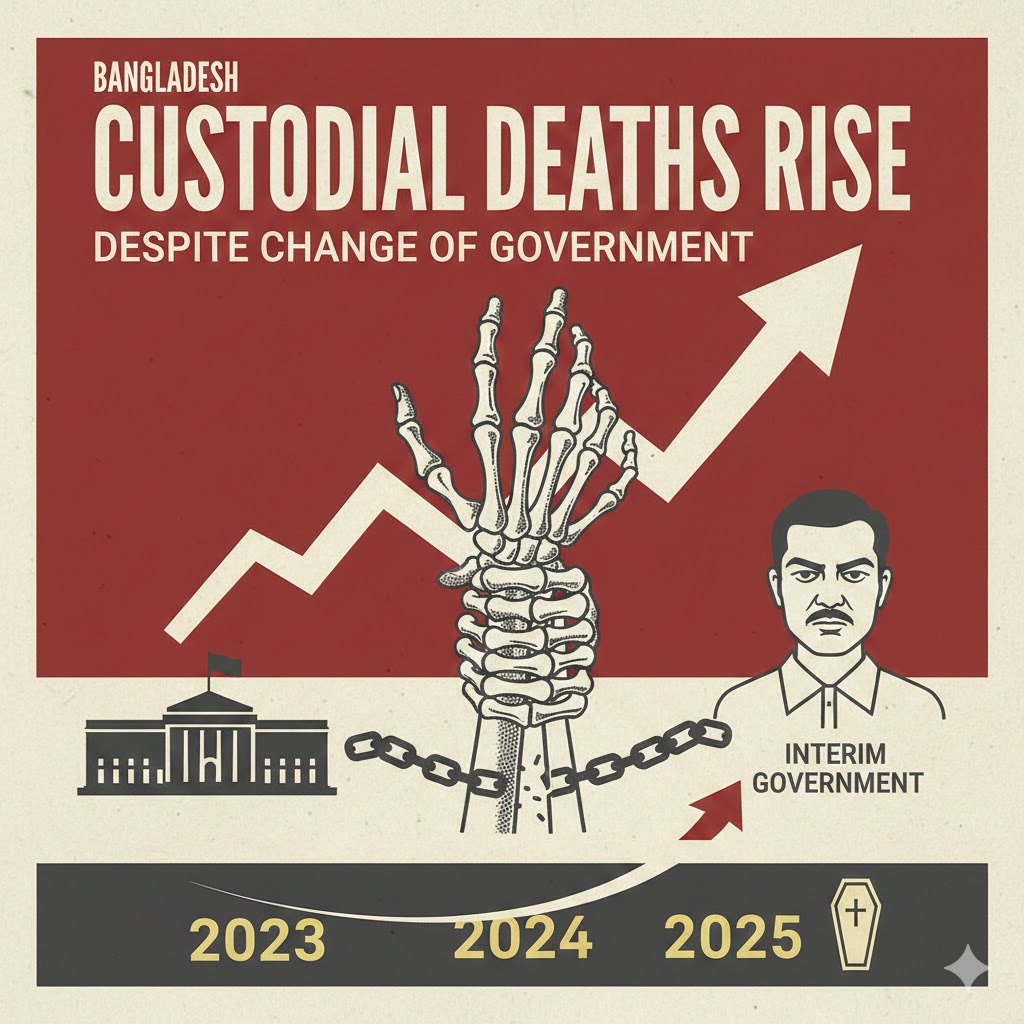
Despite a change in government, the alarming trend of deaths in custody in Bangladesh has shown no fundamental improvement. The pattern of custodial deaths that marked the years of the Awami League government has continued even after the interim government assumed power following the mass uprising. In fact, data from the Prison Directorate and observations by human rights organizations indicate that the number of deaths in custody increased in 2025 compared to 2023 and 2024.
Deaths in custody have long been a persistent allegation of human rights violations in Bangladesh. Experts argue that the death of any citizen while under state custody represents a failure of the state and raises serious questions about accountability. However, despite political change, no effective transformation has occurred in the entrenched culture of impunity within law enforcement agencies and prison administration.
632 Deaths in Four Years
According to data from the Prison Directorate:
-
185 prisoners died in custody in 2022,
-
155 in 2023,
-
120 in 2024, and
-
172 deaths were recorded in 2025.
In total, 632 people died in custody over the four-year period. During the same time, an average of 13,000 to 15,000 prisoners received medical treatment each year.
Of the 172 deaths recorded in 2025, six were officially classified as suicides. Previously, three suicides were reported in 2024, two in 2023, four in 2022, and four in 2021. Human rights activists maintain that without transparent and independent investigations, claims of suicide in custody cannot be considered credible.
Many Die on the Way to Hospital
Prison authorities claim that most deceased prisoners were suffering from serious illnesses. Some reportedly died while being transported to hospitals, while others died during treatment. However, prison officials admit that most prisons lack doctors during nighttime hours. In many facilities, the absence of ambulances prevents critically ill inmates from being transferred to hospitals in time.
Currently, Bangladesh has only 27 ambulances for 75 prisons. In the remaining facilities, rented vehicles are used to transport sick inmates. A reliable source confirmed that since 2019, the purchase of new ambulances has been stalled due to a lack of approval from the Ministry of Finance.
Severe Shortage of Doctors
Inspector General of Prisons Brigadier General Syed Md. Motaher Hossain stated that although 141 doctors are officially approved for prison services, only two doctors are currently posted on a permanent basis. The remaining prisons rely on part-time doctors from civil surgeon offices. Except for Manikganj Prison and the Rajshahi Training Center, no prison has round-the-clock medical services.
Experts believe this severe shortage of medical personnel is one of the primary causes of custodial deaths.
Deaths of Political Detainees and Allegations
Many recent custodial deaths involved politically known individuals. In December last year, Jubo Dal leader Ujjal Biswas died after being transferred from Jashore Central Jail to a hospital. The BNP alleged that he died as a result of torture while in the custody of law enforcement agencies.
Other deaths include Awami League leader Sultan Mia in Tangail Jail, former ward commissioner Murad Hossain from Dhaka Central Jail, Bogura Awami League leader Shahadat Alam Jhunu, and popular musician Prolay Chaki, who died in custody in January this year. These incidents have sparked significant political controversy.
Families of the deceased allege negligence in medical treatment and delays in transferring inmates to hospitals. Prison authorities, however, deny these claims, stating that medical procedures and investigations were conducted in accordance with regulations.
Laws Exist, Enforcement Does Not
Under the Jail Code of 1864, immediate medical attention and hospital referral are mandatory if a prisoner becomes ill. However, lawyers and human rights activists argue that these provisions are routinely ignored.
Supreme Court lawyer Advocate Al Mamun Russell said, “Prisons are holding two to three times more inmates than their capacity. As a result, prisoners are deprived of the fundamental rights guaranteed under Articles 31 and 32 of the Constitution. Moreover, deaths in custody are not properly investigated.”
A Culture of Impunity
Dr. Iftekharuzzaman, Executive Director of Transparency International Bangladesh, stated, “Custodial deaths continue because those responsible are not punished. Transfers or internal disciplinary actions are not solutions.”
Advocate Manzil Morshed, President of Human Rights and Peace for Bangladesh, said, “Regardless of the government in power, the pattern of state repression against dissenting voices has remained unchanged. Without genuine political will, this situation cannot improve.”
State Responsibility and Accountability
Experts emphasize that once a citizen is placed under state custody, the state bears full responsibility for protecting their life. Whether a detainee is a criminal suspect or a political activist, safeguarding fundamental rights is a constitutional obligation.
While the mass uprising brought political change, it failed to dismantle the culture of state violence and impunity. The continued rise in custodial deaths stands as stark evidence. Without independent investigations, transparency, and punishment of those responsible, observers warn that this deadly pattern will persist regardless of who holds power.