

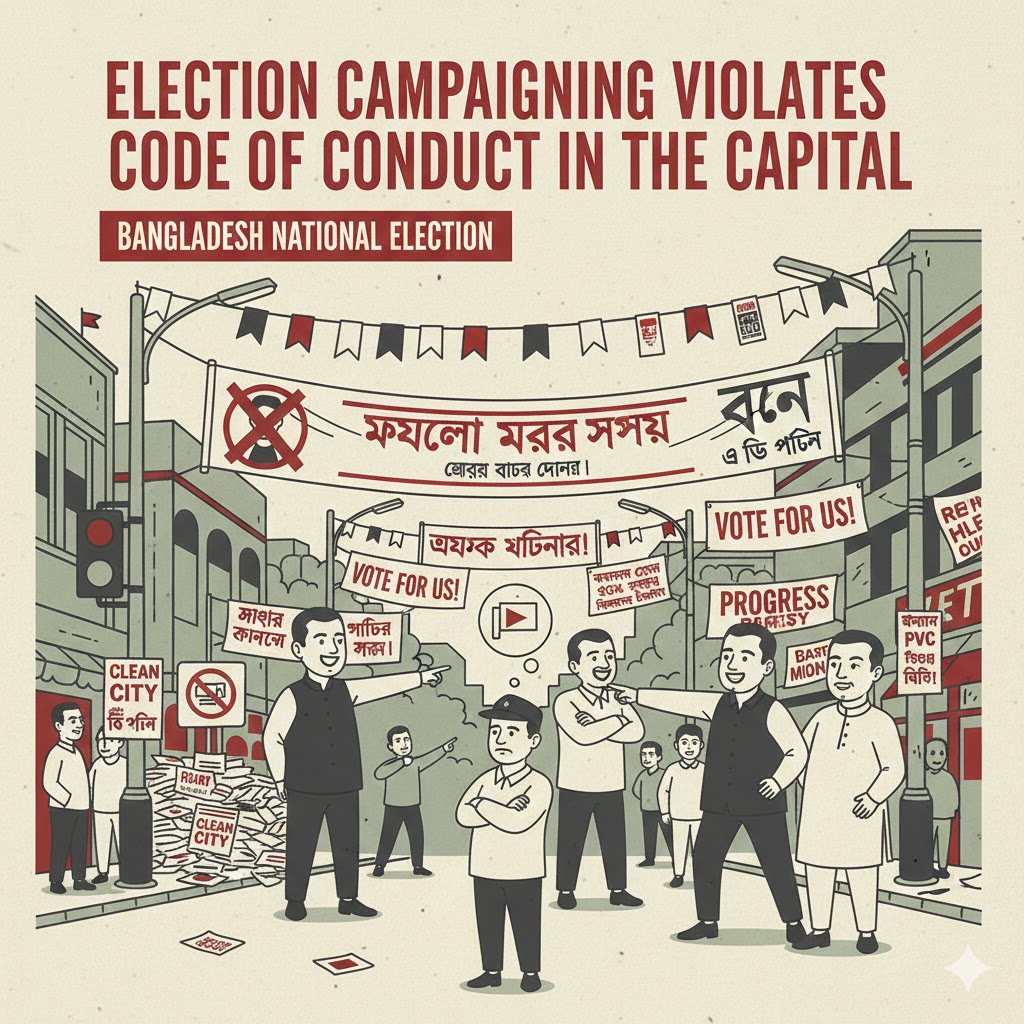
Ignoring the Election Commission’s declared code of conduct, several candidates and political parties are openly campaigning in different parliamentary constituencies of the capital using banned PVC banners. Despite clear restrictions aimed at protecting the environment and maintaining urban order, large PVC banners and festoons are being displayed on roadsides, electric poles, footpaths, and major intersections. According to field observations, the continued use of these prohibited materials has raised serious concerns among environmentalists and conscious citizens, particularly due to the apparent lack of effective action by the Election Commission and the relevant administrative authorities.
Widespread Use of Banned PVC Banners
On Saturday (January 24), visits to multiple parliamentary areas in Dhaka revealed extensive use of PVC banners in election campaigns. In Dhaka-10 constituency, BNP candidate Rabiul Alam and Jamaat-backed candidate Major (Retd.) Zakir Hossain were seen using PVC banners. Similar violations were observed in Dhaka-8 by BNP nominee Mirza Abbas, in Dhaka-4 by BNP candidate Tanvir Ahmed Robin, and in Dhaka-08 by NCP-backed candidate Nasiruddin Patwary.
Large banners displaying candidates’ photographs, symbols, and slogans were found hanging openly across these areas, despite explicit prohibitions under election rules.
Threat to Urban Order and the Environment
In many parts of the city, oversized PVC banners have been hung along roads, footpaths, and electric poles, in some cases obstructing traffic movement. In several locations, banners were seen hanging dangerously low over roads, posing risks to both vehicles and pedestrians.
Urban planners note that such banners contribute not only to visual pollution but also place additional strain on city management systems. Under election regulations, the use of plastic-based PVC banners is strictly prohibited in order to protect the environment. The rules also ban posters and banners from being placed outside designated locations. However, these directives appear largely unenforced at the field level.
Environmentalists Express Concern
Dr. Ahmad Kamruzzaman Majumder, Professor of Environmental Science at Stamford University Bangladesh and a prominent environmental expert, said, “In 2020, we conducted research on plastic use in banners and posters. While posters have decreased slightly in this election, the use of PVC banners has increased. This type of plastic does not decompose naturally. It clogs drains and canals, causing waterlogging. When burned, it releases highly toxic air pollutants. These materials are extremely harmful to the environment.”
He added, “If Election Commission guidelines are followed, there is no scope for using PVC banners. However, many candidates or their overenthusiastic supporters are violating the rules. This reflects not only environmental damage but also a lack of respect for the law.”
Environmental experts warn that PVC banners remain in the environment for long periods and ultimately turn into plastic waste. During the monsoon season, these materials worsen waterlogging, intensifying public suffering in urban areas.
Weak Monitoring Raises Questions About the Election Commission
Although the Election Commission and local administrations have repeatedly issued warnings to comply with the code of conduct, critics argue that effective monitoring is absent. While occasional drives are conducted, they are often temporary, and violations resume as election activities intensify.
A representative of environmental organization Green Voice stated, “The purpose of banning PVC banners was to protect the environment and urban life. But environmental protection cannot be achieved through directives alone without political commitment. Unless strict punishment is enforced regardless of party affiliation, these violations will continue.”
Public Suffering Continues
Excessive use of posters and banners during elections causes significant inconvenience to city residents. Sahinur Islam, a local resident, said, “During elections, the entire city becomes covered with posters and banners. After voting ends, no one takes responsibility for removing them. Ultimately, ordinary people suffer.”
Rakikul Alam, a teacher and resident of Dhaka-08 constituency, remarked, “Following the code of conduct is not just a legal obligation; it is a test of political maturity. When candidates violate rules at the very beginning of their campaigns, it becomes difficult to trust that they will uphold the law if elected.”
No Solution Without Exemplary Action
Analysts believe that if the Election Commission is truly committed to enforcing the code of conduct, it must take exemplary action against violators regardless of their political identity. Mere warnings or verbal instructions will not be sufficient to curb these irregularities.
Observers warn that continued indifference by the Election Commission and weak field-level monitoring may result in similar scenarios across other cities in the future. To protect the environment, maintain urban discipline, and restore public confidence in the electoral process, strict enforcement of election rules remains the only viable solution.