

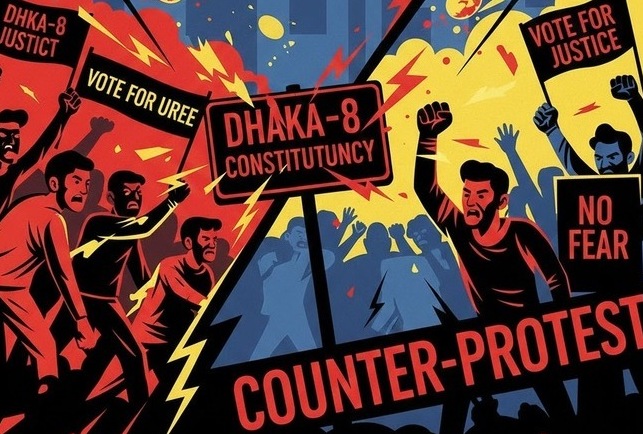
As the country heads toward the upcoming national parliamentary election, reports of sporadic clashes, rising tensions, and political confrontations have emerged from different regions. Political analysts note that such incidents are not unusual during election periods in Bangladesh, as heightened political activity often leads to friction. However, the intensity of tension, aggressive rhetoric, and counter-programs currently centering on the Dhaka-8 parliamentary constituency have drawn particular attention, setting it apart from other constituencies.
Dhaka-8, comprising key areas such as Motijheel, Kakrail, and Shantinagar, is considered politically sensitive due to its commercial and administrative importance. Any political activity in this constituency has a direct impact on daily life. During the ongoing election process, that impact has become increasingly visible, with escalating unrest affecting both residents and businesses.
Shocking Killing at the Outset of the Election
At the very beginning of the election process, a shocking incident shook the Dhaka-8 constituency. Osman Bin Hadi, an independent candidate widely known as a figure of the July uprising, was shot dead. The killing sent shockwaves through the local community and significantly altered the political atmosphere of the constituency.
The incident sparked widespread fear among residents and fueled intense discussion and speculation in political circles. Analysts say that the killing of a candidate is not merely a criminal act but a development with serious political consequences. Since the incident, the political climate in Dhaka-8 has become increasingly volatile and sensitive.
Candidacy of Nasir Uddin Patwary and Emerging Controversy
Following Osman Bin Hadi’s death, Nasir Uddin Patwary, a candidate of the National Citizens Party (NCP) backed by a ten-party alliance, emerged as a key contender in the constituency. From the outset of his campaign, his statements and political rhetoric became a subject of controversy.
At the local level, allegations surfaced that his aggressive tone and sharp remarks against political opponents contributed to rising tensions in the area. During this period, a series of egg-throwing incidents further complicated the election campaign and intensified political controversy.
Series of Egg-Throwing Incidents
According to available information, the first such incident occurred in the Motijheel Colony area, where rotten water and eggs were reportedly thrown at Osman Bin Hadi prior to his death. Subsequently, while campaigning in Motijheel, NCP candidate Nasir Uddin Patwary was allegedly targeted in an egg attack. His supporters claimed the incident was premeditated.
The situation escalated further on Tuesday when Patwary visited Habibullah Bahar College to interact with voters. His camp alleged that he was again subjected to an egg attack during the visit. The incident quickly gained attention on social media and became a topic of political debate.
However, students of Habibullah Bahar College later held a press conference denying the allegations. They stated that students were not involved in any egg-throwing incident and instead claimed that some NCP activists might have been responsible. Their statement added a new layer of complexity to the unfolding situation and raised further questions about the incidents.
Counter Rallies and Impact on Public Life
Following the series of egg-throwing incidents, tensions escalated further across Dhaka-8 and surrounding areas of the capital. On Tuesday afternoon and evening, rallies and counter-rallies took place in Kakrail, Shantinagar, and nearby areas, temporarily turning the locality into a hotspot of political confrontation.
Local residents reported that sudden processions, slogans, and heightened tensions caused widespread fear. Many people avoided leaving their homes unless necessary, while traffic movement in the affected areas dropped noticeably. Business owners expressed concern that prolonged instability could negatively affect commercial activities in this vital part of the city.
NCP Allegations and BNP’s Counterreaction
Amid the escalating tension, the NCP held a press conference in which party convener Nahid Islam blamed BNP Standing Committee member Mirza Abbas and BNP Acting Chairman Tarique Rahman for the egg-throwing incidents and recent unrest. He alleged that the attacks were part of a planned effort to humiliate their candidate and force him out of the electoral race.
“Our candidate is being subjected to intimidation and political suppression through coordinated attacks and smear campaigns,” Nahid Islam claimed.
The BNP strongly rejected these allegations. On Wednesday, supporters of Mirza Abbas and BNP activists staged protest rallies, describing the NCP’s claims as “baseless, politically motivated, and a staged drama.” The party countered by blaming Nasir Uddin Patwary for Tuesday’s unrest, alleging that his provocative statements and conduct had fueled tensions and led to the confrontations.
Growing Concern Among Residents
Residents of Dhaka-8 say they are bearing the brunt of political rivalries. “Whether we understand politics or not, the reality is that people are afraid to go out on the streets,” said one local resident.
Many fear that if such tensions persist, voter turnout on election day could decline, potentially undermining the democratic process.
Analysts Urge Restraint
Political analysts warn that developments in Dhaka-8 should not be viewed in isolation. As a key constituency in the capital, unrest there could influence the broader electoral environment. They stress that if tensions spiral out of control in such a strategic area, the impact could extend to other parts of the country.
Analysts emphasize that maintaining calm requires not only effective administrative measures but also restraint, responsible rhetoric, and tolerance from political parties and candidates.
Overall, the escalating tension in Dhaka-8—marked by egg-throwing incidents, counter-rallies, and mutual political accusations—has created renewed concern within the country’s political landscape. Such developments during a critical election period are widely seen as detrimental to a healthy democratic environment.
The key question now is whether the authorities and political stakeholders can act responsibly to ensure a peaceful, violence-free, and credible election in Dhaka-8. Voters, meanwhile, hope that despite ongoing tensions, they will be able to exercise their democratic rights safely and without intimidation.