

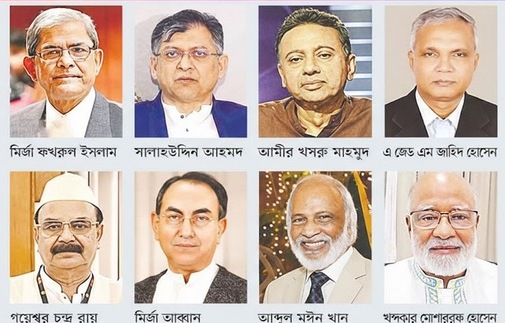
After nearly two decades, the Bangladesh Nationalist Party (BNP) is returning to state power. In the 13th National Parliamentary Election, the party secured 209 out of 297 declared seats, achieving a single-party majority. Following this landslide victory, political discussions are now centered on what the new cabinet under Tarique Rahman will look like.According to senior party sources and political analysts, preparations are underway to form a “smart cabinet” comprising a blend of experienced leaders and young talents, with a focus on good governance and rapid state reforms.
Out of 300 parliamentary seats, a party needs 151 seats—50.33 percent—to form a government. BNP has secured 69.66 percent of the seats, comfortably surpassing that threshold. The party’s seat count may further increase once results are announced for Sherpur-3, where polling was postponed due to a candidate’s death, and Chattogram-2 and Chattogram-4, where results remain suspended by court order. BNP’s allied parties have also secured three additional seats.
BNP last formed a government after winning the 2001 election. Although it secured a single majority at that time, it formed a coalition government with Bangladesh Jamaat-e-Islami. In that election, BNP’s electoral symbol “Sheaf of Paddy” won 195 seats. In the latest election, however, Jamaat-e-Islami emerged as BNP’s principal rival. Of the 297 declared seats, Jamaat secured 68 seats, while its allies won an additional nine.
Size and Structure of the Cabinet
Although no official announcement has been made regarding the cabinet’s size, party insiders indicate that BNP is likely to form a well-organized, medium-sized cabinet to ensure administrative efficiency and reduce expenditure. The total number of ministers, state ministers, and deputy ministers may range between 35 and 40. However, political considerations could necessitate adjustments.
Reliance on Experienced Leaders
Senior members of the party’s highest policymaking body—the Standing Committee—are expected to shoulder key responsibilities in the new government. Names frequently mentioned include Dr. Khandaker Mosharraf Hossain, Mirza Abbas, Gayeshwar Chandra Roy, Dr. Abdul Moyeen Khan, Nazrul Islam Khan, Amir Khasru Mahmud Chowdhury, Salahuddin Ahmed, Iqbal Hasan Mahmud Tuku, Major (Retd.) Hafizuddin Ahmed, Begum Selima Rahman, and Professor AZM Zahid Hossain.
BNP Secretary General Mirza Fakhrul Islam Alamgir is also reportedly being considered for a significant role, although speculation continues that he could be nominated for the presidency. No official confirmation has been provided.
Party sources emphasize that veteran leaders with administrative experience and political wisdom will serve as the backbone of the government. There is also discussion that Nazrul Islam Khan and Begum Selima Rahman could be appointed to key ministries under the technocrat quota.
Standing Committee member Salahuddin Ahmed stated, “We need to wait a little longer regarding cabinet formation.”
Hafizuddin Ahmed added, “Many names are being discussed, but nothing has been finalized yet. We believe it will be something positive.”
Technocrat Quota and Professional Inclusion
Under constitutional provisions, individuals who are not members of parliament may be appointed as ministers under the technocrat quota. BNP is reportedly planning to utilize this provision to bring in skilled professionals and experts.
Among those under discussion are Ruhul Kabir Rizvi, Habib-un-Nabi Khan Sohel, Syed Moazzem Hossain Alal, Humayun Kabir, Professor Moudud Hossain Alghir Pavel, Mahdi Amin, Aminul Haque, and Dr. Ziauddin Haider. Even if not appointed to the cabinet, some of them may receive key policy positions at the Prime Minister’s Office.
Young Leaders and Former MPs
To implement Tarique Rahman’s reform-oriented vision, several young leaders and experienced former members of parliament are being considered. These include Advocate Nitai Roy Chowdhury, Shahid Uddin Chowdhury Annie, ABM Ashraf Uddin Nizaan, Barrister Mohammad Naoshad Zameer, Amanullah Aman, Habibur Rashid, Sheikh Robiul Alam, Asadul Habib Dulu, Ruhul Quddus Talukder Dulu, Anindya Islam Amit, Rakibul Islam Bakul, Abul Hossain Khan, and Mohammad Ali Asgar Lobby.
Other names in circulation include Nurul Islam Moni, Air Vice Marshal (Retd.) Altaf Hossain Chowdhury, Mujibur Rahman Sarwar, ABM Mosharraf Hossain, Zahir Uddin Swapan, former Chief Whip Zainal Abedin Farroque, Abdus Salam Pintu, Advocate Zainal Abedin, Barrister Kaiser Kamal, Advocate Fazlur Rahman, Kazi Shah Mofazzal Hossain Kaykobad, Shariful Alam, Mostafizur Rahman Babul, and Afroza Khan Rita.
Further discussions reportedly involve Shamsur Rahman Shimul Biswas, Fazlul Haque Milon, Khairul Kabir Khokon, Shama Obaid, Shahidul Islam Babul, Mia Nuruddin Ahmed Apu, Khandaker Abdul Moktadir Chowdhury, A N M Ehsanul Haque Milon, Abdul Awal Mintoo, Barkatullah Bulu, Md. Shahjahan, Mohammad Fakhrul Islam, Dr. Reza Kibria, Md. Mosharraf Hossain, and Sayeed Al Noman.
Several leaders from BNP’s affiliated and associate organizations have also been elected to parliament, including Swechchhasebak Dal General Secretary SM Jilani, Rajib Ahsan, and Jubo Dal General Secretary Nurul Islam Nayan. Discussions suggest that some of them could also find a place in a youth-oriented cabinet.
Representation of Allied Parties
BNP is also considering appropriate representation for its long-standing political allies. Among elected MPs from allied parties, Barrister Andaleeve Rahman Partho and Bobby Hajjaj are being discussed. Although defeated in the election, Mahmudur Rahman Manna is reportedly under consideration for inclusion through the technocrat quota.
After a prolonged absence from power, all eyes are now on how BNP structures its new cabinet. The balance between experience and youth—and the effectiveness of the promised “smart cabinet”—will likely shape the trajectory of governance and reform in the coming years.