

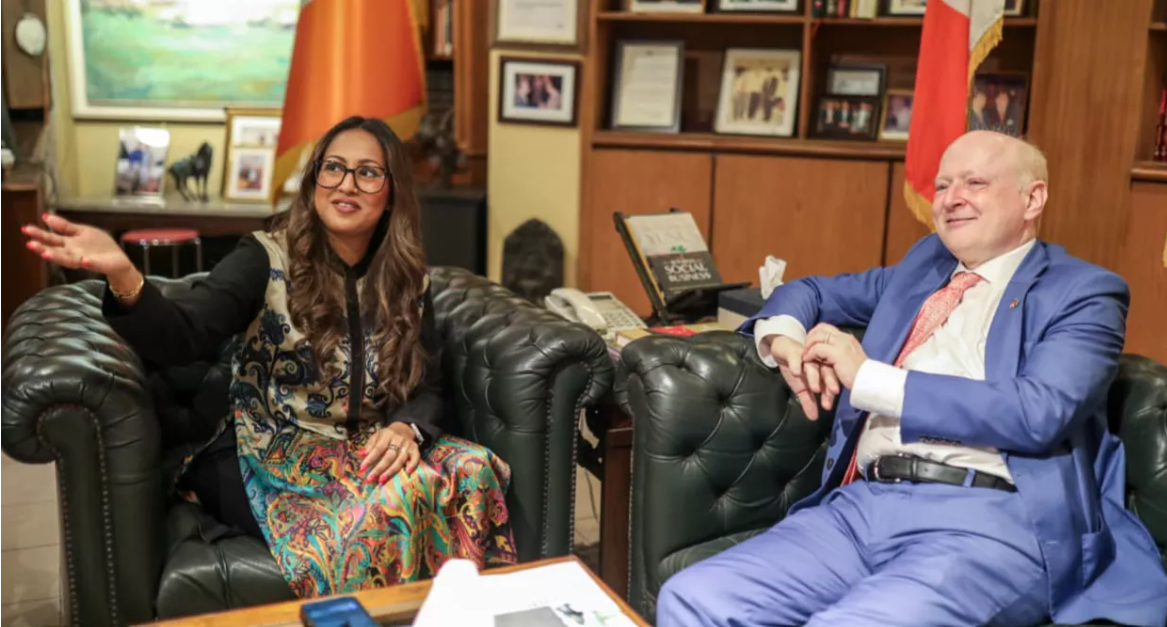
German Ambassador to Bangladesh Dr. Rüdiger Lotz has said Bangladesh and Germany have maintained close relations for 55 years but there is still considerable room to do more to take the relationship to new heights while addressing challenges.
"We have a strong partnership, and I believe there is still considerable room to do more. That is what I hope we will achieve in the coming years," the ambassador said, stressing that Bangladesh needs to address several challenges to become a more attractive destination for foreign investors.
In an exclusive interview with UNB, Lotz said the two countries enjoyed very good relations across development cooperation, business, economic and political relations, and culture with considerable opportunities to further strengthen their longstanding partnership.
Recalling his arrival in Dhaka in July last year, when Bangladesh was going through political uncertainty and the interim government was preparing for a transition to a permanent government, he said many people had doubted whether the election process would proceed smoothly.
Many had expected the election to be postponed or the process to turn violent, but neither happened, he observed.
"I think it is a very positive development that Bangladesh now has a democratically elected and legitimate government, with a functioning parliament. For a country emerging from autocracy and returning to democracy, this is something truly extraordinary," said the German ambassador.
Diversifying economy, improving investment climate
On Bangladesh's heavy dependence on the readymade garment (RMG) sector, Lotz said the industry would remain the backbone of the economy for a long time, but the country needed to explore opportunities in other sectors.
He identified leather, agribusiness and agro-processing, pharmaceuticals, information technology, logistics and shipbuilding as sectors offering considerable potential for diversification.
He said bringing in private businesses and encouraging investment would be the best way to support the process.
Good governance, a streamlined regulatory framework and stronger efforts to combat corruption are essential, the Ambassador said, noting that investors should not have to approach dozens of different authorities to obtain necessary permissions.
"A company interested in investing here should not have to approach 40 different authorities to obtain the necessary permissions. The process needs to be simplified," Ambassador Lotz observed.
He also stressed the importance of compliance, skills development, improvements across the broader education sector and investment in infrastructure.
"All these issues fall under what we generally call the ease of doing business. Addressing them would make Bangladesh a more attractive destination for foreign capital," Ambassador Lotz said.
He noted that government representatives understood these challenges and were trying to address.
Stability and workers' rights important for investment
Regarding the investment climate, particularly amid recent unrest in the RMG sector, the ambassador said most German companies operating in Bangladesh were here for the long term.
They had established entire supply-chain systems and were producing substantial quantities for the market, requiring know-how, logistical capacity and large-scale manufacturing facilities.
Therefore, he said, occasional periods of social unrest would not necessarily put the entire system into question, although political stability remained important.
He also stressed the need to strike a balance between ensuring decent wages and living standards for workers and protecting the interests of the industry.
Lotz said Germany is strongly committed to improving working conditions, referring to due diligence legislation in the European Union, particularly in Germany, which promotes environmentally and socially responsible and sustainable working environments.
He said the issue was not simply about improving conditions in Bangladesh, as customers in European countries increasingly demanded such standards.
"For companies, it is risky to face criticism that they are producing goods under miserable conditions in a country like Bangladesh, taking advantage of low prices and exploiting the situation," he said.
There is a growing understanding that products labelled 'Made in Bangladesh' should be recognised as having been produced under socially and environmentally sustainable conditions.
"So, this is not only a matter of legal compliance. It has also become a business necessity," said the Ambassador.
Keen to support renewable energy transition
On renewable energy cooperation, Lotz said Germany was actively providing grants and loans to companies interested in introducing rooftop solar systems in Bangladesh.
He cited a jute factory, where Germany supported the installation of approximately 18 megawatts of solar power, enabling nearly the entire production facility to operate on solar energy.
The project received support from KfW, Germany's development finance institution.
"It demonstrates what can be achieved," he said.
Noting that renewable energy currently accounts for only around three percent of Bangladesh's energy mix, the ambassador welcomed the government's ambition to increase the share to 20 to 30 percent by 2030 and go further. "I believe this is achievable," he said.
Germany currently generates around 60 percent of its electricity from renewable sources, he noted, adding that Bangladesh had considerably more favourable climatic conditions for solar energy.
"If we can generate a significant amount of solar energy there, Bangladesh, with its much more favourable climatic conditions, certainly has considerable potential," he said.
He identified rooftop solar as particularly important while also pointing to opportunities in wind energy, although its development could be challenging in Bangladesh. Energy efficiency is another crucial area, he added.
Lotz said the renewable energy transition was one of the key pillars of Germany-Bangladesh cooperation.
He also called for examining energy issues from a broader regional perspective, saying South and Southeast Asia did not fundamentally suffer from an electricity shortage if the available potential in hydropower, wind and solar energy could be properly utilised.
"We need to consider this within a broader regional framework rather than limiting ourselves to national boundaries. I know regional cooperation is difficult, but it is something that deserves serious attention," he said.
Referring to the crisis in the Gulf this year, he said it had demonstrated the risks of depending on fuel imports from a single region, both in terms of energy security and cost.
Education key to becoming a top-20 economy
On Bangladesh's potential to become one of the world's top 20 economies, Lotz said economic diversification, infrastructure development and investment in education would be crucial.
He suggested exploring opportunities in light manufacturing, assembly, information technology and other industries.
Referring to South Korea in the 1960s and Vietnam in the 1990s, he said their macroeconomic indicators at those respective periods were quite similar to Bangladesh's current position.
Both countries had invested enormously in education, he noted.
The ambassador welcomed the current government's increased budgetary allocations for education, describing it as particularly important for Bangladesh's long-term development.
"Education is, of course, a long-term investment. You will not see the results immediately. If you start educating children today, you may see the results 25 years later. But it has to be done," he said.
He added that investment in education today would bring benefits for Bangladesh in the decades ahead.
"Germany needs skilled workers, sees migration opportunities"
On migration, Lotz emphasised the importance of distinguishing between regular and irregular migration, saying he preferred the term 'irregular migration' rather than 'illegal migration'.
"While the process may be legally irregular, we are talking about human beings. Human beings are not illegal," he said.
He noted that Germany needed migrants, particularly people with skills in demand in its labour market.
Comparing the demographic situations of the two countries, he said the median age in Germany was around 46, compared with approximately 26 in Bangladesh.
With an ageing population and many people approaching retirement, Germany would need around 400,000 people annually in the coming years to fill vacancies left by retiring workers.
"This need can only be addressed through migration," he said.
Germany was still far from attracting the required number of workers, and there was a growing understanding within the country that migration was necessary.
However, language barriers and differences in professional skills remained major challenges.
He said Germany had a highly developed vocational training system, which was not necessarily available to the same extent in Bangladesh, particularly for non-academic professions.
"These are issues we need to address," he added.
Bangladesh's vibrant art scene
Beyond economic and political cooperation, Lotz also highlighted the potential for stronger cultural engagement between the two countries.
Sharing his impressions of a visit to Gallery Cosmos and Cosmos Atelier71 on Thursday, he said he greatly appreciated art, although he did not personally draw or paint.
He sometimes enjoyed writing, but had not been involved in visual art himself.
Nevertheless, he praised the creativity on display and the opportunity for artists to come together and pursue their interests and passions in a free and independent atmosphere over several months.
Describing Bangladesh's contemporary art scene as rich and lively, he said art offered a wonderful way to address societal challenges and structures and communicate issues that could sometimes be difficult to express verbally.
He said the major challenge was bringing Bangladesh's vibrant art scene to the attention of the international art community.
Institutions such as Gallery Cosmos were important in promoting Bangladeshi artists internationally and creating opportunities for buyers to discover their work.
"I think this is an area that still needs further development, although things are moving in the right direction," he said.
Lotz expressed interest in promoting collaboration between Bangladeshi and German artists, saying many German artists would be interested in visiting Bangladesh, exploring its art scene and working with local artists.
"There is so much energy and creativity here, which I have not necessarily encountered in other countries," he said.
He described Bangladesh's art scene as one that had not yet been fully discovered by the international art market.
Goethe-Institut, cultural exchange and Machan Art Center
The ambassador said Germany had considerable cultural engagement in Bangladesh, primarily through the Goethe-Institut, which had been an important institution in the country for many years.
He said many people still remembered attending cultural events organised by the institute during their teenage years or early adulthood.
German language training was another important activity, with demand for courses far exceeding the institute's current capacity.
"We also regularly organise workshops on environmental issues and other subjects," he said.
He mentioned Germany's support for the establishment of Machan Art Center, which aims to bring artistic activities to marginalised areas where such opportunities are not readily available.
He said it was remarkable to see the amount of art and creativity emerging from those communities.
"Art should not be considered something exclusively for an elite group. It is for everyone," Lotz said.
He said the embassy supported this approach through workshops, events and the involvement of community members.
In his message to Bangladeshi artists, Lotz encouraged them to continue pursuing their creative work and said he wanted to do his best to promote Bangladeshi art and explore opportunities to bring it to Germany.
"If you have any ideas or suggestions, please feel free to approach the embassy. We can discuss whether there are opportunities to work together," he said.
Easing Visa
He expressed hope that the waiting times for German student visas could be reduced to just a couple of weeks during the course of next year following the introduction of a new online application system.
Under the new system, applicants will have to upload their documents immediately during the application process, allowing much of the verification work to be completed earlier and helping the German Embassy identify genuine students more efficiently.
"We are closing the existing waiting list, and everyone will have to apply again," the ambassador said.
He said the existing system had faced two major problems: many applicants registering on the waiting list did not actually intend to study in Germany, while a large number of fraudulent documents had made the verification process considerably longer.
The German Embassy has to spend considerable time checking the authenticity of documents, which also affects genuine applicants, he said.
"Our experience suggests that many people who are not genuinely interested in studying will not go through the process of uploading the required documents," Lotz said.
"My hope and expectation is that this system will help reduce the unacceptable waiting times, which have sometimes stretched to a couple of years, to hopefully just a couple of weeks during the course of next year."
Describing the proposed timeframe as manageable, he said students who secured admission to German universities could not be expected to wait several years for visas.
"We also need young, skilled and intelligent people at German universities. It is a win-win situation for both countries," he added.