

Bangladesh awoke on Tuesday to a heavy stillness. Begum Khaleda Zia—former prime minister, opposition leader, twice-elected head of government, and the country’s first woman to hold that office—died at 6am after a prolonged illness. She was 80.For her supporters, it was the passing of a defiant symbol of democratic resistance; for her critics, a rival whose shadow shaped three decades of politics. For the nation, it marked the end of an era that Bangladesh never fully confronted—only postponed.
Within hours of her death at Dhaka’s Evercare Hospital, crowds of party activists gathered outside, many in tears. Others stood silently, as if unsure whether grief or anger should come first.
“A death with responsibility attached”
At a press conference outside the state guest house Jamuna, law, justice and parliamentary affairs adviser Dr Asif Nazrul cut through the customary condolences with an unusually blunt assessment.
“The then government must bear responsibility for her death,” he said, directly naming Sheikh Hasina and her administration.
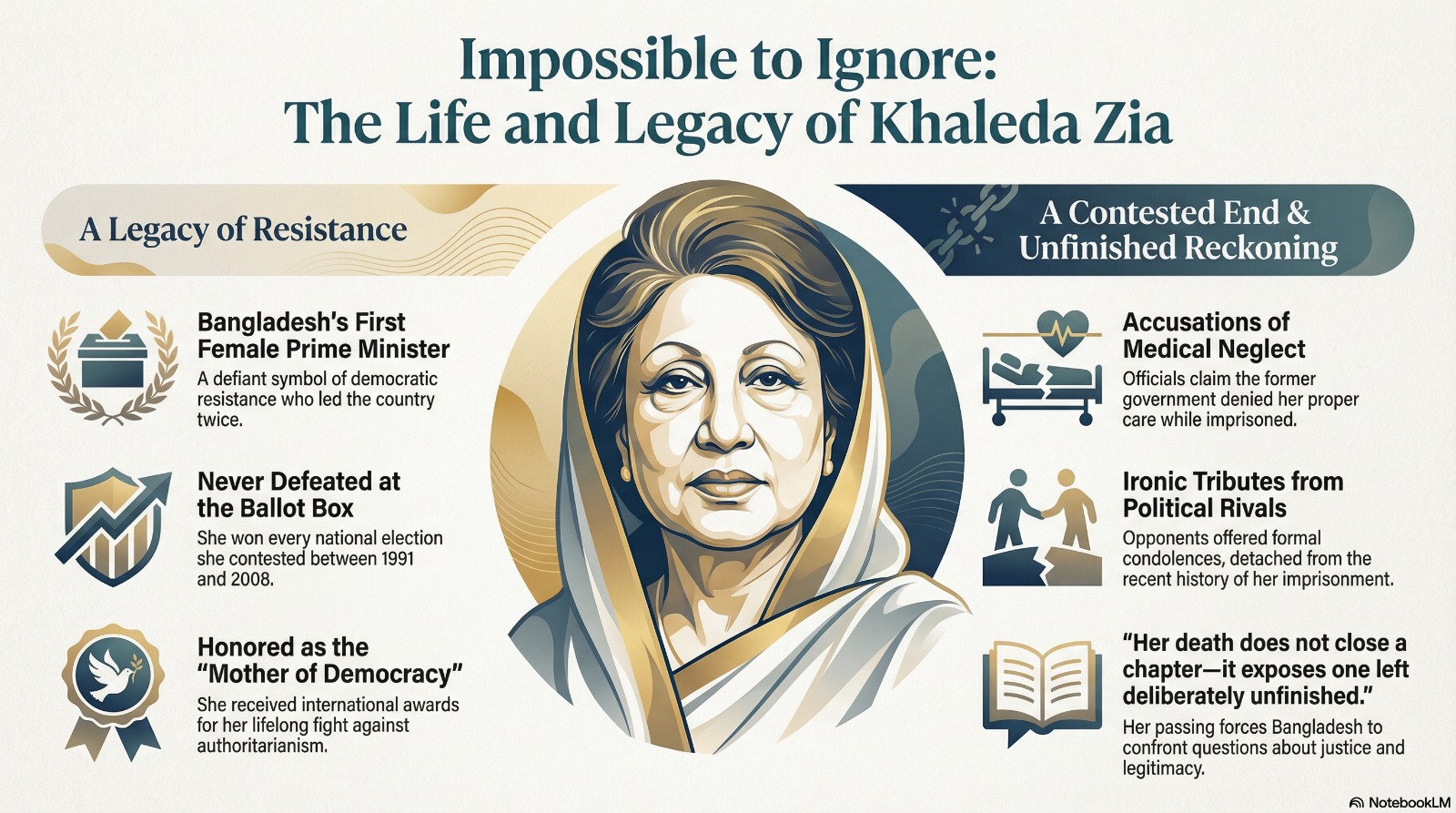
Nazrul accused the former government of imprisoning Khaleda Zia through what he called a “farce of a verdict”, subjecting her to “inhuman treatment” and denying her timely medical care. The corruption cases that led to her imprisonment, he noted, were later exposed as legally unsustainable through appeals and reviews in the highest courts—long after irreversible damage had been done.
He added that interim chief adviser Professor Muhammad Yunus had personally overseen Khaleda Zia’s medical situation whenever possible. “Had her physical condition allowed overseas treatment again, full state cooperation would have been ensured,” he said.
The statement carried a quiet indictment: help arrived too late because justice had arrived even later.
A son’s farewell
In a deeply personal statement, Tarique Rahman, acting chair of the Bangladesh Nationalist Party (BNP), described his mother not in the language of power, but of loss.
“My mother answered the call of Almighty Allah today,” he said. “Inna lillahi wa inna ilayhi raji’un.”
To the country, he said, she was an uncompromising leader; to many, “the mother of democracy”. To him, she was a woman who surrendered family, comfort and health to a cause that rarely repaid her kindness.
“She fought authoritarianism, fascism and domination throughout her life,” Rahman said, adding that despite repeated arrests, medical neglect and isolation, she never relinquished courage—or compassion.
Khaleda Zia lost her husband, president Ziaur Rahman, to assassination. She later lost a son. “The country became her family,” Rahman said. “Bangladesh was her identity.”
Never defeated at the ballot box
Khaleda Zia contested four national elections between 1991 and 2008, winning every time—often from multiple constituencies. International organisations later honoured her with titles such as “Fighter for Democracy” (New Jersey State Senate, 2011) and “Mother of Democracy” (Canadian Human Rights International Organisation, 2018).
These accolades stand in sharp contrast to the narrative constructed during her imprisonment—one that framed her less as a political rival and more as a legal inconvenience.
The choreography of condolences
Tributes soon followed from political figures who, until recently, had little room for nuance.
India’s prime minister Narendra Modi, posting on X, recalled a “warm meeting” in 2015 and praised Khaleda Zia’s contribution to India–Bangladesh relations. It was a statesmanlike message—brief, polished, and curiously detached from the years in which New Delhi openly backed the government that kept her sidelined and silenced.
In Bangladesh, Sheikh Hasina, the deposed former prime minister and Khaleda Zia’s lifelong rival, issued a condolence message describing Zia as a key figure in the struggle for democracy. The words were formal, almost ceremonial—history rewritten into neutral prose, stripped of prisons, courtrooms and hospital wards.
Perhaps most striking was the statement from Sajeeb Wazed Joy, Hasina’s son, who warned that Khaleda Zia’s death could destabilise Bangladesh at a “critical moment”, while expressing sympathy for her family. It was a sentiment that landed awkwardly among those who remember how political stability once justified prolonged incarceration.
In Bangladesh, irony rarely announces itself. It waits.
An unfinished reckoning
Khaleda Zia’s death does not close a chapter—it exposes one left deliberately unfinished. Her final years unfolded under surveillance, legal pressure and medical vulnerability, raising questions the country avoided asking while she was alive.
Who decides when justice becomes punishment?
How long can elections be postponed before legitimacy expires?
And how many funerals must a democracy hold before it admits what it has lost?
As night fell on Dhaka, party flags drooped outside the hospital gates. The crowds slowly dispersed. What remained was not unity, nor closure—but an unease that Bangladesh may yet have to confront the truths it delayed until its most stubborn witness was gone.
Khaleda Zia, in death, has become what she was denied in life: impossible to ignore.