

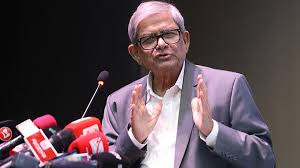
With his refined language, courteous manner and decades-long political experience, Mirza Fakhrul Islam Alamgir stands as one of the most respected and recognisable figures in Bangladesh’s political landscape. He is a politician who has traversed the arduous path of politics with personal integrity, political decorum and unwavering loyalty to his party, while upholding a rich family legacy. Despite enduring imprisonment, legal harassment and continuous political adversity, he has never wavered in his commitment to party discipline and responsibility. Mirza Fakhrul Islam Alamgir was born on January 26, 1948, into a distinguished family in Thakurgaon district. His father, Mirza Ruhul Amin, was a renowned lawyer and politician who was elected to parliament several times both before and after independence. In independent Bangladesh, he was associated with the Jatiya Party. His mother, Mirza Fatema Amin, was an educated and culturally conscious woman who firmly believed in family values. This political and social environment played a crucial role in shaping Mirza Fakhrul’s character and leadership qualities.
Academically, he was known for his intellect and analytical mindset. He completed his higher secondary education at Dhaka College and later earned both his bachelor’s and master’s degrees in Economics from the University of Dhaka. In 1972, he passed the Bangladesh Civil Service (BCS) examination and joined the education cadre, beginning his professional career as a lecturer in the Department of Economics at Dhaka College. He later taught at several government colleges across the country.
Alongside teaching, he also served in various government capacities. He worked as an auditor at the Directorate of Inspection and Audit under the Government of Bangladesh. In 1979, during the presidency of Ziaur Rahman, he was appointed Private Secretary to the then Deputy Prime Minister S. A. Bari. However, after military ruler Hussain Muhammad Ershad assumed power in 1982 and S. A. Bari resigned, Mirza Fakhrul returned to his teaching profession. Until 1986, he served as a Professor of Economics at Thakurgaon Government College.
His engagement with politics began during his student life. While studying at the University of Dhaka, he was actively involved with the East Pakistan Students’ Union (now the Bangladesh Students’ Union). He was elected General Secretary of the S. M. Hall unit and later served as President of the Dhaka University unit during the historic mass uprising of 1969. The political movements and democratic aspirations of that era deeply influenced his political philosophy.
In 1986, Mirza Fakhrul formally resigned from his teaching career and entered active politics. Two years later, in 1988, he contested the Thakurgaon Municipality election and was elected Chairman. During the nationwide movement against the autocratic rule of General Ershad, he joined the Bangladesh Nationalist Party (BNP). In 1992, he was elected President of the BNP’s Thakurgaon district unit and simultaneously served as Vice-President of the party’s farmers’ wing.
His journey in parliamentary politics began in 1991. He contested the fifth and seventh parliamentary elections from the Thakurgaon-1 constituency as a BNP nominee but was defeated on both occasions. However, in the eighth parliamentary election in 2001, he secured a decisive victory from the same constituency and was elected a Member of Parliament. Following the formation of the BNP government that year, he was first appointed State Minister for Agriculture and later served as State Minister for Civil Aviation and Tourism, a position he held until 2006.
In the ninth parliamentary election in 2008, he faced defeat once again. In the eleventh parliamentary election in 2018, he received BNP nominations from both Thakurgaon-1 and Bogura-6 constituencies and was elected from Bogura-6. However, as he did not take the oath, the Election Commission later declared the seat vacant. According to party sources, Mirza Fakhrul is expected to contest the upcoming parliamentary election from his home district of Thakurgaon as a BNP candidate.
His importance within the BNP grew significantly after the party’s fifth national council in 2009, where he was elected Senior Joint Secretary General. Following the death of then BNP Secretary General Khandaker Delwar Hossain in 2011, party chairperson Begum Khaleda Zia appointed him as Acting Secretary General. Later, at the BNP’s sixth national council in 2016, he was formally elected Secretary General of the party.
As a leader of the opposition, Mirza Fakhrul has led numerous democratic movements, protests and political programmes. He has consistently emerged as a firm and vocal critic of government policies. Despite being arrested multiple times and facing numerous legal cases and political repression, he has remained steadfast in his commitment to party ideology and democratic principles.
In his personal life, Mirza Fakhrul Islam Alamgir is married to Rahat Ara Begum. The couple has two daughters, both of whom are well-educated and established in their respective fields. Known for his disciplined and modest lifestyle, he maintains the same sense of order and restraint in his family life as he does in politics.
Through a rare combination of courtesy, eloquence and political wisdom, Mirza Fakhrul Islam Alamgir has earned his place as a trusted and credible leader in Bangladesh’s political arena. Throughout his long political career, his uncompromising stance on party ideals and democratic values has set him apart, securing him a distinctive and dignified position in contemporary Bangladeshi politics.