

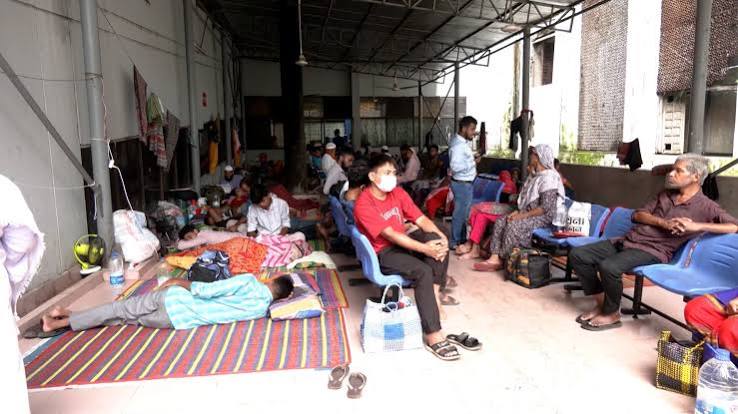
The government has undertaken several initiatives to improve the country’s health sector. In the 2026–27 fiscal year budget, a record Tk 69,401 crore has been allocated to health, raising the sector’s allocation to more than 1 percent of GDP, or approximately 1.02 percent. However, no major visible progress has been observed in the sector over the past six months. Government officials and sector experts, however, argue that six months is not sufficient time to deliver the expected results from such large-scale reforms.
An analysis of the commitments made in the election manifesto of the BNP-led government and the current situation shows that, although a large budget allocation and several administrative initiatives have been introduced, ordinary citizens have yet to experience any significant improvement in the overall quality of healthcare.
Nevertheless, some policy and administrative measures taken during the government’s initial period are in line with its election pledges. The health sector’s budget allocation has been increased this fiscal year to more than 1 percent of GDP. In addition, 192 healthcare facilities have been transferred from the Ministry of Local Government to the Ministry of Health. The government has also approved an Executive Committee of the National Economic Council (ECNEC) project aimed at expanding primary healthcare services in urban areas.
The government’s response to the sudden measles outbreak can be considered one of its more visible successes. Its efforts to quickly procure vaccines and contain the outbreak have been noticeable. However, the government cannot entirely avoid responsibility for the deaths of more than 900 children from measles.
The government has also announced plans to recruit 100,000 healthcare workers and 5,000 new doctors, while work is reportedly underway to develop the design of an e-health card. After assuming office, the government also began work on five 200-bed specialised children’s hospitals in Khulna, Barishal, Rangpur, Rajshahi and Cumilla. Initiatives have also been taken to increase hospital capacity across the country. Recently, at a public gathering, Prime Minister Tarique Rahman announced plans to upgrade all 503 upazila health complexes to 151-bed facilities.
However, beyond large budget allocations and infrastructure-related announcements, there remains a significant gap in structural and institutional reform.
Economist Professor Dr Rumana Haque said that the government has yet to fully meet the enormous expectations that people had when it assumed office. Although transforming the health system is a time-consuming process, she said a more effective roadmap was needed for measures that could have been implemented quickly.
Rumana Haque further said that while announcements have been made regarding infrastructure development and hospital construction, there is still a lack of clarity regarding investment in grassroots and primary healthcare, as well as transparency and proper planning for the recruitment of 100,000 workers. She also noted that there is still no clear direction regarding the new development budget or how the allocated funds will be utilised.
Public health expert Dr Mushtaq Hossain said the government’s initiatives largely consist of fragmented routine activities and a list of aspirations. He argued that the first priority should be the establishment of an independent health commission, which would formulate a comprehensive reform plan and monitor its implementation and progress.
Asked whether he was satisfied with the government’s performance during its first six months, Health Secretary Md Kamruzzaman Chowdhury said, “We are working. There is no question of being satisfied or dissatisfied at this stage.”
Considering the government’s election manifesto and its major budgetary commitments, its first six months in the health sector can be described as a period of planning and preparation. The government has demonstrated its intentions and made some progress through increased budget allocations, administrative transfers and the creation of posts. However, ordinary people have yet to see any major improvement in the quality of healthcare or experience substantial benefits from these initiatives.