

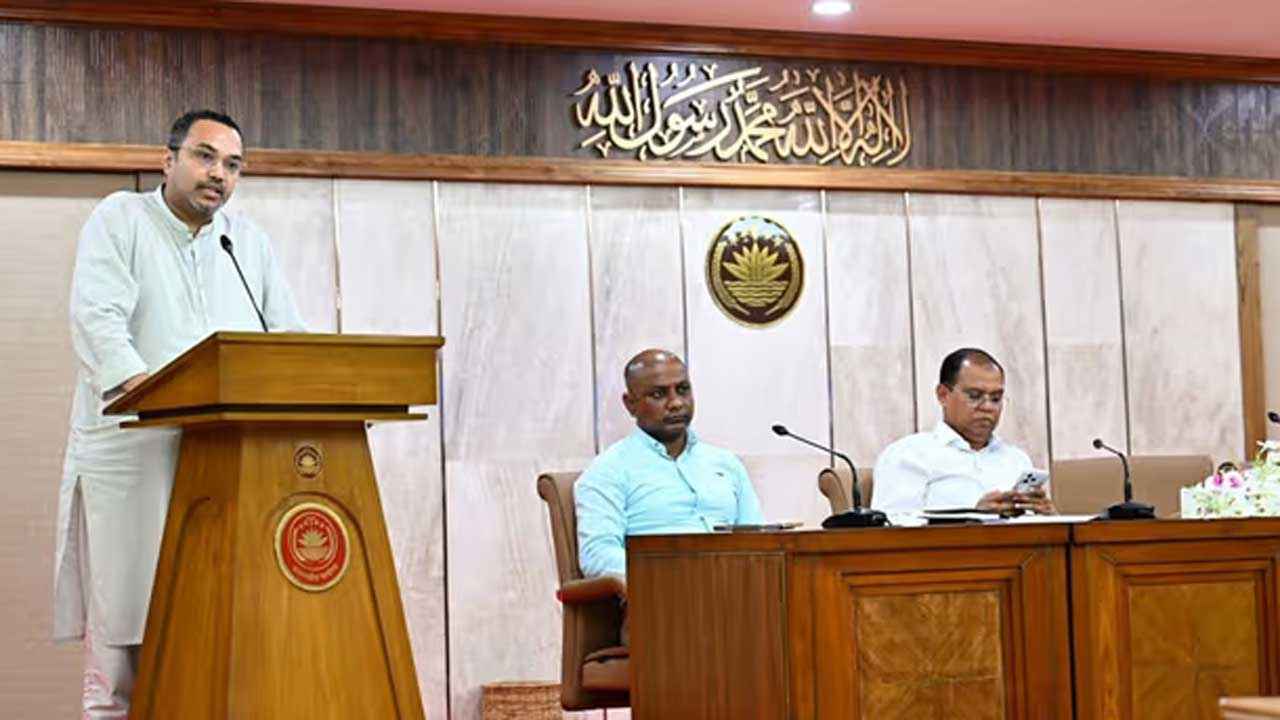
Dhaka, May 25: The Bangladesh Nationalist Party (BNP) government, led by Tarique Rahman, marked its first 100 days in office with a press conference held at the Prime Minister’s Office on Monday afternoon. During the briefing, Prime Minister’s Office spokesperson and adviser with the status of state minister, Mahdi Amin, highlighted the government’s visible progress, reform initiatives, and people-oriented programs implemented over the past three months.
Additional Press Secretary Atikur Rahman Ruman also addressed the event, while Deputy Press Secretary Zahidul Islam Rony moderated the press conference.
According to government officials, the administration has taken swift and effective measures since assuming office to ensure public welfare, economic stability, social security, and administrative accountability. The government emphasized that its first 100 days focused primarily on improving living standards, revitalizing agriculture and labor sectors, expanding education and healthcare services, modernizing infrastructure through technology, and strengthening democratic institutions.
Social Security and Public Welfare
The government announced the introduction of a “Family Card” program aimed at strengthening women-centered social protection. Through this initiative, women from low- and middle-income families are expected to gain easier access to government subsidies and social support services.
A financial honorarium program has also been launched for imams, muezzins, khatibs, and other religious figures to ensure greater economic security for religious workers.
In another major relief measure, the government withdrew additional monthly charges imposed on prepaid electricity meters, a decision welcomed by consumers. Furthermore, the subsidized rice distribution program for 5.5 million low-income families at a rate of Tk 15 per kilogram has been continued. The administration also announced plans to introduce an “LPG Card” to make cooking fuel more affordable and accessible.
Agriculture and Rural Economy
To support farmers, the government waived agricultural loans of up to Tk 10,000, including interest, for small-scale farmers. Officials described the initiative as a significant relief package for the agricultural sector.
The administration also introduced plans for a “Farmer Card,” which aims to establish a digital agricultural management system, enabling farmers to access government support and services more efficiently.
Large-scale canal excavation projects have been initiated across the country to improve irrigation systems and reduce waterlogging. The government further announced plans to implement the Padma Barrage Project, which is expected to have long-term positive impacts on agriculture and water management.
Special programs have also been designed to strengthen the rural economy and generate employment opportunities in villages and remote areas.
Labor and Employment Initiatives
To ensure workers’ rights and financial security, the government implemented strict monitoring measures to guarantee timely payment of salaries, allowances, and bonuses ahead of Eid celebrations.
In an effort to stimulate economic activities, the administration announced a special economic fund worth Tk 60,000 crore. Plans have also been undertaken to reopen closed factories and establish employment exchange offices in every district of the country.
The government additionally plans to provide official identity cards to nearly 200,000 freelancers working in the information technology sector, a move expected to strengthen the country’s growing digital economy.
Education and Youth Development
One of the government’s most notable announcements was free education for female students up to the honors level. The administration also pledged to expand merit-based scholarship programs.
To modernize education, initiatives have been taken to introduce smart classrooms and free Wi-Fi services in educational institutions nationwide. Plans for introducing mid-day meal programs in schools were also announced to improve student nutrition and attendance.
The government further unveiled a startup fund to encourage young entrepreneurs and emphasized the importance of technical and skill-based education to prepare youth for future employment opportunities.
Healthcare and Humanitarian Measures
The government stated that nearly 100 percent of children had been brought under the measles vaccination program. It also announced plans to extend maternity leave benefits, which are expected to enhance women’s participation in the workforce while ensuring maternal health protection.
Authorities revealed that efforts are underway to allocate 5 percent of the country’s GDP to the healthcare sector. The administration also plans to convert unused government buildings into maternity centers and healthcare clinics.
Additionally, injured participants of the July movement will receive assistance for medical treatment abroad under a special humanitarian initiative.
Eid Travel and Hajj Management
To make Eid travel smoother and safer, the government introduced special train and water transport services. Separate compartments for women on trains have also been arranged to ensure safer travel for female passengers.
Authorities were instructed to ensure the rapid removal of sacrificial animal waste during Eid-ul-Azha. The government also pledged to ensure fair prices for rawhide traders and announced measures to reduce airfare costs for general Hajj pilgrims.
Economy and Expatriate Welfare
The administration claimed that remittance inflow had increased to nearly $3.75 billion. To improve services for overseas Bangladeshis, the government announced plans for a “Probashi Card.”
Officials also stated that agreements are being negotiated with several countries to recover funds allegedly smuggled abroad. At the same time, the government reported repayment of $90.66 million in foreign debt and highlighted growth in foreign exchange reserves and export earnings.
Democracy, Parliament, and Administration
During the first 100 days, the government held 10 cabinet meetings and made 60 important decisions, of which 37 have already been implemented.
The administration also highlighted the passage of a record 94 bills in parliament and the rapid formation of parliamentary standing committees. Government representatives stressed the importance of public engagement, accountability, and direct public hearings conducted under the Prime Minister’s leadership.
Infrastructure and Technological Development
The government announced plans for an economic corridor stretching from Teknaf to Tetulia, aimed at boosting nationwide connectivity and economic growth.
Officials said work on the third terminal of Hazrat Shahjalal International Airport is progressing rapidly. High-speed free Wi-Fi services are also being introduced at airports and on trains.
The administration further announced plans for AI-based traffic management systems, the “Green and Clean Dhaka” master plan, and the introduction of 250 electric buses as part of an environmentally friendly urban transport initiative.
Environment, Sports, and Culture
As part of its environmental agenda, the government pledged to plant 250 million trees over the next five years. Plans to establish thousands of biogas plants nationwide and increase the use of renewable energy were also unveiled.
In the field of sports and culture, the government introduced plans for a “Sports Card,” the construction of sports villages across the country, and the distribution of sports equipment to schools and clubs.
The administration also declared a “Nazrul Year” to honor the legacy of national poet Kazi Nazrul Islam and announced new initiatives to engage young people in sports and cultural activities.
At the conclusion of the press conference, government officials reaffirmed their commitment to continuing development programs, strengthening accountability, and implementing welfare-oriented policies to meet public expectations in the days ahead.