

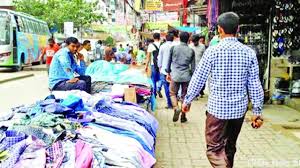
Eviction drives aimed at clearing sidewalks in the capital, Dhaka, are not new. However, recent initiatives to remove street hawkers without any clear rehabilitation plan or alternative employment arrangements have raised serious concerns among various quarters. A large section of economists, social analysts, and political observers believe that such a decision could produce adverse consequences and potentially backfire on the government, pushing it into a difficult situation.
In Dhaka, an estimated 500,000 hawkers earn their livelihoods through small-scale businesses on footpaths. Most of them belong to low-income groups, for whom street vending is the only source of income. According to relevant sources, nearly 5 million people depend directly or indirectly on these hawkers. In other words, eviction would not only affect half a million individuals but would also directly impact a much larger population, including their families. The consequences could extend beyond the capital, potentially creating an adverse socio-economic environment across the country.
If similar eviction drives are carried out in cities nationwide, analysts warn that nearly 10 million people could become unemployed, putting more than 25 million individuals at risk of economic hardship. Such a scenario could significantly disrupt the country’s socio-economic stability.
Experts caution that the sudden eviction of hawkers without alternative employment opportunities would push them into severe financial distress. A large portion of this population could fall into unemployment, poverty, and uncertainty. This, in turn, may increase the risk of social crimes such as theft, mugging, and robbery, as individuals struggle to survive.
As one economist noted, “Street hawkers are an integral part of the urban informal economy. They not only sustain themselves but also generate employment opportunities for many others through supply chains. Eliminating this sector abruptly would have multidimensional negative impacts across various sectors of the economy.”
The current economic context makes the issue even more sensitive. The country has yet to fully recover from the shocks of the COVID-19 pandemic and continues to face multiple challenges, including sluggish industrial growth, rising inflation, and pressure on foreign exchange reserves. Additionally, political instability and recent major national events, including sudden changes in government, have further strained the economy, according to analysts.
Political observers warn that decisions restricting livelihoods during an already fragile economic period may trigger significant political repercussions. In particular, communities directly affected by such measures may develop deep resentment, which could translate into broader public dissatisfaction.
There are also indications of quiet discontent within the ruling party. Several leaders, speaking on condition of anonymity, have expressed concern that such a decision should have been made with greater consideration of ground realities. According to them, “The combination of economic pressure and hawker eviction could provoke negative reactions among the public.”
They further warn that if the income of half a million hawkers is abruptly cut off, many may be forced into criminal activities out of desperation. This could lead to a deterioration in law and order, ultimately posing a significant challenge for the government.
Meanwhile, the global situation remains uncertain. Rising geopolitical tensions, particularly ongoing conflicts in the Middle East, are beginning to impact the global economy. Increasing fuel prices, higher import costs, and mounting pressure on foreign currency reserves are making conditions more difficult for developing countries like Bangladesh. Under such circumstances, additional internal economic disruption could worsen the situation further.
In this context, experts emphasize the importance of maintaining internal economic stability. They argue that putting a large informal sector like street vending at risk could impose additional strain on an already fragile economy.
However, urban planners acknowledge that keeping sidewalks free from encroachment is necessary. Ensuring smooth pedestrian movement, reducing traffic congestion, and maintaining urban order are all valid priorities. Nevertheless, they stress that any eviction process must be planned and humane; otherwise, the consequences could be severe.
According to one urban planning expert, “The focus should not be on eviction alone, but on rehabilitation. Designated markets or stalls can be developed to relocate hawkers. This would help maintain urban order while also preserving livelihoods.”
Analysts also point out that in many developed cities, authorities allocate specific zones where street vendors can operate under regulations. Introducing similar measures in Bangladesh could offer a sustainable and balanced solution.
Overall, many observers consider the eviction of hawkers without alternative arrangements to be short-sighted. They argue that such a move could have not only economic but also social and political repercussions, potentially placing the government in a difficult position.
Experts suggest that the government should reconsider the policy and engage with all relevant stakeholders to develop a comprehensive strategy. Initiatives such as rehabilitation programs, access to microcredit, skills training, and alternative employment opportunities could help mitigate the impact.
Ultimately, sustainable development can only be achieved when its benefits reach all segments of society. The key challenge for policymakers now is to strike a balance between maintaining urban order and protecting the livelihoods of millions of vulnerable people.