

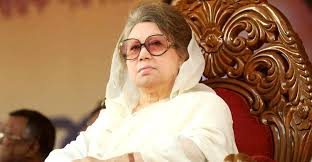
A towering chapter in Bangladesh’s political history has come to an end. Begum Khaleda Zia, three-time former Prime Minister and Chairperson of the Bangladesh Nationalist Party (BNP), passed away on Tuesday (December 30) at the age of 80. She breathed her last at the Coronary Care Unit (CCU) of Evercare Hospital in Dhaka while undergoing treatment (Inna Lillahi wa Inna Ilaihi Raji’un). The information was confirmed to journalists by BNP Media Cell member Atikur Rahman Rumon, while the party’s official social media platforms also announced her demise.
With her passing, Bangladesh loses one of its most influential political figures, marking the conclusion of a long, eventful and defining era in the country’s democratic journey.
A Long Battle with Illness
Bangladesh’s first female Prime Minister had long been suffering from multiple serious ailments, including liver cirrhosis, kidney complications, diabetes and heart disease. Her health deteriorated sharply late at night on November 23, prompting her admission to Evercare Hospital. Despite relentless efforts by doctors and prayers from millions across the country, she succumbed to her illnesses.
From Homemaker to Icon of Mass Movement
Once a shy and publicity-averse homemaker, Begum Khaleda Zia emerged—through the demands of history—as an uncompromising leader of the anti-autocracy movement. Born in 1945 in Dinajpur, Khaleda Khanam Putul led a quiet family life after marrying young Pakistan Army officer Ziaur Rahman.
The Liberation War of 1971 profoundly altered her destiny. While Ziaur Rahman declared revolt and served as a sector commander on the battlefield, Begum Khaleda Zia remained in Dhaka with her two young sons, detained by Pakistani forces. The nine months of war passed under constant fear, uncertainty and psychological trauma until she was freed after independence on December 16.
Even after independence, when Ziaur Rahman became Army Chief and later President, she remained distant from political limelight, living a modest life that later endeared her to the masses.
A Tragic Turning Point and Entry into Politics
The assassination of President Ziaur Rahman on May 30, 1981, during a failed military coup in Chattogram marked the darkest moment of her life. At a time when the BNP was gripped by internal divisions and conspiracies, senior party leaders urged her to step forward.
She formally joined the BNP as a primary member on January 3, 1982, and assumed party leadership in 1983. Her political emergence was swift and transformative. Turning personal grief into strength, she travelled tirelessly from Teknaf to Tetulia, gradually becoming the voice of millions.
The ‘Uncompromising Leader’ Against Military Rule
During General Hussain Muhammad Ershad’s military regime, Begum Khaleda Zia stood as an unyielding symbol of resistance. In 1986, when several parties agreed to contest elections under Ershad, she unequivocally refused, declaring that no fair election was possible under military rule. This stance cemented her image as the “Uncompromising Leader.”
Over nine years, she endured arrests, baton charges, tear gas, house arrests and repeated repression. Yet her steadfast leadership ultimately accelerated the downfall of the Ershad regime in 1990 and laid the groundwork for the demand for a non-party caretaker government.
First Woman Prime Minister and Democratic Reforms
In the landmark election of February 27, 1991—widely regarded as one of the fairest in Bangladesh’s history—the BNP secured a parliamentary majority. Begum Khaleda Zia took oath as Bangladesh’s first female Prime Minister and the second woman leader in the Muslim world.
One of her most historic achievements was restoring parliamentary democracy by abolishing the presidential system, thereby institutionalising democratic governance.
During her tenures (1991–1996 and 2001–2006), Bangladesh witnessed notable socio-economic transformation. She championed female education by introducing free education and stipends for girls up to higher secondary level, a policy that reshaped the country’s social fabric.
Major infrastructural projects, including the Jamuna Multipurpose Bridge, expansion of rural road networks, liberalisation of the telecommunications sector, banning of polythene, social forestry programmes and the introduction of VAT, were implemented during her administrations.
Resistance, Imprisonment and Endurance
Following the declaration of emergency on January 11, 2007, she faced intense pressure to go into exile but firmly refused, choosing imprisonment over compromise. After the Awami League assumed power in 2009, she endured nearly 16 years of sustained political persecution.
Her eviction from her long-time residence at Dhaka Cantonment in 2010, prolonged blockades, house arrest, and denial of basic rights marked a grim chapter in her life. In 2015, while she remained confined to her political office for 93 days, she received the devastating news of her younger son Arafat Rahman Coco’s death in exile—a moment that deeply scarred the nation.
In 2018, she was imprisoned in politically motivated cases and held in solitary confinement at the old Dhaka Central Jail. Her health deteriorated rapidly amid inadequate medical care. Despite repeated medical recommendations, she was denied permission for advanced treatment abroad.
Freedom, Forgiveness and Final Legacy
Following the mass uprising of August 5, 2024, which led to the fall of the Sheikh Hasina government, Begum Khaleda Zia was unconditionally released on August 6 after nearly six years of imprisonment and effective house arrest.
Even in freedom, she displayed statesmanship rather than vengeance. In a historic virtual address to a BNP rally on August 7, she urged the nation to reject hatred and revenge, calling instead for peace, unity and rebuilding a democratic Bangladesh—words that will remain etched in history.
An Everlasting Beacon
Begum Khaleda Zia chose the dust of the streets over a life of comfort, prison cells over exile, and principles over compromise. Repression weakened her body but never her resolve.
Though she is no longer among us, her 54-year political legacy continues to shine brightly. In the history of Bangladesh’s democracy, Begum Khaleda Zia will remain a guiding star—unyielding, indomitable, and eternal.