

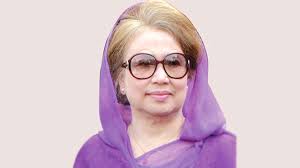
Begum Khaleda Zia, Chairperson of the Bangladesh Nationalist Party (BNP) and three-time former Prime Minister of Bangladesh, has passed away (Inna Lillahi wa Inna Ilaihi Raji'un). She breathed her last at 6:00am on Tuesday (December 30) while undergoing treatment at Evercare Hospital in the capital. She was 80. Her death has cast a deep shadow of mourning over the country’s political landscape. Over a political career spanning nearly five decades, Begum Khaleda Zia emerged as one of the most prominent symbols of Bangladesh’s democratic movement.
Early Life and Family Background
Begum Khaleda Zia was born on August 15, 1946, in Dinajpur district. Her father was Iskandar Majumder and her mother was Taiba Majumder. Following the Partition of the subcontinent, her father migrated from Jalpaiguri in India to what was then East Pakistan. The family’s ancestral home was in Feni district.
She completed her secondary education at Dinajpur Government Girls’ High School and later studied at Surendranath College in Dhaka.
In 1960, she married then army officer Ziaur Rahman—later the proclaimer of independence, a war hero and President of Bangladesh. This marriage would ultimately shape the course of her political destiny.
Entry into Politics
The assassination of President Ziaur Rahman in a failed military coup on May 30, 1981, marked a turning point in Khaleda Zia’s life. Transforming personal grief into political resolve, she gradually stepped into active politics.
On January 2, 1982, she joined the BNP as a general member. Within a short time, she rose rapidly—becoming Vice-Chairperson in March 1983 and Chairperson of the party in August 1984.
Anti-Ershad Movement and the ‘Uncompromising Leader’
Following General Hussain Muhammad Ershad’s military takeover in 1982, Begum Khaleda Zia assumed a leading role in the movement to restore democracy. She was a key architect of the seven-party alliance formed in 1983.
Rejecting the controversial 1986 parliamentary elections, she refused to participate despite several parties doing so. Her unwavering stance against military rule led to her arrest seven times between 1983 and 1990.
During this period, she strengthened the BNP’s student wing, Jatiyatabadi Chhatra Dal, which played a decisive role in the anti-Ershad movement. Her firm resistance to authoritarian rule earned her the title of the “Uncompromising Leader.”
First Female Prime Minister
In the landmark and widely acclaimed free and fair election held on February 27, 1991, Begum Khaleda Zia emerged victorious and became Bangladesh’s first female Prime Minister.
Under her leadership, the presidential system was abolished and parliamentary democracy was restored. Her first term witnessed significant economic reforms, job creation and industrial growth. Employment in the ready-made garment sector increased by nearly 29 percent within five years, with approximately 200,000 women entering the workforce.
Role on the International Stage
As Prime Minister, she raised Bangladesh’s rightful claim to a fair share of Ganges water at the United Nations. In 1992, during a visit to the White House, she brought international attention to the plight of Rohingya Muslim refugees.
Her diplomatic efforts culminated in a repatriation agreement with Myanmar, facilitating the return of Rohingya refugees who had taken shelter in Bangladesh in the early 1990s.
Second and Third Terms in Office
In February 1996, despite the BNP securing a parliamentary majority, she resigned within a month in response to demands for a caretaker government system. In the subsequent June election, the BNP lost power but emerged as the largest opposition party with 116 seats.
In 1999, she formed the four-party alliance. Riding on promises to curb corruption and terrorism, she led the alliance to victory in the 2001 general election, becoming Prime Minister for the third time.
In recognition of her contributions to women’s empowerment and leadership, Forbes magazine ranked her 29th on its list of the world’s most powerful women in 2005.
Imprisonment and Declining Health
In 2006, Begum Khaleda Zia handed over power peacefully. She was arrested during the military-backed caretaker government in 2007. After the Awami League assumed power in 2009, she served as Leader of the Opposition.
In 2018, she was imprisoned in what her party described as politically motivated corruption cases. Her health deteriorated significantly during incarceration. Amid the COVID-19 pandemic in 2020, she was conditionally released and allowed to remain at home.
Despite the need for advanced treatment abroad, permission was long denied. Following the political upheaval of 2024, she travelled to London for medical treatment. After returning to Bangladesh, her health again worsened, leading to her hospitalization on November 23, 2025.
Contributions to Education and Social Development
Her governments introduced compulsory free primary education, free education for girls up to Class 10, stipends for female students, and the “Food for Education” programme. The upper age limit for entry into government service was raised from 27 to 30, and the education sector received its highest-ever budget allocation during her tenure.
An Unbeaten Electoral Record
Throughout her long political career, Begum Khaleda Zia never lost an election. She won from five different constituencies between 1991 and 2001, and secured victories in all three seats she contested in the 2008 general election.
A Chapter Closes
With the passing of Begum Khaleda Zia, an era in Bangladesh’s political history comes to an end. Her life—defined by struggle, leadership, sacrifice and resilience—will remain etched in the nation’s collective memory as a defining chapter of its democratic journey.