

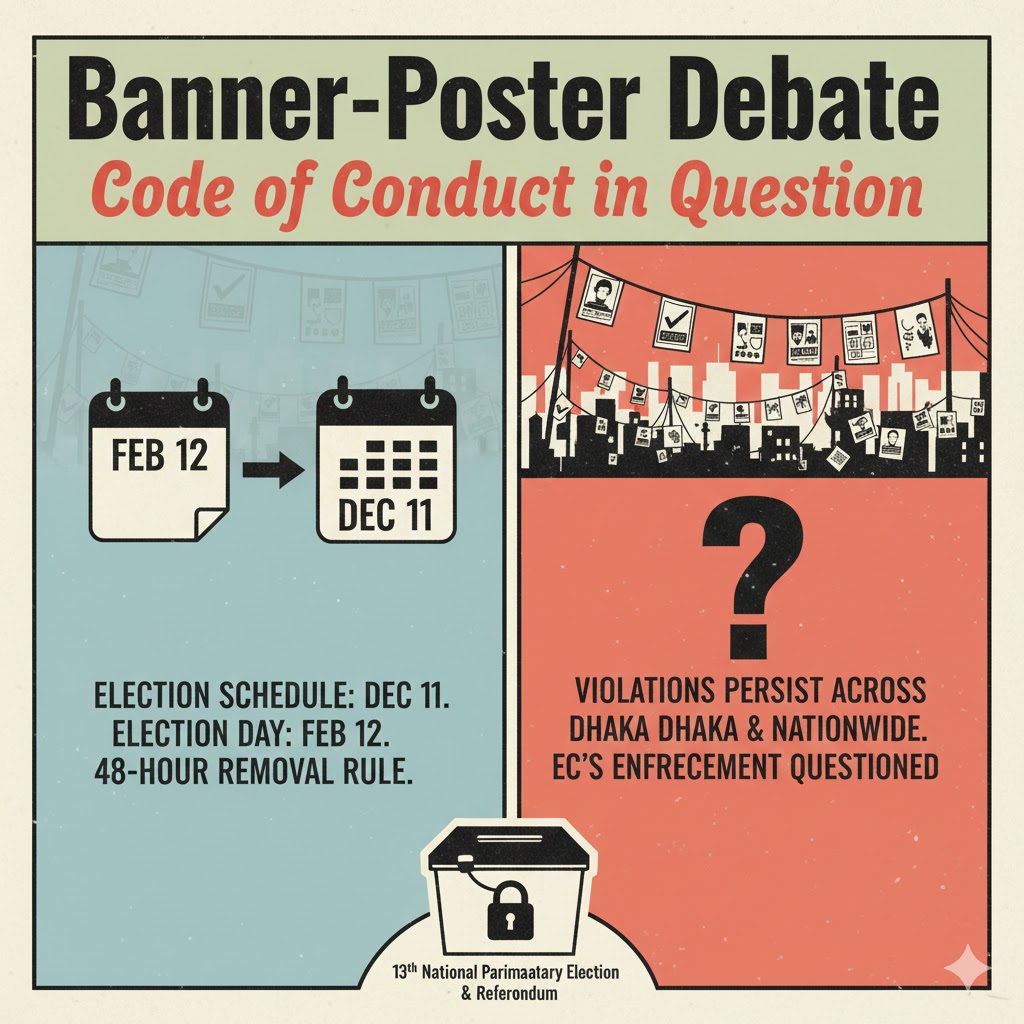
The electoral atmosphere across Bangladesh is heating up ahead of the 13th National Parliamentary Election and the concurrent referendum scheduled for February 12. In this context, the Election Commission (EC) officially announced the election schedule on December 11. While the code of conduct was supposed to come into effect immediately after the schedule announcement, its implementation on the ground remains questionable. According to EC directives, all candidates and associated personnel must remove banners, posters, festoons, and other campaign materials within 48 hours of the schedule announcement. However, observations from the capital, Dhaka North and South, as well as district towns, upazilas, and rural areas, reveal that banners and posters continue to dominate public spaces, casting doubt on the EC’s capacity and strictness in enforcing the code of conduct.
Field observers and political analysts suggest that this is not merely a delay but reflects the influence of certain candidates and the disproportionate dominance of their campaigns. An analyst, who wished to remain anonymous, said, “Senior candidates are exerting direct pressure on their campaign workers. Some claim, ‘The banners were put up by the workers on their own initiative; I didn’t know,’ which is practically impossible without the candidates’ consent.”
Internal reports from political parties also indicate disparities in code of conduct compliance. Influential and financially strong candidates appear to enjoy greater freedom to violate the rules. This raises serious concerns about maintaining a level playing field and equal opportunity for all participants in the election.
An EC senior official emphasized, “No violations of the code of conduct will be overlooked. Monitoring on the ground has been intensified, and mobile courts will be deployed if necessary.” However, political analysts argue that warnings or announcements alone are insufficient. Without visible punitive measures, enforcing the code of conduct effectively will remain a challenge.
Certain constituencies in Dhaka, Chattogram, and Rajshahi have emerged as critical areas of concern. Reports indicate that in Dhaka-7, Chattogram-5, and Rajshahi-3, candidates have yet to remove banners and festoons. Although local administration and law enforcement agencies are actively monitoring these areas, limitations in enforcement persist.
Civil society representatives stressed, “Elections are not only about voting day. The strict enforcement of the law and code of conduct must begin immediately after the schedule announcement. Failure to remove banners and posters will make maintaining law and order on voting day even more difficult.” They warned that if enforcement is biased—targeting smaller candidates while letting prominent candidates off—the public’s confidence in the electoral process could be seriously undermined.
The EC has further stated that failure to remove banners and posters could result in fines, warnings of disqualification, and even criminal proceedings. Relevant administrative and law enforcement authorities have been issued necessary directives, though it remains uncertain how effectively these will be implemented on the ground.
In conclusion, while the electoral momentum is intensifying after the schedule announcement, the enforcement of the code of conduct and maintenance of order remain critical. The credibility and public confidence in the election will depend heavily on how strictly the EC, authorities, candidates, and political parties adhere to and enforce the rules. Without coordinated action, the transparency and legitimacy of the election process face significant challenges.