

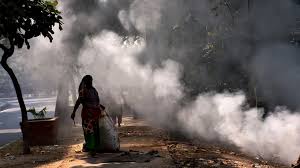
Invisible killer dust and severe air pollution have become an inseparable part of daily life for residents of Dhaka, posing serious threats to public health. The concentration of fine particulate matter in the air is increasing steadily, with respirable silica dust identified as the most dangerous component. Experts warn that this dust can directly penetrate the lungs and cause long-term health damage.
Two recent international-standard studies have revealed that the levels of fine particulate matter (PM), toxic gases, and respirable silica dust in Dhaka’s air far exceed the safety limits set by the World Health Organization (WHO). Conducted in early 2025, the studies provide an in-depth analysis of pollution sources, intensity, and associated health risks in the capital.
The research identified seven pollution “hotspots” across Dhaka, including Gabtoli–Aminbazar, Jatrabari–Demra, Uttara–Abdullahpur, Kanchpur–Sonargaon, and Mugda–Badda corridors. In these areas, respirable silica dust levels were found to be three to twelve times higher than the permissible safety limit.
Winter Sees the Worst Pollution Levels
According to the studies, Dhaka’s air quality deteriorates most severely during winter. During this season, stagnant air, reduced humidity, and sudden spikes in fine particulate matter create hazardous conditions. Levels of dust, sulfur dioxide, nitrogen dioxide, carbon monoxide, and ozone rise significantly above normal. As a result, air pollution in Dhaka is no longer a seasonal issue but has evolved into a year-round public health crisis.
Major Sources of Pollution
Researchers identified road dust and exposed construction materials as the primary sources of air pollution in the city. Broken roads, vehicle movement, and pedestrian activity cause accumulated dust to become airborne. Uncovered sand transportation, piles of sand and cement on roadsides, brick crushing at construction sites, and dust settled on roads significantly increase silica concentrations.
Vehicles and industrial activities were identified as the second-largest pollution sources. Old and unfit vehicles—particularly diesel-powered buses and trucks—contribute heavily to fine particulate emissions. Additionally, emissions from small roadside industries, biomass burning, and waste incineration further degrade air quality. Southern parts of Dhaka, where industrial density is higher, experience the worst air pollution.
Brick Kilns Add to the Crisis
The studies also identified brick kilns as a persistent source of pollution. Coal-fired brick kilns in areas such as Savar–Ashulia, Demra–Rupganj, and Aminbazar–Gabtoli emit smoke that remains suspended in the air for extended periods. Due to outdated technology and inadequate filtration systems, pollution control remains ineffective. Researchers warned that without shutting down illegal kilns and adopting modern technologies, reducing air pollution would be impossible.
Rising Health Risks
Experts say prolonged exposure to polluted air increases the risk of respiratory diseases, asthma, pneumonia, breathing difficulties, heart disease, and congenital disorders. Cases of eye irritation, skin problems, and allergies are also on the rise. Long-term exposure to respirable silica dust can cause permanent lung damage known as silicosis, a condition with no complete cure.
The environmental impact is equally alarming. Dust accumulation on leaves disrupts photosynthesis, stunting plant growth and reducing crop yields. River water is becoming acidic, threatening aquatic life. In many parts of the capital, the annual growth rate of trees has declined at an alarming level.
Voices from the Affected Communities
Residents of highly polluted areas report severe daily hardships.
Gabtoli resident Fazlur Rahman said, “The road dust is so intense that breathing becomes difficult even while walking. Sending children to school feels frightening.”
Maryam, a resident of Jatrabari, said, “Dust from construction sites combined with vehicle smoke has made going outside almost impossible. I suffer from constant coughing and breathing problems.”
Policy Failures Under Scrutiny
Researchers pointed to policy failure as the core reason behind the crisis. Despite existing environmental laws, enforcement remains weak. Regulations requiring construction materials to be covered are ignored, brick kiln policies are poorly implemented, vehicle fitness checks are irregular, and waste burning continues unchecked. Lack of coordination among responsible agencies has further worsened the situation.
Expert Opinion
Professor Dr. Ahmad Kamruzzaman Majumder, Dean of the Faculty of Science at Stamford University Bangladesh and a noted environmentalist, emphasized the importance of individual and institutional action. He advised maintaining proper indoor ventilation, regular cleaning of household items, and wearing masks outdoors. However, he stressed that strong government enforcement is essential.
“Unfit vehicles must not be allowed on the roads under any circumstances. Environmental compliance in construction activities must be ensured. Awareness alone is not enough—without strict enforcement of laws, pollution control is impossible,” he said.
Call for Urgent Action
Experts warn that without immediate and effective measures—such as covering construction materials, upgrading brick kilns with modern technology, phasing out old vehicles, regularly sprinkling water on roads, strengthening monitoring by the Department of Environment, and expanding urban greenery—Dhaka’s air will soon become unfit for human breathing. Failure to act promptly could result in long-term and devastating consequences for public health and the environment.