

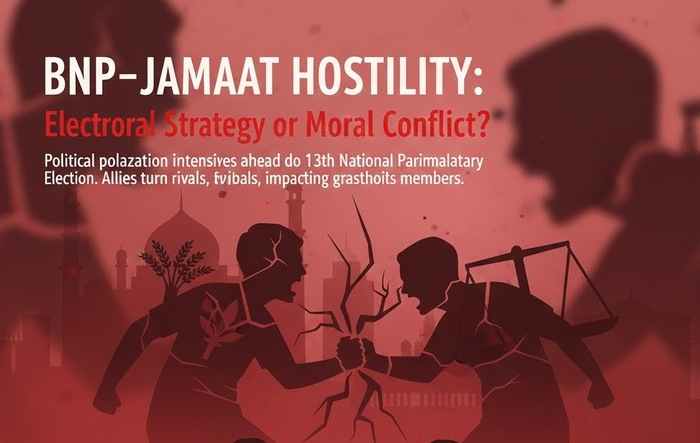
Ahead of the 13th National Parliamentary Election, tensions between Bangladesh’s two main political rivals, BNP and Jamaat-e-Islami, are intensifying. Once close political allies, the two parties are now openly engaging in a series of critical statements against each other. The verbal sparring at the leadership level is affecting grassroots members and supporters, creating a new layer of political polarization.Political analysts suggest that the root of this conflict lies more in electoral strategy and political calculation than in ideological differences. Dr. Sabbir Ahmed, Professor of Political Science at Dhaka University, told Jago News, “This is primarily election-driven political competition. In such contests, rivals naturally target each other’s vulnerabilities—that is normal.”
Political analyst Altaf Parvez noted that BNP and Jamaat are now the main contenders in this election. He explained, “Since there is no direct BNP–Awami League confrontation this time, BNP must face Jamaat. As a result, both parties are attempting to weaken each other politically.”
Parvez added that this strategy of targeting opponents is dividing voters into two distinct blocs, a tactic likely to intensify during the campaign. However, he questioned how much of this rivalry is principled versus strategic. According to him, if the criticism is ideological, both parties should first reflect on their past actions.
He reminded that BNP had previously allied with Jamaat despite knowing its historical record, and after the 2001 election, Jamaat leaders held ministerial positions in BNP’s government. Similarly, Jamaat remained under BNP’s political umbrella despite knowing about BNP’s corruption allegations. Therefore, if current criticism is moral, both parties have a responsibility to acknowledge their past.
Dr. Sabbir Ahmed also highlighted that Jamaat operated for years under BNP’s political shadow, with BNP assuming Jamaat would always remain aligned. Recently, however, Jamaat has been asserting itself as an independent political force, which BNP has struggled to accept. With Jamaat now stronger at the grassroots level, it has become a significant rival in several constituencies.
Nevertheless, Dr. Sabbir believes the hostility will not escalate into violent confrontation. He expects the conflict to remain primarily rhetorical and strategic.
Statements from top party leaders have further exposed this tension. Jamaat Amir Dr. Shafiqur Rahman, during a divisional meeting in Sylhet, accused certain groups of corruption and misappropriation, remarks analysts interpret as targeting both BNP and the Awami League. In response, BNP acting chairman Tarique Rahman criticized Jamaat’s role during the 1971 Liberation War and dismissed recent allegations of Jamaat’s corruption as unfounded.
Additionally, statements by BNP Secretary General Mirza Fakhrul Islam Alamgir and Jamaat Secretary General Mia Golam Parwar have widened the gap between the two parties.
Analysts also note that both the Liberation War and religion are being employed as electoral tools. Dr. Sabbir Ahmed said that invoking the Liberation War could serve as a vote-gaining strategy for BNP, as similar tactics are used by other parties.
Altaf Parvez added that both the Liberation War and religion have been politically exploited. He emphasized that the Liberation War is integral to Bangladesh’s identity and cannot be claimed by any single party. Similarly, using religion as a political tool contradicts the spirit of 1971, the 1990 democratic movement, and recent popular uprisings.
Overall, analysts agree that the current hostility between BNP and Jamaat largely reflects electoral realities. However, they caution that if this rivalry crosses ideological limits, it could deepen divisions within the country’s political landscape.