

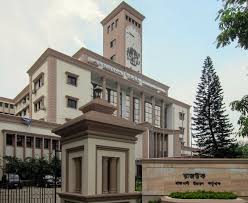
A three-member investigation committee—formed on the instructions of the High Court—has uncovered widespread violations of RAJUK’s land allotment regulations, specifically Rule 13/A, which governs the “reserved quota” category. The committee’s findings show that plots meant for individuals with national-level exceptional contributions were instead allocated to relatives, affiliates, and preferred individuals of influential political figures.
Rule 13/A Requirements Ignored
According to RAJUK’s land allocation rules, a plot under the reserved quota may only be granted to applicants who:
-
Have made an “extraordinary contribution” to the nation in public service or any professional field; and
-
Applied within the stipulated time under the official allotment notification but did not receive a plot.
The investigation, however, found that these mandatory criteria were repeatedly ignored.
10-Katha Plot Allocated to Dr. Munawar Mahmud
Dr. Munawar Mahmud—son-in-law of former Prime Minister Sheikh Hasina’s energy adviser, Tawfiq-e-Elahi—received a 10-katha plot under the reserved quota despite:
-
Never applying during the official application period, and
-
Residing permanently abroad, with no demonstrated need for a plot.
In 2019, RAJUK’s board allotted him the plot based solely on directives from the Prime Minister’s Office and the administrative ministry. After receiving the allotment, Mahmud authorized his father-in-law as am-mukhtar, who subsequently sold the plot to businessman and former MP A.K. Azad.
The committee reported no documentation explaining what “extraordinary national contribution” justified his qualification—calling it a direct violation of the rules and the published prospectus.
Former President Abdul Hamid’s Two Sons Receive Plots
Former President Abdul Hamid’s son, Rasel Ahmed, did not apply for a plot under the official process but was allotted a 10-katha plot in 2014 under the reserved quota. No national-level achievements or professional contributions were recorded in support of his allotment. His identity in the RAJUK files was limited to being “son of Abdul Hamid.”
Another 10-katha plot was similarly allocated to his brother, MP Rezwan Ahmad Taufiq, under the same quota.
The investigation committee concluded that both cases represent clear violations of the 13/A criteria.
Deputy Attorney General Motahar Hossain Saju: Plot Enlarged Without Procedure
Former Deputy Attorney General Motahar Hossain Saju received a 5-katha plot under the reserved quota in 2012—despite not applying under the official notification. Later that year, he applied to have the plot converted to a 10-katha allotment.
Though there was no formal recommendation from the ministry supporting his request, RAJUK’s board unilaterally expanded his plot to 7.5 kathas, bypassing all legal requirements.
The committee noted that:
-
No “significant national contribution” was documented, and
-
The allocation and expansion were made solely on administrative directives—constituting a severe breach of the rules.
Three Plots Allotted to Members of Saifuzzaman Shikhor’s Family
Kamrun Laila Jolly—daughter of former MP Asaduzzaman—first applied through the autonomous-body employee category but was not selected. Later, she received a 5-katha plot under the reserved quota through ministry instructions.
Additionally:
-
Her mother, Mrs. Monowara Zaman, and
-
Her brother, Saifuzzaman Shikhor, MP
were each allotted separate plots under the same quota.
The committee flagged this as a direct and deliberate violation, noting that allocating three reserved-quota plots to members of one family contradicts both the letter and spirit of the rules.
Reserved Quota Limit Exceeded: 600 Allowed vs. 942 Allotted
In the Purbachal New Town Project (2009), RAJUK designated 10% (600 plots) as reserved quota. Investigators found that this number was exceeded by a large margin, with 942 plots allotted under the quota.
The additional beneficiaries included:
-
Ministers, state ministers, MPs, and judges
-
Political activists (domestic and expatriate)
-
Select journalists, cultural personalities, and athletes
-
Favored government and private officials
-
Relatives and associates of powerful political figures
-
Staff of the Prime Minister’s Office, Ganobhaban, and Bangabhaban (2009–2024)
The committee said that in most cases, no evidence was provided to justify the beneficiaries’ eligibility under Rule 13/A.
Progress of the Investigation
The committee—formed on 29 May 2024 and led by former Grade-1 civil servant Mohammad Moniruzzaman—has so far:
-
Identified irregularities in 200 plot allotments, submitted to the ministry and High Court
-
Detected irregularities in an additional 100 plots, soon to be reported
The investigation committee states that from 2009 to 2024:
-
Reserved quota plots were overwhelmingly allocated based on political influence, partisan preference, and administrative pressure, not merit
-
Rule 13/A, the 2009 Allotment Procedure, the 2008 prospectus, and the 1969 RAJUK land rules were routinely violated
As a result, widespread procedural breaches occurred across RAJUK’s major residential projects—most notably the Purbachal New Town Project.