

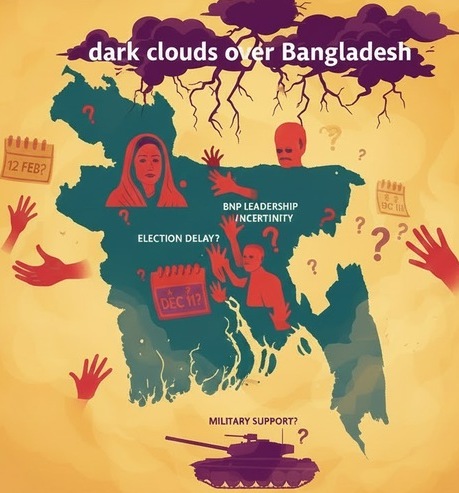
A dense fog of political uncertainty has settled over Bangladesh. Ordinary citizens say they are unable to understand which direction the country’s political situation is heading. Conversations with people from various walks of life reveal a growing belief that the upcoming national election may not take place soon. Although the interim government and the Election Commission (EC) are speaking of preparations, the reality on the ground—political tension, conflicting statements and persistent rumors—is steadily eroding public confidence.
The interim government has already instructed the Election Commission to begin preparations for the polls. The EC has indicated that the election schedule may be announced on 11 December. If everything proceeds as planned, the national election is expected to be held around mid-February, possibly on 12 February. While administrative bodies have begun initial preparations, the prevailing political instability continues to deepen public uncertainty.
To ensure a free and peaceful election, the authorities have sought full cooperation from the military. The Army Chief has also assured support. Yet this assurance alone has not been strong enough to dispel political doubts—especially because the internal situation within the country’s second-largest political party, the BNP, remains complicated, particularly regarding leadership issues.
BNP Chairperson and former Prime Minister Begum Khaleda Zia has long been ill, leaving her political role largely inactive. At the same time, ongoing uncertainty over the return of BNP’s Acting Chairman Tarique Rahman has created confusion both within the party and among the general public. Despite several public indications of his possible return, he has not come back to the country. This has led many—including senior BNP members—to believe that his return remains genuinely uncertain.
Although the BNP Secretary General and other senior leaders have repeatedly assured supporters that Tarique Rahman will return, the continually changing dates and unfulfilled promises have weakened public trust. A recent social media post related to his return has further muddied the political waters, triggering renewed debate and tension across the country.
Political analysts say that the present scenario indicates “dark clouds” gathering over Bangladesh’s political landscape. According to them, “The dark clouds over Bangladesh are unlikely to clear anytime soon.” Many leaders from the BNP and other political parties echo the same concern, warning that the coming days may bring greater instability.
Adding to the anxiety is a widespread rumor that, after the previously discussed “Minus Two Formula,” a new “Minus Four Formula” involving alleged domestic and international actors is now being plotted. Although there is no official evidence supporting these claims, such rumors alone have been enough to heighten confusion and fuel fears of political upheaval.
Compounding the political tensions is an ongoing economic crisis. The country’s foreign exchange reserves have declined, industries are slowing down, and foreign investment has dropped significantly. Business leaders say the absence of a fully elected government has made investors increasingly hesitant. Medium and large investors are reluctant to commit to new ventures, deepening economic stagnation. According to business circles, political instability lies at the root of the current economic slowdown.
BNP Standing Committee member Amir Khasru Mahmud Chowdhury has said that Tarique Rahman will certainly return to the country at the right time, whenever he deems it appropriate.
While ordinary citizens continue to express uncertainty regarding the upcoming national election, the Chief Adviser’s Press Secretary, Shafiqul Alam, has repeatedly assured the public that the election will be held on schedule.
As a result, anxiety among ordinary citizens is growing. People believe that not only political parties, but also economists, business leaders, and the administration as a whole are eagerly waiting for the election. Many feel that if, after 15 years, a genuinely representative government is elected through a free and fair vote, political stability will return and the economy will have a chance to recover. Such a change, they believe, could improve the lives of ordinary people.
However, despite repeated assurances from the government, a large segment of the public remains uncertain about whether the election will actually take place on time. Ground realities show rising tension, persistent rumors, confusion, and widespread doubt. As many citizens say, “The sound of an approaching political storm can already be heard in Bangladesh.”
And the question that now weighs heavily on people’s minds is: Where will this all end?