

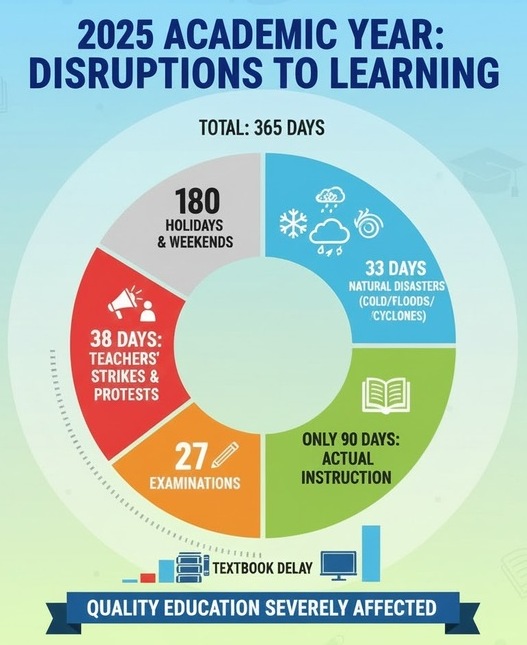
In the current 2025 academic year, classes in government and private primary and secondary schools have been conducted for less than 100 days. Holidays, examinations, and disruptions caused by teachers’ strikes, protests, and rallies have prevented students from attending regular classes. Additionally, delays in textbook distribution have significantly affected the quality of education. According to the official academic calendar for government primary schools, a total of 180 days are lost due to government and weekly holidays. Of the remaining 185 working days, teachers observed 38 days of strike action demanding salary and allowance increases, and 27 days were allocated for examinations. Due to cold waves, floods, cyclones, and other disruptions, classes were effectively held on only 107 days. Considering delays in textbook delivery, the number of actual instructional days fell below 90.
A similar situation has been observed in government secondary schools. Of 185 working days, only 95–100 days saw full classes due to exams, teachers’ protests, natural disasters, and unplanned school closures. In MPO-listed private secondary schools, strikes and protests have reduced actual class days to just 65–70.
The learning deficit has left students and parents concerned. Parents are worried about their children’s education being compromised. Sirajul Islam, a parent of a student at the historic Arani Monomohini High School in Bagar, Rajshahi, said, “There are very few actual classes. Most days my child only goes to school to mark attendance. Learning happens mainly through private tuition.”
Education experts have warned that prolonged learning gaps pose serious risks to the country. Dr. Manzur Ahmed, Emeritus Professor at BRAC University, said, “Quality education requires classroom-based teaching. Textbooks must be provided at the start of the year, and teachers must be present in classrooms.”
Dr. Sadik Hasan, Professor of Public Administration at Dhaka University, stated that deficits in primary-level English and mathematics cannot easily be overcome at secondary and higher education levels. Such prolonged learning gaps result in an inadequately skilled workforce, posing a warning sign for the nation.
Experts emphasize the urgent need to halt class disruptions due to strikes and holidays and to reconcile teachers’ legitimate demands with maintaining educational standards. Failure to address these issues endangers both the country’s education system and its future generations.