

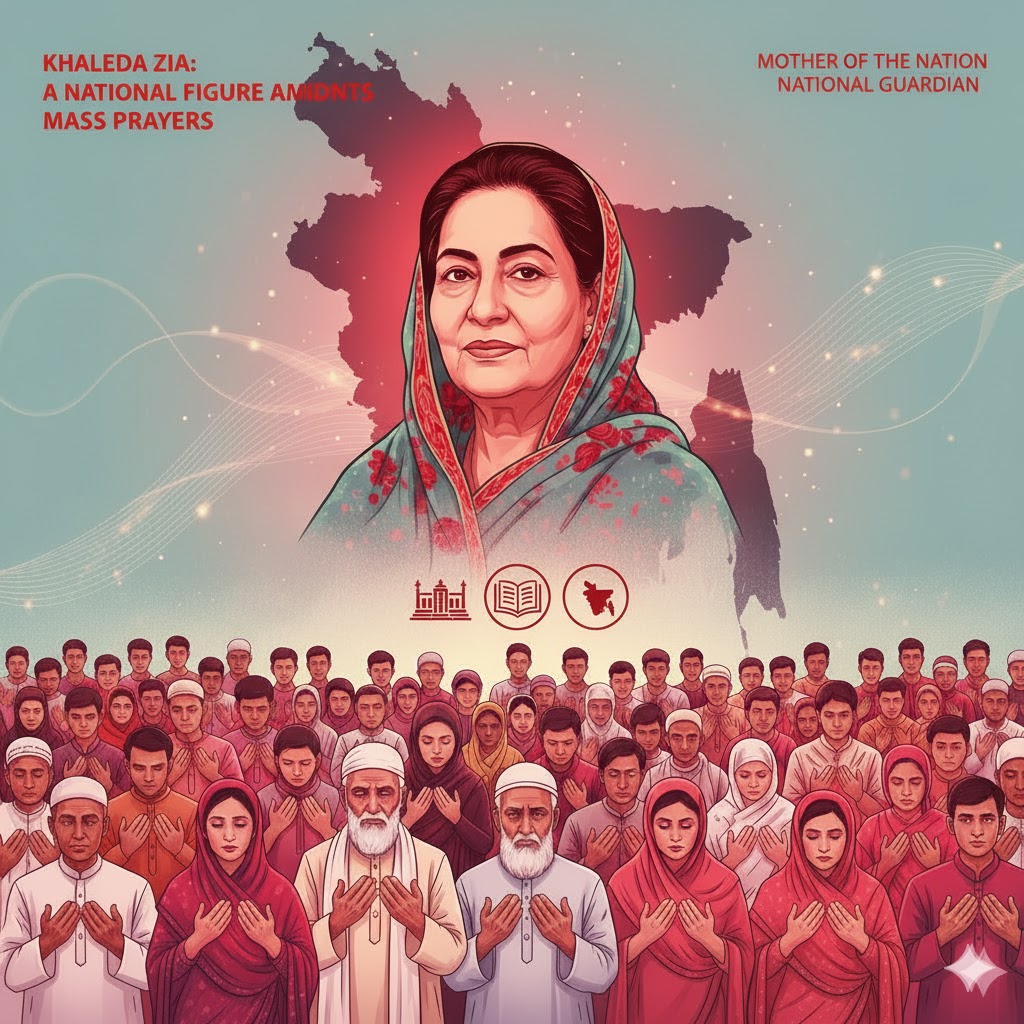
Begum Khaleda Zia, Chairperson of the BNP and former Prime Minister of Bangladesh, has increasingly transcended her role as a party leader to become a figure of national prominence. Leaders of various political parties, professionals, social and religious organizations, and citizens from all walks of life have expressed deep concern for her health and are praying for her swift recovery. The overwhelming compassion and nationwide participation surrounding her illness have created a unique moment in Bangladesh’s political culture.
With a political career spanning nearly five decades, three terms as Prime Minister, and a legacy of firm leadership during times of national crisis, Khaleda Zia remains a symbol of respect and devotion for millions. The government’s recent steps—including granting her VVIP status, deploying SSF protection, and inquiries from high-level state authorities—reflect the acknowledgment of her stature as a national leader.
The President, Chief Adviser, members of the Advisory Council, chiefs of the armed forces, top civil and military officials, leaders from parties beyond the BNP, and representatives of social and religious groups have participated in special prayer gatherings for her recovery. Beyond political considerations, a sense of human empathy and emotional solidarity has emerged—an occurrence that analysts describe as rare in contemporary Bangladeshi politics.
Throughout her political life, Khaleda Zia has endured imprisonment, harassment, and repeated persecution. During the 1/11 political crisis, she declared that Bangladesh was her final home and that she would never leave the country. In contrast to instances where several political figures chose exile or sought refuge abroad during Prime Minister Sheikh Hasina’s prolonged 16-year tenure, Khaleda Zia’s steadfast decision to stay in Bangladesh earned her widespread public admiration—strengthening the emotional bond millions feel for her today.
Social media platforms, particularly Facebook, are flooded with posts praying for her recovery. Citizens are expressing their concerns, grief, and heartfelt respect in numerous ways. Many refer to her as the “mother of the nation” or a “national guardian.” Political observers note that such nationwide emotional response to the illness of a political leader is extremely uncommon.
Khaleda Zia is widely considered a rare and extraordinary figure in Bangladeshi politics. Her journey—through family, society, and the state—has inspired many. She has led the BNP, founded by the late President Ziaur Rahman, with determination and resilience for decades. Like historical figures such as Maulana Bhashani, Sher-e-Bangla A.K. Fazlul Huq, and Huseyn Shaheed Suhrawardy, she has secured her place in history by serving three terms as the Prime Minister of Bangladesh.
Her rise from homemaker to head of government is a story of remarkable struggle and achievement. As the first female Prime Minister of Bangladesh, she played a significant role in women’s empowerment. Her tenure is remembered for administrative reforms such as improving education, expanding electricity and communication networks, modernizing the public pay scale, and introducing the city corporation system—all of which many still view as milestones of stability and national progress.
Today, her worsening health has rekindled political debate and public concern across the country. Discussions surrounding her treatment, humanitarian obligations, and future political role dominate the national narrative. Combining her longstanding political legacy with the public’s deep emotional connection, Khaleda Zia has emerged as far more than a party leader—she has become a widely respected national figure in the eyes of a significant portion of the population.