

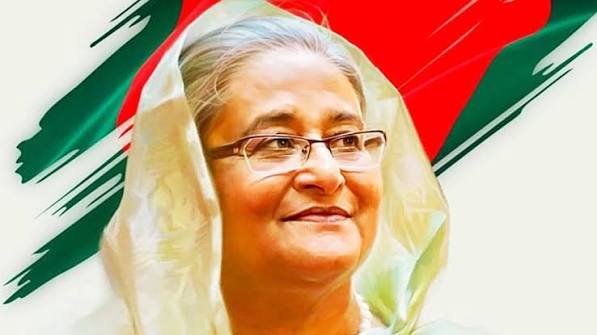
The Election Commission (EC) has blocked the National Identity Card (NID) of former prime minister Sheikh Hasina after she left Bangladesh and took refuge in India following the July uprising. As long as her NID remains blocked, she has no scope to apply for a new one, according to EC officials.
Officials said there are both legal and technical reasons behind the restriction. Under the National Identity Registration Act, a person who has already been issued an NID cannot apply for another one.
Obtaining two NIDs is a punishable offence under the law. Several people have previously been found to have registered as voters more than once to obtain multiple identity cards, and legal cases have been filed against some of them. Others, claiming to have applied for multiple NIDs inadvertently, have voluntarily cancelled one of their cards. In such cases, the second NID is generally cancelled while the first one remains valid.
From a technical standpoint, obtaining two NIDs through separate registrations is now virtually impossible. Whenever a person submits a fresh application, the applicant's fingerprints are checked against the database on the EC's server. If the person has already been registered, the fingerprints are matched with the existing records, preventing the new application from being processed.
In the past, however, some individuals reportedly managed to register for a second NID by using their toes instead of their fingers. After such cases came to light, the authorities introduced additional checks to prevent this practice.
Sources said that in March last year, the NID Wing's System Manager, Muhammad Ashraf Hossain, locked the NID records of Sheikh Hasina and 10 members of her family. In the relevant official note, he stated that the records had been locked on the verbal instructions of ASM Humayun Kabir, director general of the NID Wing.
Those whose NID records were locked include Rehana Siddiq, Sheikh Hasina, Sajeeb Ahmed Wazed, Saima Wazed, Shahin Siddiq, Bushra Siddiq, Tulip Rizwana Siddiq, Azmina Siddiq, Radwan Mujib Siddiq and Tarique Ahmed Siddiq.
Contacted on the matter, NID Wing System Manager Muhammad Ashraf Hossain said a locked NID card could no longer be used.
He added that an NID could also be locked when someone was suspected of obtaining voter registration through false information, pending completion of an investigation. In many cases, he said, the NIDs of prominent individuals were locked at the request of various authorities to prevent possible misuse. Such cards could subsequently be unlocked upon request.
Before the NIDs of Sheikh Hasina and her family members were locked, Bangladesh Bank had suspended their bank accounts. NID verification is required for withdrawing money from bank accounts, while the identity card has also become essential for accessing a wide range of public and private services.
Responsible EC officials said that having an NID locked does not necessarily mean that the information provided by its holder is incorrect or that the card was obtained through fraudulent means. NIDs are sometimes locked at the request of different government agencies in connection with corruption investigations or other matters.
They clarified that Sheikh Hasina's NID was not locked because of incorrect information. All the information on her identity card was valid, but the card remains inactive. As a result, she cannot access citizen services using it while the restriction remains in place.
Therefore, applying for a new NID is not an option in her case. She may, however, apply to have her existing NID unlocked. Once it is reactivated, she will be able to use the same identity card to access relevant services.
Mohammad Saiful Islam, director (Operations) of the EC's NID Wing, said he was unaware of the former prime minister's specific case or whether she had submitted any application.
"However, as a general rule, if a person's NID has been blocked, there is no scope for that individual to obtain a new one through a fresh application. The person already has an NID; it is simply in a locked state," he said.
The issue became a major topic of discussion after Reuters reported on Monday (November 9) that Sheikh Hasina had applied to the Bangladesh High Commission in New Delhi for a new passport and NID.
However, Saidur Rahman, press minister at the Bangladesh High Commission in New Delhi, told BanglaNews that the former prime minister, who was ousted following the student-led mass uprising, had not personally applied for a new passport or NID.
"We received an email from a firm named Matrix Chambers requesting the issuance of a passport and NID in Sheikh Hasina's name. We do not know whether the request is genuine. There is no way for us to establish that it was actually made on Sheikh Hasina's behalf," he said.
Rahman said the email, sent by the law firm, did not include any document or evidence of authorisation from Sheikh Hasina.
"We have forwarded the email to the Ministry of Foreign Affairs," he added.
Sources said a letter requesting the issuance of a new Bangladeshi passport and NID for Sheikh Hasina was sent to the Bangladesh High Commission in New Delhi by her lawyer. The letter was reportedly sent on Monday (November 9) by UK-based lawyer Steven Powles KC to Priti Rahman, Bangladesh's acting high commissioner to India.
Meanwhile, Foreign Affairs State Minister Humayun Kabir described the reported application for a new passport and NID as "utterly ridiculous".
"Bangladesh does not issue passports to terrorists. Rather, we want to bring her back to the country under the extradition treaty and ensure that her sentence is carried out," he said.