

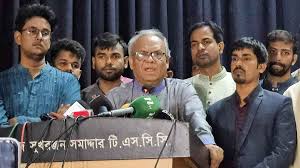
BNP Senior Joint Secretary General and former RUCSU Vice President Ruhul Kabir Rizvi has said that the Bangladesh Nationalist Party (BNP) is the “champion of democracy” in the country. “Democracy and BNP are inseparable. Multiparty democracy, Ziaur Rahman, Begum Khaleda Zia, and Tarique Rahman are united by one commitment — a pledge that can never be broken,” he said. He made these remarks on Tuesday (November 11) afternoon while addressing a discussion meeting organized by the Rajshahi University unit of Jatiyatabadi Chhatra Dal (JCD) at the TSC Complex, marking the 50th anniversary of ‘7 November National Revolution and Solidarity Day.’
Rizvi said, “BNP has never compromised on the question of democracy — neither with Ershad nor with the tyrant Hasina. Inspired by that legacy, we continue our struggle. The spirit of November 7 guided the events of August 5, which ultimately forced her (Sheikh Hasina) to flee. November 7 cannot be described in simple terms — it was the day we truly attained independence. Every revolution needs a courageous herald of freedom, and in 1971 it was Major Zia who declared from Kalurghat Radio, ‘I am Zia speaking — I declare the independence of Bangladesh.’ The same voice echoed again on November 7. Ziaur Rahman was the central figure of that historic day.”
Highlighting recent student politics, Rizvi said, “RUCSU elections have been held, and coexistence has returned to the campus — something that was absent during the fascist era. Where fascism grows, democracy cannot breathe. Under fascism, democratic institutions, the Election Commission, the press, and freedom of speech all come under attack, and universities are no exception. Sheikh Hasina’s rule was worse than dictatorship — it was fascist rule. During that time, Chhatra Dal activists could not work freely, attend classes, or use the library. They endured 15–16 years of such oppression.”
At the discussion, JCD Central General Secretary Nasir Uddin Nasir said, “During the July-August movement, 142 of our leaders and activists were martyred. Despite widespread irregularities and conspiracies in student union elections, Chhatra Dal perhaps did not achieve the expected results. Still, we believe we should have done better.”
He added, “Those who were elected as VP, GS, and AGS in DUCSU and JUCSU elections were aligned with the Awami League and shared their political ideology. But those who contested from Chhatra Dal or other opposition student organizations could not even stay in their dormitories because they opposed fascism. Even the Dhaka University elections could not ensure a level playing field.”
Nasir further said, “After two student union elections, I have realized that every VP and GS elected in future student bodies seems required to have ties with the Chhatra League. Though we lost in four consecutive student elections, we must learn from our mistakes and move forward.”
Rajshahi University JCD President Sultan Ahmed Rahi said, “On November 3, 1975, when Khaled Mosharraf imprisoned Shaheed Ziaur Rahman, the united soldiers and people freed him on November 7. That day was not an ordinary date — it symbolized Bangladesh’s sovereignty. Ziaur Rahman worked tirelessly to establish Bangladesh as a dignified nation in the global arena.”
The event was attended by President of the Nationalist Teachers’ Forum Professor Abdul Alim, Chairman of the Folklore Department Professor Jahangir Hossain Babu, President of Zia Parishad Habibur Rahman Habib, and around 300 leaders and activists of BNP and its affiliated organizations.
Rizvi said, “BNP has never compromised on the question of democracy — neither with Ershad nor with the tyrant Hasina. Inspired by that legacy, we continue our struggle. The spirit of November 7 guided the events of August 5, which ultimately forced her (Sheikh Hasina) to flee. November 7 cannot be described in simple terms — it was the day we truly attained independence. Every revolution needs a courageous herald of freedom, and in 1971 it was Major Zia who declared from Kalurghat Radio, ‘I am Zia speaking — I declare the independence of Bangladesh.’ The same voice echoed again on November 7. Ziaur Rahman was the central figure of that historic day.”
Highlighting recent student politics, Rizvi said, “RUCSU elections have been held, and coexistence has returned to the campus — something that was absent during the fascist era. Where fascism grows, democracy cannot breathe. Under fascism, democratic institutions, the Election Commission, the press, and freedom of speech all come under attack, and universities are no exception. Sheikh Hasina’s rule was worse than dictatorship — it was fascist rule. During that time, Chhatra Dal activists could not work freely, attend classes, or use the library. They endured 15–16 years of such oppression.”
At the discussion, JCD Central General Secretary Nasir Uddin Nasir said, “During the July-August movement, 142 of our leaders and activists were martyred. Despite widespread irregularities and conspiracies in student union elections, Chhatra Dal perhaps did not achieve the expected results. Still, we believe we should have done better.”
He added, “Those who were elected as VP, GS, and AGS in DUCSU and JUCSU elections were aligned with the Awami League and shared their political ideology. But those who contested from Chhatra Dal or other opposition student organizations could not even stay in their dormitories because they opposed fascism. Even the Dhaka University elections could not ensure a level playing field.”
Nasir further said, “After two student union elections, I have realized that every VP and GS elected in future student bodies seems required to have ties with the Chhatra League. Though we lost in four consecutive student elections, we must learn from our mistakes and move forward.”
Rajshahi University JCD President Sultan Ahmed Rahi said, “On November 3, 1975, when Khaled Mosharraf imprisoned Shaheed Ziaur Rahman, the united soldiers and people freed him on November 7. That day was not an ordinary date — it symbolized Bangladesh’s sovereignty. Ziaur Rahman worked tirelessly to establish Bangladesh as a dignified nation in the global arena.”
The event was attended by President of the Nationalist Teachers’ Forum Professor Abdul Alim, Chairman of the Folklore Department Professor Jahangir Hossain Babu, President of Zia Parishad Habibur Rahman Habib, and around 300 leaders and activists of BNP and its affiliated organizations.