

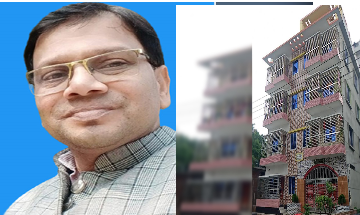
Faridpur: Mohammad Jahangir Alam, a cashier at the Faridpur Public Works Department (PWD), began his government career in the 14th pay grade. After nearly 20 years in service, questions have been raised over the scale of his visible assets compared with his official income.
Several contractors have alleged that Jahangir has built an influential “commission syndicate” by remaining in the same position for a prolonged period. According to their claims, contractors are required to pay commissions and additional amounts for various services, including the processing of bills, enabling him to accumulate substantial wealth.
A Mansion Worth Tk 40 Million
Local residents claim that Jahangir owns a lavish house in his village, reportedly built at a cost of around Tk 40 million. He is also said to own an apartment in a 10-storey building in Faridpur city. In addition, substantial amounts of land are reportedly registered in his and his wife’s names.
The extent and value of these properties have raised questions among locals about whether they are consistent with his legitimate income from government employment.
Allegation of a 5% Commission on Bills
Several local contractors have alleged that Jahangir demands a mandatory 5% commission for processing bills related to PWD projects. They further claim that additional payments are demanded for preparing estimates, renewing contractor licences and issuing new licences.
According to the contractors, anyone who refuses to pay the demanded commission or additional money faces delays and harassment, including having their files held up.
Several contractors, speaking on condition of anonymity, alleged that Jahangir has developed a strong sphere of influence after remaining in the same position for many years. They claimed that this influence has enabled him to exert control over various activities within the department.
Questions Over the Disparity Between Income and Assets
Jahangir reportedly joined government service with a basic salary of Tk 10,200 under the 14th pay grade. Based solely on that initial basic salary, his earnings over 20 years would amount to approximately Tk 2.448 million. However, his salary has increased over the years, and he has also received allowances and other legitimate benefits.
Even after taking those factors into account, local residents have questioned the apparent disparity between his official income and his visible assets, particularly his village residence, city apartment and land holdings.
The actual ownership, market value and source of funding for these assets would require verification through official records, including income-tax documents, bank statements, property deeds and loan documents.
Jahangir’s Explanation for the Source of His Wealth
When asked about the source of funds used to construct his house, Jahangir said he had taken a bank loan of Tk 6 million. He also claimed that he received Tk 2 million from his elder sister through a bank cheque. In addition, he said his wife had taken an Tk 800,000 loan from Sonali Bank and that he had withdrawn approximately Tk 1 million from his personal savings.
However, he was unable to immediately provide bank statements or other supporting documents to substantiate these claims.
Asked about the contractors’ allegations of commission payments and the existence of a “syndicate,” Jahangir denied the allegations. He said he was not involved in any such syndicate.
Union Chairman’s Statement
Chowdhury Iran Hossain, chairman of the local Kamarkhali No. 1 Union Parishad, said Jahangir’s father had worked as a land officer. However, according to the chairman, the assets left by his father were not substantial enough to explain the scale of property reportedly accumulated in the area.
The chairman, however, could not confirm whether all the properties in question were purchased in Jahangir’s own name or were registered under the names of other family members.
Executive Engineer’s Response
Faridpur PWD Executive Engineer Mohammad Khairuzzaman said he was aware of the allegations made by some contractors against cashier Jahangir Alam but, to his knowledge, those allegations were not accurate.
However, he said he had no information about the amount of Jahangir’s personal movable and immovable assets or the sources of funds used to acquire them.
The allegations surrounding Jahangir’s wealth and the alleged commission network therefore warrant verification through relevant official records. A review of his income-tax returns, asset declarations, bank accounts, loan documents and property records could help determine the actual ownership and source of his assets and whether they are consistent with his legitimate sources of income.