

Traction motors are among the most critical components of Bangladesh Railway’s locomotives. From turning the wheels to hauling heavy trains, these motors play a vital role in railway operations. Yet allegations have emerged that a powerful contractor syndicate has long maintained control over the repair of these crucial components.
Although open tenders are invited for the work, allegations include manipulating tender conditions, awarding contracts at prices higher than the estimated cost, awarding contracts to firms without their own repair facilities, and allowing contractors to use railway-owned workshops and equipment.
Against the backdrop of these allegations, the Anti-Corruption Commission (ACC) launched an investigation into traction motor repair work on March 8 this year. Most recently, similar allegations of irregularities have surfaced in a tender worth nearly Tk 6 crore for the repair of 34 traction motors.
Contract Awarded at 8% Above Estimated Cost
According to railway sources, a tender was invited on February 1, 2026, for the repair of 34 traction motors of locomotives in the 2300, 2400, 6000 and 6100 series, with an estimated cost of around Tk 5.95 crore.
The contract was subsequently awarded to Dhaka-based contractor Messrs Srija Metal Industries for Tk 6,45,52,604—approximately 8% higher than the estimated cost.
Despite the bid being higher than the estimated cost, the tender evaluation subcommittee and technical committee recommended its approval, describing the quoted price as “consistent with the current market rate.”
According to documents, the deadline for submitting bids was initially set for December 17. Following an application from Srija Metal Industries, the deadline was extended to December 31. The eligibility requirement regarding previous experience was also amended following the company’s application.
Initially, bidders were required to have experience in similar work worth at least Tk 30 lakh. The requirement was later increased to Tk 3 crore.
The railway authorities say the procuring entity has the authority to determine the financial threshold for previous experience. However, several contractors allege that requirements concerning experience, annual turnover and financial capacity are structured in such a way that new or mid-sized firms are effectively excluded from competition.
Same Contractor Allegedly Operating Behind Different Firms
Several railway officials and contractors allege that contractor Afsar Ali Biswas has exercised significant influence over traction motor repair work for many years. According to them, he has controlled a large portion of the sector through different companies for nearly 17 to 18 years.
Sources familiar with the matter claim that traction motor repair contracts are currently being obtained through Messrs Srija Metal Industries and Messrs Ropita Enterprise.
Although the ownership and management of the two firms have changed at different times, allegations have been made that they are ultimately controlled by Afsar Ali Biswas. However, these allegations could not be independently verified.
There are also allegations that even after the change of government, at least 21 traction motor and armature repair contracts have been completed through companies allegedly controlled by the same group.
Allegations of Having No Own Repair Facility
According to the tender requirements, a contractor seeking traction motor repair work is supposed to have its own repair workshop and necessary infrastructure.
However, several competing contractors allege that companies controlled by Afsar Ali Biswas do not have fully equipped repair facilities of their own. Instead, they allegedly carry out repair work using railway-owned workshops and equipment.
This has raised questions about whether any undue benefits are being provided in exchange for the use of government facilities.
The contractors also claim that they have invested crores of taka in establishing their own workshops, purchasing modern equipment and developing skilled manpower, yet they continue to lose out on contracts.
Allegations of Substandard Repairs
Questions have also been raised over the quality of traction motor repairs.
According to people familiar with the matter, some motors reportedly become defective again only a few months after being repaired, creating the need for them to be repaired again under new contracts.
Railway sources say there have also been incidents in which traction motors of passenger trains travelling from the northern region towards Dhaka malfunctioned en route. In some cases, motors reportedly failed after the trains reached Dhaka but before their return journeys. As a result, alternative engines or motors had to be attached to keep the trains in service.
ACC Investigation
Against the backdrop of these allegations, the ACC launched an investigation on March 8 into alleged irregularities and corruption in traction motor repair work.
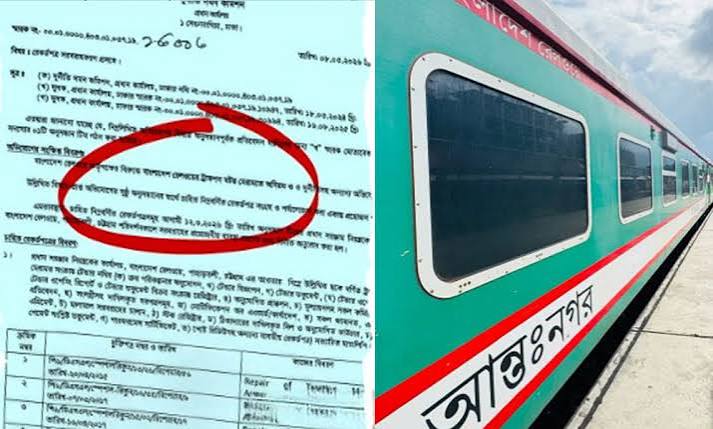
ACC Deputy Director (Money Laundering) Jahangir Alam sent a letter to the Chief Controller of Stores at Pahartali in Chattogram, requesting certified copies of all documents relating to traction motor repair contracts executed on April 20, 2015; March 7 and April 16, 2017; April 5, 2018; and June 30, 2019.
Railway Authorities Deny Allegations
Railway Director General Md Afzal Hossain denied allegations of providing undue benefits to contractor Afsar Ali Biswas or having any business connection with him.
Speaking to journalists at Rail Bhaban on July 28, he said qualified contractors participate in tenders through the e-GP system and receive contracts only after fulfilling the stipulated requirements.
Railway Additional Director General (RS) Fakir Md Mahiuddin also said that the contract had been awarded after the successful bidder fulfilled all tender conditions. He added that two more firms, Nure Elahi Enterprise and Kamal Enterprise, had recently been included in traction motor repair work.
Overall, allegations concerning the tendering process, eligibility criteria, contract awards and the use of railway-owned workshops and equipment have prompted calls for a full and impartial investigation.
The ACC investigation is expected to clarify whether the allegations of irregularities have substance or whether the entire process was conducted in accordance with the applicable public procurement rules.